

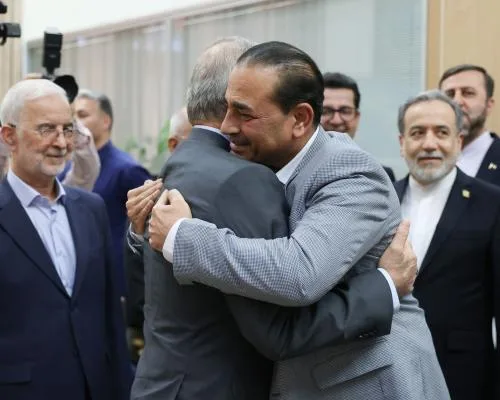
The single sharpest fact in the news right now is that Donald Trump, the President of the United States, announced on Saturday that a peace deal with Iran 'has been largely negotiated', after calls with a Pakistani mediator, Gulf allies, and Israel. This deal could potentially pave the way for an end to the war launched by the US and Israel in February. It's a deal that don't come easily, and it's been in the works for a while.
And what's really significant here is that the strait of Hormuz will be opened as part of the deal. The strait of Hormuz is a crucial shipping lane, and its closure has had a huge impact on global trade. It's a vital waterway that can't be blocked without serious consequences. Trump wrote on his social media platform that 'final aspects and details' of a 'Memorandum of Understanding' are still being discussed and 'will be announced shortly'. He didn't give a specific timeline, but he said it's going to happen soon.
But how did we get here? Well, a Pakistani source told Reuters that Iran and Pakistan had submitted a revised proposal to the United States to end the war and reopen the strait of Hormuz. A regional official with direct knowledge of the Pakistan-led mediation efforts told the Associated Press earlier on Saturday that the potential deal would include an official declaration of the war's end. It would also include two-month negotiations on Iran's nuclear program, the opening of the crucial shipping lane by Iran, and an end to the US blockade of Iranian ports. These are key points that can't be overlooked.
Trump had phone discussions with many Middle Eastern leaders, including those of Saudi Arabia, the United Arab Emirates, Qatar, Egypt, Jordan, and Bahrain, as well as Pakistan's army chief, Field Marshal Asim Munir, and Turkey's President, Recep Tayyip Erdoğan. Trump said in his post that he had a call with Prime Minister Bibi Netanyahu of Israel, which 'likewise, went very well'. He didn't reveal what they discussed, but it's clear that they're on the same page.
'The deal being floated with Iran seems straight out of the Wendy Sherman-Robert Malley-Ben Rhodes playbook: Pay the IRGC to build a WMD program and terrorize the world,' Mike Pompeo, who served as CIA director and secretary of state during Trump's first term, wrote on social media. He's not happy with the deal, and he's making his feelings known.
As for the exact negotiations, details remain sparse. Trump said he'd met with American negotiators, including special envoy Steve Witkoff and adviser Jared Kushner, along with JD Vance, to discuss the latest round of proposals. The lead-up to the announcement remained tense, with Trump continuing to threaten strikes. Trump had told CBS and Axios he would only sign a deal 'where we get everything we want'. He added that if a deal was not reached, the US would begin striking Iran again.
It's a threat that can't be taken lightly.
The Iranian proposal included the provisional reopening of the strait of Hormuz. However, Iran also requested the US end its blockade of Iranian ports, the release of billions of dollars in frozen Iranian assets, and a plan to compensate Iran for damages suffered during the war. According to Drop Site's source, the Iranian proposal included permanently ending the war before negotiating any deal on Tehran's nuclear program. It's a proposal that's not without its challenges.
Iran's top negotiator said earlier in the day there would be no compromise over its national rights during a meeting with the Pakistani army chief in Tehran. 'Our intention was first to draft a memorandum of understanding, a kind of framework agreement composed of 14 clauses,' he said on state television. Iran's Fars news agency, which is close to the powerful Islamic Revolutionary Guard Corps, reported that the strait of Hormuz would remain under Iranian control. It's a point that's not up for debate.
- The deal includes the opening of the strait of Hormuz
- Two-month negotiations on Iran's nuclear program
- End to the US blockade of Iranian ports
- Release of billions of dollars in frozen Iranian assets
- A plan to compensate Iran for damages suffered during the war
The announcement came after a Pakistani source told Reuters that Iran and Pakistan had submitted a revised proposal to the United States to end the war and reopen the strait of Hormuz. This is a significant development in the conflict between the US and Iran, and it will be interesting to see how it plays out. It's a deal that has the potential to change the dynamics of the region.
Three senior Iranian officials told the New York Times the agreement would stop the fighting in Iran and in Lebanon, and could release $25 billion in Iranian assets frozen overseas, with a nuclear agreement to be negotiated within 30 to 60 days. Shortly after Trump's post characterizing the draft agreement, the news agency reported on Telegram that 'the management of the Strait, determining the route, time, method of passage, and issuing permits will continue to be the monopoly and discretion of the Islamic Republic of Iran'. It's a statement that makes it clear who's in control.
News of the potential deal triggered dismay among Republican hawks who had spent years calling for US military action against Iran, and deriding the 2015 deal to limit Iran's nuclear enrichment in return for sanctions relief negotiated during the Obama administration. Trump withdrew from that international deal, known as the Joint Comprehensive Plan of Action (JCPOA), in 2018. It's a move that had serious consequences, and it's still being felt today.
As the situation continues to unfold, it's clear that this deal has the potential to significantly impact the region and the world. The US, Iran, and other countries involved will move forward with the negotiations and the implementation of the deal. They'll have to work together to make it happen, and it won't be easy. The deal's success depends on it, and it's something that can't be taken for granted. It's going to take time, effort, and compromise to make it work, but it's possible.