

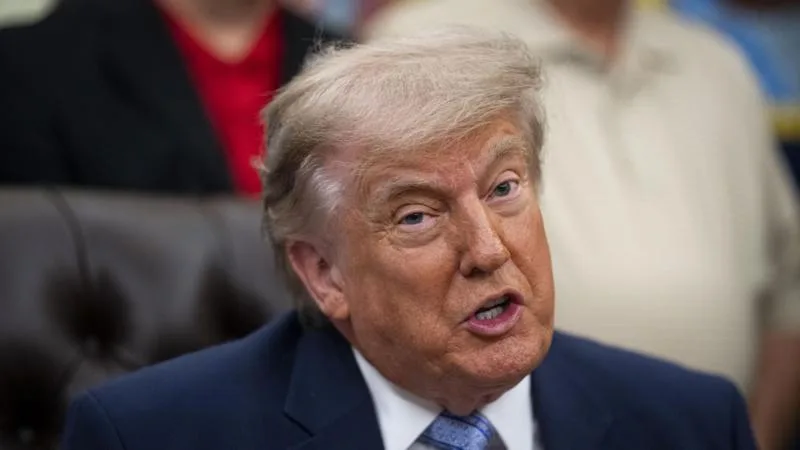
US President Donald Trump has announced that Iran is 'getting a lot closer' to reaching an agreement with the US. This development comes after weeks of talks between the two nations, with a temporary ceasefire in place since early April.
The news of a potential agreement has sparked both hope and caution, with many experts warning that significant challenges still need to be overcome. One of the main sticking points is the issue of nuclear weapons, which Iran's foreign ministry spokesperson, Esmaeil Baqaei, has said won't be part of any initial proposals.
Trump, in an interview with CBS News, confirmed that he had seen a draft agreement with Iran but refused to comment on whether it was satisfactory. He did, however, insist that any agreement would 'absolutely' prevent Iran from obtaining a nuclear weapon.
Trump said, 'I will only sign a deal where we get everything we want.' He also said, 'We're going to have a deal, or we're going to have a situation where no country will ever be hit as hard as they're about to be hit.'
Baqaei, on the other hand, told state television that the US and Iranian positions had been converging in the last week. However, he warned that this didn't mean agreements would be reached on key issues. He accused the Americans of 'contradictory statements'. Iran is in the process of finalising a memorandum of understanding, which could lead to further talks within 30 to 60 days.
The US has been redirecting vessels and allowing humanitarian aid ships to pass through the Strait of Hormuz, which has been a major point of contention between the two nations. US Central Command (Centcom) has reported that it has redirected 100 vessels, disabled four, and allowed 26 humanitarian aid ships to pass since the blockade began.
Centcom commander Admiral Brad Cooper said that US forces had been 'highly effective' in 'allowing zero trade into and out of Iranian ports, which has squeezed Iran economically'. This has put significant pressure on Iran's economy.
Meanwhile, Iran has claimed military control of an area around the Strait of Hormuz. They've said that all transit through the strait 'requires coordination with and authorisation from the Persian Gulf Strait Authority'. The US and Gulf allies have repeatedly rejected Iranian attempts to assert control over the strait. The US has told ships not to comply with Iran's rules.
The developments in US-Iran relations have significant implications for global politics, particularly in the Middle East. The talks between the two nations have been closely watched by other countries in the region, including Saudi Arabia, Qatar, the United Arab Emirates (UAE), Egypt, Turkey, and Pakistan.
French President Emmanuel Macron has been actively involved in the negotiations. He's spoken to Trump and the leaders of the UAE, Qatar, Saudi Arabia, and Jordan about the talks with Iran. France is pushing for a negotiated solution. The number one priority is a complete reopening of the Strait of Hormuz.
US Secretary of State Marco Rubio has also been involved in the talks. He visited India on Saturday and expressed cautious optimism about the prospects of a deal. Rubio emphasised the US's position that Iran must not be allowed a nuclear weapon. He spoke of reopening the Strait of Hormuz without tolls from Iran.
The country also needs to turn over its highly enriched uranium, he said. The new sense of momentum comes after the mood appeared to have soured in Washington. Anonymous officials briefed US media on Friday that the administration was preparing for a fresh round of military strikes, although no final decision had been made.
As the talks between the US and Iran continue, it's unclear whether the two nations can overcome their differences and reach a lasting agreement. The stakes are high, and the outcome of these negotiations will have far-reaching consequences for global politics and security. The world is watching to see what happens next.
Key Facts
- US President Donald Trump says Iran is 'getting a lot closer' to an agreement
- Nuclear issues remain a major hurdle in the talks
- The US has redirected 100 vessels and allowed 26 humanitarian aid ships to pass through the Strait of Hormuz
- Iran has claimed military control of an area around the Strait of Hormuz
- The US and Gulf allies have rejected Iranian attempts to assert control over the strait
- French President Emmanuel Macron is pushing for a negotiated solution
- US Secretary of State Marco Rubio has expressed cautious optimism about the prospects of a deal