

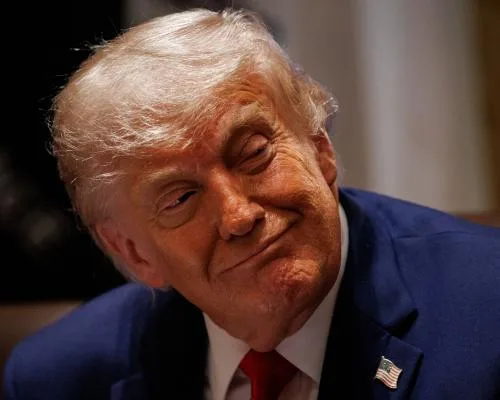
Donald Trump is back in court, and he’s doubling down on a staggering $10bn defamation claim against the Wall Street Journal. The former president is furious over an article that alleged he signed a birthday card for the convicted sex offender Jeffrey Epstein, an accusation the Trump camp insists is pure fiction. A judge previously tossed out the lawsuit for being legally messy, but Trump’s team has now refiled the complaint, hoping this version sticks.
At the time of publication, Defendants recklessly disregarded whether the Defamatory Statements were true and/or they purposefully avoided the discovery of the truth.
This lawsuit is just one piece of a much larger puzzle. Trump has been busy taking on various media organisations, a campaign his critics call an attempt to muzzle the press. He’s also keeping his sights on personal rivals. Prosecutors are currently digging into E Jean Carroll, the 82-year-old writer who previously sued Trump for sexual assault. They’re looking at whether she committed perjury during her 2022 testimony when she claimed she didn’t get outside help to fund her legal fights.
While the court drama plays out, the actual business of governing in Washington is anything but dull. The Supreme Court is preparing to release major opinions today, including cases that could shift how the government functions. One case, Trump v Cook, focuses on his bid to sack Federal Reserve governor Lisa Cook, highlighting his desire to tighten his grip on the central bank. Another case, Trump v Slaughter, questions if he can legally fire Rebecca Slaughter from the Federal Trade Commission. The court is also weighing in on Trump v Barbara.
This is a heated challenge to his administration’s attempts to restrict birthright citizenship.
The economic front isn’t any calmer. Inflation is creeping up, with the core Personal Consumption Expenditures (PCE) price index hitting 3.8% in April. This is a noticeable jump from the 3.5% reported in March. Kevin Marsh, the fresh face at the head of the Federal Reserve, is now managing an economy where the cost of living remains a massive headache for the average household.
Healthcare in the US is also hitting a wall, particularly for women. A study from the Journal of the American Medical Association shows that since the Dobbs v Jackson Women’s Health Organization ruling, access to miscarriage care has become a postcode lottery. In states that slapped down abortion bans, doctors are increasingly forced to tell patients to just go home and wait, rather than prescribing standard medicine like mifepristone. This shift is a direct result of the legal confusion following the overturning of Roe v Wade.
Politics across the country feels like a pressure cooker. President Trump has been using his executive powers to push for tighter rules on mail-in voting, a move that Democrats fear will lock millions of people out of the ballot box. A judge recently refused to block these new orders. Trump is also flexing his muscles abroad, threatening to “blow up” Oman if they don’t play ball regarding the strait of Hormuz. He wants to ensure that the vital waterway stays open for international shipping despite the ongoing US-Israel conflict with Iran.
Closer to home, the fight over money is getting ugly. California governor Gavin Newsom is trying to block a $1.776bn “anti-weaponization fund” created by the Department of Justice. The fund was set up to pay out people who claimed they were victims of “lawfare,” a catch-all term for legal battles they say were politically motivated. Newsom has slammed the fund as a complete waste of tax money, warning it might end up in the pockets of those involved in the 6 January 2021 Capitol riot. Meanwhile, Guatemala has agreed to join forces with the US to launch military strikes against drug cartels.
This marks a sharp shift in regional security cooperation.