

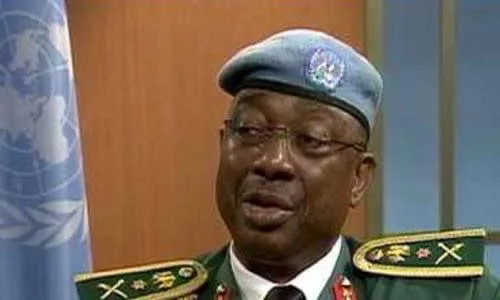
The Soldier Who Bridged Continents
Lieutenant General Chikadibia Isaac Obiakor, the man who quietly became one of the most recognizable faces of African military influence on the global stage, died in an Abuja hospital this past Wednesday, May 27, 2026. At 75, he carried the weight of decades of service that saw him navigate the world's most volatile conflict zones.
Born in 1951 in Zaria and hailing from Awka South in Anambra, he was cut from the classic mold of the Nigerian military elite. He started his journey at the Nigerian Military School in Zaria, eventually stepping into the Nigerian Defence Academy in 1971 as a member of the 10th Regular Course. This generation of officers defined how the Nigerian state operated in the shadows and in the light of governance.
A Career Forged in Fire
Obiakor wasn’t just a boardroom soldier; he understood the reality of the frontlines. During the mid-90s, when the Liberian civil war was at its most chaotic, he served as the commander of the ECOMOG Artillery Brigade. His presence there was more than just firepower. He served as the lead coordinator for the country's 1997 elections, a job that kept a fragile state from collapsing entirely.
His tactical work in Liberia set a blueprint for how Nigerian officers handled multinational operations. He later earned a Master’s degree in Strategic Studies from the University of Ibadan, proving that he valued the classroom as much as he did the firing range. His colleagues often spoke of him as a calm operator. He was the type of man who kept his voice low while making high-stakes decisions that dictated the movement of thousands of troops.
"He achieved international prominence by becoming the first African to serve as the UN Military Adviser for Peacekeeping Operations at the UN HQ New York."
The UN Years
By 2006, the United Nations tapped him to serve as Force Commander of their mission in Liberia. The global community had stopped viewing African officers as participants and started seeing them as essential architects of peace. Two years later, he reached the peak of his international career, becoming the first African to occupy the role of United Nations Assistant Secretary-General and Military Adviser for Peacekeeping.
Even after hanging up his uniform in 2011, the UN couldn't quite let him go. They repeatedly pulled him back into service to lead high-sensitivity investigations into humanitarian crises and conflict outbreaks in Syria, South Sudan, and the Democratic Republic of Congo. He was a fixer for the world’s most complicated messes.
A Legacy in Print
The Nigerian government awarded him the Officer of the Order of the Federal Republic, or OFR, for his diplomatic and security work. Perhaps his most personal contribution to the service is his 2022 book, Rough Road to Peace. It serves as a candid look at the life of an officer who spent his years balancing national defence with international duty.
For those who served under him, he wasn't just a general; he was a standard for conduct. As tributes flow in from diplomatic circles and military barracks across the country, his influence clearly reached well past his 2011 retirement. His life serves as a definitive case study in how a focused, disciplined soldier can bridge the gap between regional military prowess and global strategic authority.