

Oil prices have seen a significant drop, falling below $100 a barrel on Monday. This decrease is largely attributed to the hopes of a peace deal between the US and Iran. The Brent crude futures, which serve as the global oil benchmark, were down 6% to $97.28 a barrel, marking the lowest level in two weeks. It's a notable decline, and the market is watching it closely.
The potential peace deal is aimed at ending the near three-month US-Israeli war on Iran. However, despite the progress, the US and Iran remain at odds over key issues, such as Iran's blockade of the Strait of Hormuz. An Iranian government spokesperson has cautioned that an agreement isn't imminent, indicating that there's still much work to be done. They can't agree on everything yet, and that's causing uncertainty.
The Strait of Hormuz's de facto closure sent energy prices soaring after the US and Israel first launched missile strikes on Tehran on 28 February. Warren Patterson, the head of commodities strategy at ING, told Reuters, "We've been at this stage before, only for talks to break down. Therefore, the market will likely be more cautious about overreacting." He's right; they don't want to overreact. The market won't jump to conclusions.
Even if the strait reopens, analysts say a return to normal oil flows will take months. Damaged energy infrastructure in Qatar and elsewhere needs to be repaired. Last week, Barclays stuck to its average Brent crude oil price forecast of $100 this year, but said there were risks it could be higher. They're not ruling out higher prices.
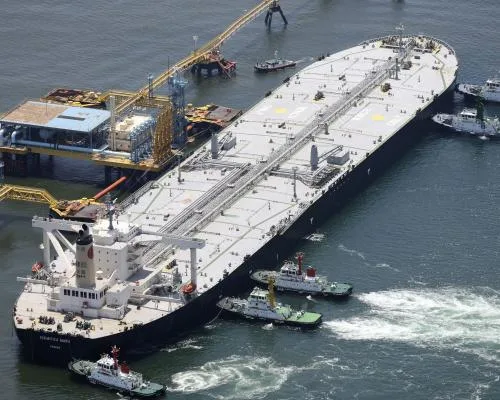
Two tankers carrying liquefied natural gas were exiting the strait on Monday, heading to Pakistan and China. A supertanker with Iraqi crude left the Gulf bound for China on Saturday after being stranded for almost three months, Reuters reported, citing shipping data. The UBS analyst Giovanni Staunovo said, "We continue to believe that the key factors for the oil market to watch should be the physical oil flows, and so far, flows through the strait remain restricted." He's focusing on the oil flows, and they're still restricted.
The global economy has been watching the situation closely, with many markets seeing gains on the hopes of a peace deal. Japan's Nikkei rose nearly 3% on Monday. The pan-European Stoxx 600 index was up 0.9%. Several markets were closed on Monday for a public holiday, including in the US and the UK. They didn't trade on Monday.
Stocks have largely shrugged off fears over the war's consequences for the world economy, and focused more on the artificial intelligence boom and strong company profits. The dollar dipped 0.3% against a basket of major currencies on Monday. The pound gained nearly 0.6% to $1.3506, which is the highest since mid-May. Gold climbed 1.46% to $4,574 an ounce. It's a significant gain for gold.
Stephen Innes, an independent analyst, said, "Treasury [bond] futures rallied, gold climbed, and equity futures pushed higher as investors started pricing the possibility that the world's most dangerous energy choke point may soon reopen to something resembling normal flow." He's talking about the strait reopening, and it's a big deal. Investors are hoping for a return to normal.
Inflation fears have risen around the world because of the higher cost of oil, gas, and many other materials, including fertilizer. Fertilizer is expected to drive food prices sharply higher in the coming months. As a result, expectations of interest rate cuts from central banks prior to the Iran war quickly gave way to predictions of rate increases. Markets expect the Bank of England to raise rates twice this year. They won't cut rates now.
The situation with oil prices and the potential peace deal between the US and Iran is complex and multifaceted. Many analysts are cautious, given the history of negotiations between the two countries. Yet, the current developments offer a glimmer of hope for a resolution to the conflict, which could have significant implications for the global economy. It's not a simple situation, and they're watching it closely.
- Oil prices fell below $100 a barrel on Monday.
- Brent crude futures were down 6% to $97.28 a barrel.
- The US and Iran are nearing a peace deal to end the near three-month US-Israeli war on Iran.
- The Strait of Hormuz's de facto closure sent energy prices soaring after the US and Israel first launched missile strikes on Tehran on 28 February.
- Two tankers carrying liquefied natural gas were exiting the strait on Monday, heading to Pakistan and China.
The potential peace deal and the drop in oil prices come at a critical time for the global economy, which has been facing inflation and economic uncertainty. As the situation continues to evolve, it's essential to keep a close eye on the developments and their implications for the world economy. They can't afford to ignore it, and they won't. The world is watching, and they're waiting to see what happens next.