

The single sharpest fact in one or two punchy sentences. Who did what, where, when, and why it matters.
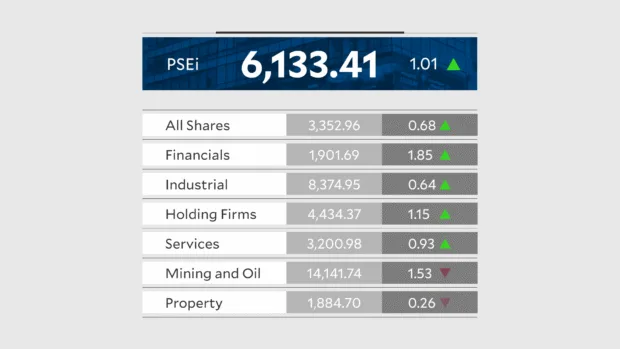
The Philippine Stock Exchange index (PSEi) surged 1.01 percent to 6,133.41 points on Monday, ending two consecutive days of decline amid easing tensions in the Middle East. The benchmark index had dropped 1.43 percent to 6,072.24 points on Friday.
Investors' appetite for risk returned as the US and Iran agreed to pause military exchanges and resume negotiations, following heightened tensions over the weekend. According to Luis Limlingan, head of sales at Regina Capital, the market drew support from the development.
Philstocks Financial Inc. also noted that the market's gain was driven by the return of investors' appetite for risk, despite lingering uncertainty in the region. The United States and Iran's agreement to halt military exchanges and resume negotiations was seen as a positive development for the market.
The PSEi's gain was led by the property counter segment, which rose 2.03 percent. The industrials sector also gained 1.45 percent, while the services counter segment rose 1.35 percent.
The market's gain was tempered by the decline of some blue-chip stocks, including BDO Unibank and SM Investments. BDO Unibank fell 1.04 percent, while SM Investments dropped 0.93 percent.
Despite the market's gain, the Philippine Stock Exchange's volume remained low, with a total of 1.3 billion shares traded. The market's liquidity remained a concern, especially as investors continued to wait for clearer signs of a resolution to the US-Iran tensions.
The Philippine Stock Exchange's gain was also seen as a positive sign for the country's economy, which has been facing headwinds due to the ongoing trade tensions between the US and China. The market's gain was seen as a reflection of investors' confidence in the country's economic prospects.
Key Facts
- The Philippine Stock Exchange index (PSEi) surged 1.01 percent to 6,133.41 points on Monday.
- The PSEi had dropped 1.43 percent to 6,072.24 points on Friday.
- The market drew support from the US and Iran's agreement to halt military exchanges and resume negotiations.
- The property counter segment led the market's gain, rising 2.03 percent.
- The industrials sector gained 1.45 percent, while the services counter segment rose 1.35 percent.
- BDO Unibank fell 1.04 percent, while SM Investments dropped 0.93 percent.
- The Philippine Stock Exchange's volume remained low, with a total of 1.3 billion shares traded.
- The market's liquidity remained a concern, especially as investors continued to wait for clearer signs of a resolution to the US-Iran tensions.
- The Philippine Stock Exchange's gain was seen as a positive sign for the country's economy, which has been facing headwinds due to the ongoing trade tensions between the US and China.
A pull quote from Luis Limlingan, head of sales at Regina Capital, said:
The market is feeling more confident as the US and Iran are on the path to resolving their differences.
The Philippine Stock Exchange's gain was also seen as a reflection of investors' confidence in the country's economic prospects. The market's gain was seen as a positive sign for the country's economy, which has been facing headwinds due to the ongoing trade tensions between the US and China.
The Philippine Stock Exchange's gain was driven by the return of investors' appetite for risk, despite lingering uncertainty in the region. The United States and Iran's agreement to halt military exchanges and resume negotiations was seen as a positive development for the market.
The market's gain was tempered by the decline of some blue-chip stocks, including BDO Unibank and SM Investments. BDO Unibank fell 1.04 percent, while SM Investments dropped 0.93 percent.
Despite the market's gain, the Philippine Stock Exchange's volume remained low, with a total of 1.3 billion shares traded. The market's liquidity remained a concern, especially as investors continued to wait for clearer signs of a resolution to the US-Iran tensions.
The Philippine Stock Exchange's gain was seen as a positive sign for the country's economy, which has been facing headwinds due to the ongoing trade tensions between the US and China. The market's gain was seen as a reflection of investors' confidence in the country's economic prospects.