

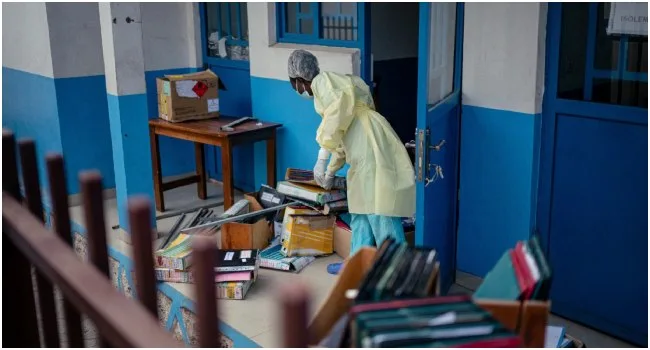
The World Health Organization (WHO) has declared an international health emergency due to an Ebola outbreak in the Democratic Republic of Congo. This declaration comes after a case was confirmed in the major eastern city of Goma, which has a population of over 1 million people.
And this isn't just any case - it's a case that traveled from another city, Bunia, where the patient's husband had died of Ebola. The patient, the wife of the deceased, had already shown symptoms of the disease when she traveled to Goma. This has raised fears that the disease will spread further. It's a concern because the city of Goma is a major transportation hub, and it's possible that the disease could spread to other areas.
But what's the situation like in Nigeria? The Nigeria Centre for Disease Control and Prevention (NCDC) says there aren't any confirmed cases of Ebola in the country. The NCDC Director-General, Jide Idris, has asked Nigerians to remain calm and to avoid spreading misinformation about the disease. He doesn't want people to panic, and he's urging them to rely on credible sources of information.
So, what's being done to prevent the spread of the disease? The NCDC is working with stakeholders, including the Port Health Service, to ensure continued vigilance and preparedness within the public health system. They're taking this step because they don't want to take any chances. Healthcare workers are also being advised to maintain a high index of suspicion for Ebola in patients presenting with compatible symptoms and relevant travel or exposure history. They're being told to be vigilant and to report any potential cases immediately.
Yet, despite these efforts, the situation in the Democratic Republic of Congo is dire. A total of 88 deaths and 336 suspected cases of the highly contagious haemorrhagic fever have been reported, according to the Africa Centres for Disease Control and Prevention. The WHO Director-General, Tedros Adhanom Ghebreyesus, has expressed deep disquiet over the rising number of cases. He's worried that the situation could get out of control if it's not managed properly.
"I determine that the epidemic constitutes a public health emergency of international concern," Ghebreyesus said. He didn't mince words, and he made it clear that the situation is serious.
The declaration of a public health emergency is a rare move by the WHO, and it highlights the seriousness of the situation. But it's not all bad news - the WHO has also said that the outbreak doesn't meet the criteria of a pandemic emergency, which means that it's still contained within a specific region. This is good news, because it means that the disease hasn't spread to other parts of the world.
So, what's the history of Ebola in the Democratic Republic of Congo? The disease was first identified in 1976, and since then, there have been several outbreaks in the country. The most recent outbreak, which started in August 2018, has been the largest and most complex. It's been a challenging situation, and it's required a lot of resources to manage.
And what about the people affected by the outbreak? The patients who have been infected with the disease are mostly from the North Kivu province, where the outbreak was first reported. The province has been experiencing a lot of violence and instability, which has made it difficult for healthcare workers to access the area and provide treatment. They're facing a lot of challenges, and they're doing their best to cope.
But there's still hope. The WHO and other healthcare organizations are working together to provide treatment and prevent the spread of the disease. And with the declaration of a public health emergency, more resources will be made available to fight the outbreak. This is a positive development, and it could make a big difference in the coming weeks.
- 88 deaths and 336 suspected cases of Ebola have been reported in the Democratic Republic of Congo.
- The WHO has declared an international health emergency due to the outbreak.
- The outbreak doesn't meet the criteria of a pandemic emergency.
- The NCDC has activated emergency surveillance in Nigeria to prevent the spread of the disease.
- Healthcare workers are being advised to maintain a high index of suspicion for Ebola in patients presenting with compatible symptoms and relevant travel or exposure history.
In terms of what's next, the WHO will be working with the Democratic Republic of Congo and other countries in the region to provide support and resources to fight the outbreak. They won't be able to do it alone, so they're counting on international cooperation. The organization will also be working to increase awareness and education about the disease, and to provide training for healthcare workers. They're taking a comprehensive approach, and they're hoping that it will pay off.
The situation is serious, but it's not hopeless. With the right resources and support, it's possible to contain the outbreak and prevent further spread of the disease. And for now, Nigerians can rest assured that there aren't any confirmed cases of Ebola in the country. They don't have to worry, at least not yet. The NCDC is monitoring the situation closely, and they're ready to respond if necessary.