

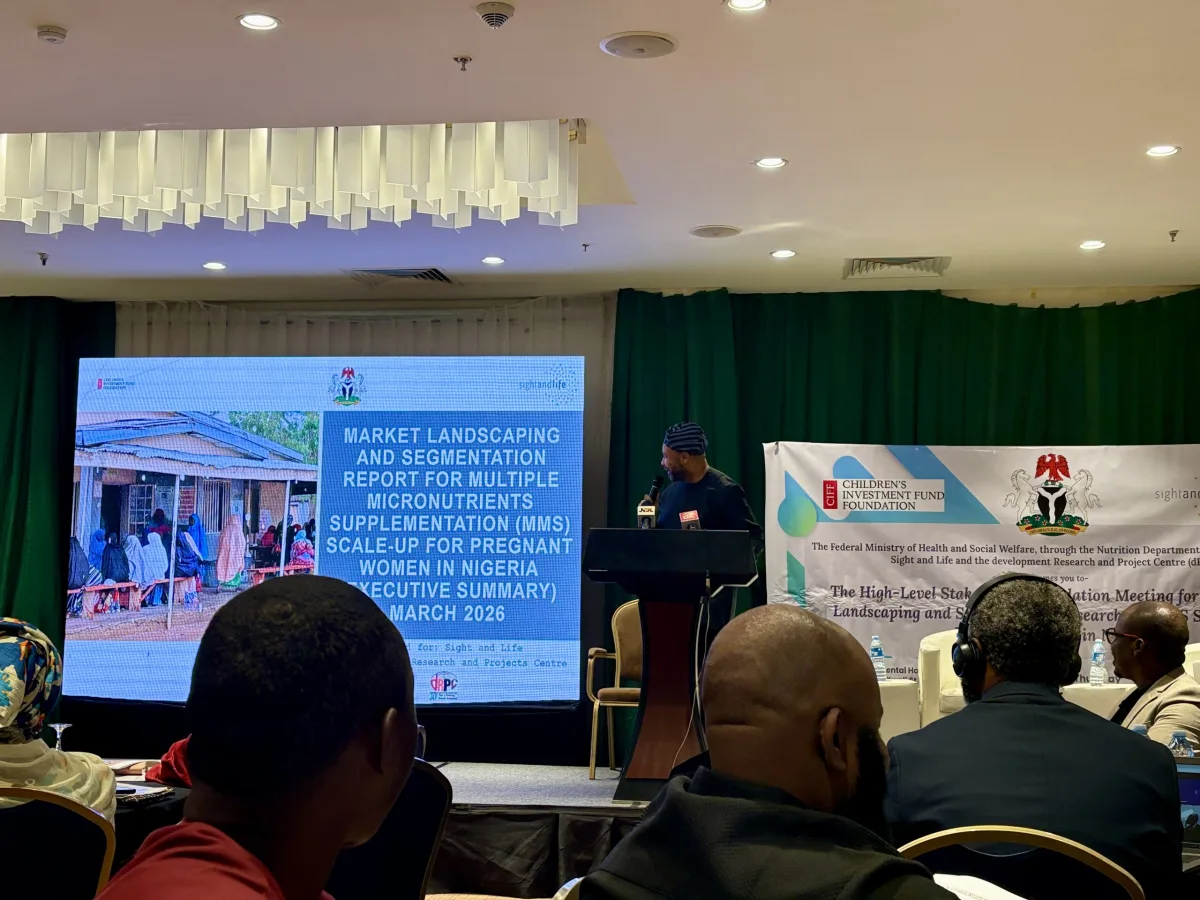
Lagos and Kano are the Nigerian states most ready to roll out Multiple Micronutrient Supplements (MMS) for pregnant women at scale, a new study says.
The market landscaping and segmentation assessment, presented in Abuja on Thursday, examined financing, demand, supply systems, and implementation readiness across six states. Stanley Ukpai, Director of Projects at the development Research and Projects Centre (dRPC), said both states were classified as Tier One because of strong antenatal care (ANC) utilisation, health system capacity, financing commitments, and logistics readiness.
But the two states got there through very different routes.
Lagos is driven by its private health sector — private facilities handle 82.5 per cent of health service delivery there, making it the most privately driven maternal health market among the states assessed. That means a dense network of facilities and well-developed logistics systems are already in place for rapid MMS expansion.
Kano, on the other hand, relies heavily on public health. Primary healthcare centres (PHCs) make up 75.6 per cent of health facilities in the state. What pushed Kano to the top tier was sustained political commitment and significant public financing for nutrition. It's the only state among those assessed with explicit budget lines for both Iron-Folic Acid (IFA) and MMS. Kano also recorded ₦500 million in co-financing under the Community and Nutrition Financing mechanism, plus ₦144 million earmarked specifically for MMS procurement.
The study, led by the Federal Ministry of Health and Social Welfare through its Nutrition Department, in collaboration with Sight and Life and dRPC, classified Bauchi and Imo as Tier Two states. Niger and Bayelsa landed in Tier Three due to structural and geographic constraints.
Bauchi has the highest PHC dominance at 93.7 per cent, but low ANC coverage and dependence on donor-funded programmes held it back. Imo showed a more balanced public-private system with 49.7 per cent PHC coverage and relatively high ANC use, but MMS access there still depends mostly on private pharmacies and retail distribution.
Niger State faces insecurity, long travel distances, and low ANC uptake — all limiting effective supplementation coverage despite 81.2 per cent PHC dominance. Bayelsa, with 60 per cent PHC coverage, is constrained by its riverine geography and recurring flooding, which disrupt supply chains and make supplementation campaign-driven rather than routine.
The assessment, conducted in 2025, used a mixed-methods approach and interviewed 162 stakeholders — including government officials, health workers, development partners, HMOs, Patent and Proprietary Medicine Vendors, facility managers, and 70 pregnant women across the six states and the Federal Capital Territory.
Ukpai said Nigeria's maternal nutrition challenge is huge: about seven million pregnancies occur annually, and maternal anaemia affects roughly 50 per cent of pregnant women — about 3.5 million cases each year, according to the 2024 Nigeria Demographic and Health Survey (NDHS). He called this both a public health urgency and a significant market opportunity for maternal supplementation.
Nigeria is transitioning from IFA to MMS, backed by global evidence and World Health Organisation (WHO) recommendations. The federal government first endorsed MMS through a ministerial directive in 2021 and reinforced the policy with the National MMS Roadmap 2025–2029, which targets 40 per cent coverage initially and 60–70 per cent by 2039.
According to Ukpai, MMS provides broader nutritional benefits and is generally better tolerated than IFA because it causes fewer side effects, including nausea. But he warned that successful scale-up depends on sustainable financing, strong consumer demand, and reliable supply systems.
The study identified three major financing channels: domestic public funding, donor support, and Drug Revolving Fund systems. Federal allocations for MMS have increased, though specific figures weren't detailed in the presentation.