

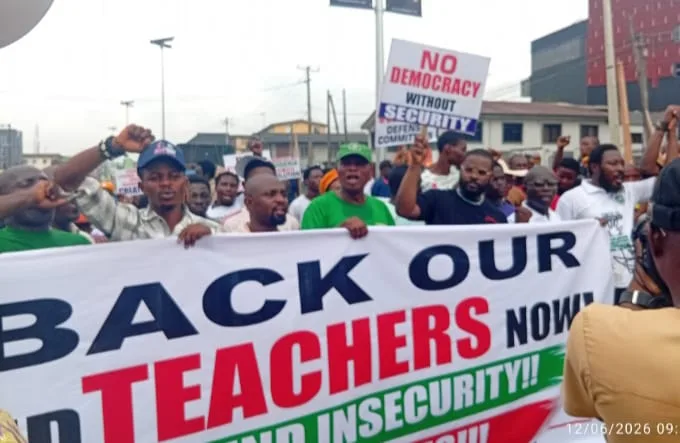
Tension rose under the Ikeja Bridge on Friday as two groups with opposing views on Nigeria's democracy occupied the same space, forcing police to step in and prevent a breakdown of order.
One side was a coalition of civil society groups, trade unions, youth organisations, faith-based bodies, and social movements. They'd declared June 12 a day of mass action over insecurity and economic hardship. The other side called itself "Team Nigeria" and came to support President Bola Tinubu.
Both groups set up loudspeakers and music systems, each trying to drown out the other. The stand-off over control of the venue grew charged until police officers led by Superintendent Akinwumi Oke arrived to restore order.
The protest was led by human rights lawyer Femi Falana, activist Hassan ‘Soweto’ Taiwo, and labour representatives. Falana arrived with his wife Funmi Falana and his son, musician and activist Folarin Falana, known as Falz. Their presence energised supporters already gathered at the ground.
Falana said the demonstration was meant to draw attention to insecurity in states including Oyo, Zamfara and Kebbi, as well as repeated abductions across the country. He also criticised worsening hardship and what he described as shrinking civic space.
“What we have in Nigeria is civil rule, not democracy,” he said, urging police authorities to ensure that counter-mobilisation didn't disrupt lawful assemblies.
The counter-rally continued with loud music and chants, keeping tension high. Both sides remained separated by security operatives. As of press time, no injuries or arrests had been confirmed, and police stayed on ground to maintain order.
The protest coalition had earlier issued a statement saying Nigerians "deserve a pro-people government that places the protection of lives and property at the core of governance." It warned that insecurity had disrupted farming, education, travel, and livelihoods across the country. The group also criticised key economic reforms — fuel subsidy removal, exchange-rate adjustments, electricity tariff increases, and inflationary pressures — arguing they'd worsened living conditions despite rising government revenues.
The demonstration fell on the same day as official Democracy Day activities. President Tinubu delivered a national address marking 27 years of uninterrupted civilian rule since 1999.
In his broadcast, Tinubu said Nigeria's democracy remained "not perfect, but ours" and urged citizens to strengthen democratic institutions while defending his administration's economic and security reforms. He acknowledged insecurity remained a national concern, citing abductions in parts of Oyo, Borno, and other states. He added that the government had declared a security emergency, recruited more than 50,000 police officers, and increased defence spending to address threats.
On the economy, the president defended subsidy removal and foreign exchange liberalisation, saying they'd stabilised public finances, increased revenue to federal and subnational governments, and improved investor confidence.
Nigeria adopted June 12 as Democracy Day in 2018, recognising the annulled June 12, 1993 presidential election won by the late Moshood Kashimawo Olawale (MKO) Abiola. That election is regarded as the freest and most credible in the country's history. The law making June 12 an official annual public holiday was signed in June 2019.
On Friday in Lagos, the competing interpretations of what democracy means played out physically under the bridge — one side demanding change, the other defending the current order, with police in the middle keeping the peace.