

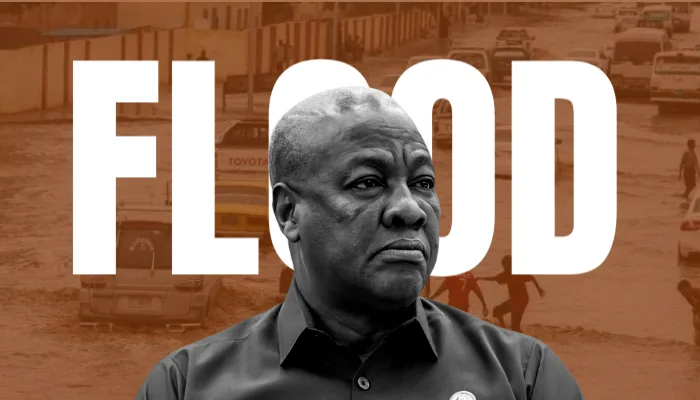
Heavy rains this month turned roads from Kaneshie and Odawna to the Kwame Nkrumah Circle area into rivers within hours, trapping commuters and flooding markets. The floodwaters also washed away one of President John Dramani Mahama’s signature campaign promises: to bring an end to Accra’s perennial flooding.
Mahama, who returned to office in January 2025, made flooding a centrepiece of his 2024 election campaign. In a Facebook post on May 27, 2024, he pledged an “engineering solution” to a problem that's plagued the low-lying coastal city for decades. His plan included investing in sustainable drainage systems, clearing structures in waterways, proper waste management, and proactive measures to mitigate the impact of heavy rains. “We can't afford to continue risking the lives and livelihoods of our people. It's time for real change and real solutions,” he wrote.
The promise was tied to criticism of his predecessor, Nana Akufo-Addo. Mahama said the previous government claimed to have spent $200 million on the World Bank-backed Greater Accra Resilient Integrated Development Programme (GARID), yet the impact hadn't been felt. He added that parliament was recently recalled to approve another $150 million for the same GARID. His National Democratic Congress argued the previous government’s failure to desilt the Odaw River, the Korle Lagoon and other drains had worsened the flooding.
Two months into his term, in March 2025, Mahama set up a seven-member Anti-Flood Taskforce chaired by Deputy Chief of Staff Stanislav Dogbe. Its first act was an aerial survey of flood-prone areas including Weija, the Sakumo Ramsar site and the Tema Fishing Harbour. Dogbe told reporters the army would help desilt major drains. In April 2025, Mahama toured flood-prone sites and, visibly angered by buildings erected on wetlands, ordered the demolition of structures blocking watercourses. “These wetlands were nature's way of protecting us. Now, because of greed and negligence, people are building on watercourses and, when the rains come, innocent lives are lost and homes are destroyed.
This must stop,” he said.
Alongside engineering pledges, the government turned to financial protection. In the 2026 budget, the administration committed to a parametric flood insurance scheme for the capital, protecting 1.2 million vulnerable residents. The scheme builds on a project launched in 2022 under a public-private partnership led by Ghana’s Ministry of Finance, the U.N. Development Programme’s Insurance and Risk Finance Facility and the Insurance Development Forum, with German government support. It delivered two parametric insurance products – an Excess Rainfall Cover and a Flood Footprint Product – for the Greater Accra Metropolitan Area.
Unlike traditional insurance, which pays out based on damage assessments, parametric products trigger faster payouts based on predefined parameters such as rainfall levels or flood severity, targeting vulnerable households in low-income and informal settlements.
Progress has been slow. One analysis noted that procurement began only in September 2025, following approval from the Ministry of Finance, and that the January 2025 presidential transition had greatly slowed the flood product process. Experts have also cautioned that insurance is a complement, not a cure. Infrastructure projects take years to complete while floods happen in hours. Even with improved drainage, flood risk will persist as climate change intensifies extreme rainfall.
The rains came anyway. After days of downpours in early June 2026, the capital was paralysed. Returning from a visit to Belarus on June 9, Mahama directed the disaster management agency NADMO and other bodies to prepare a comprehensive report on the flooding, saying this year’s rains had been more intense than usual.