

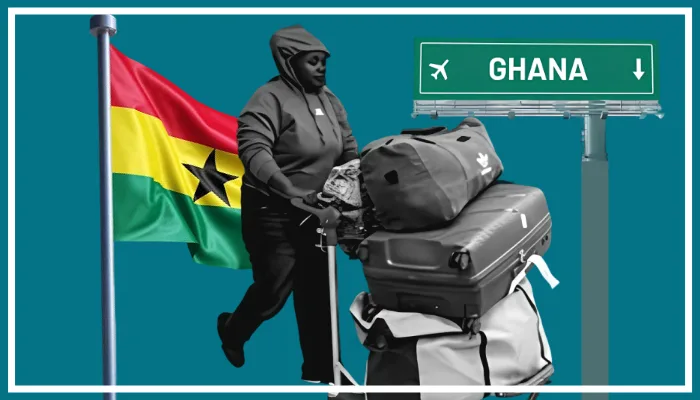
Ghana has now brought home more than 5,000 stranded citizens from around the world since the COVID-19 pandemic began — the latest being 327 people left homeless after a mass demolition in neighbouring Côte d'Ivoire.
The group had been living in the Port Bouët district of Abidjan when a demolition exercise destroyed their homes and livelihoods. The Foreign Affairs Ministry said the government moved them by road over two days, providing buses and trucks free of charge. 228 arrived on Thursday and the rest on Friday.
The operation came barely two weeks after Accra began a larger evacuation of citizens from South Africa, where anti-immigration protests have stoked fears among foreign nationals. By mid-June, Ghana had brought home about 1,000 citizens from South Africa, with more than 1,500 registered for evacuation.
The repatriation effort has been complicated by a dispute over the legal status of the returnees. South Africa's Border Management Authority found that only about 10% of the first group of 300 had correct papers. International Relations Minister Ronald Lamola said most of those flown out had broken immigration law rather than fled persecution. “With the bulk of all Ghanaians that have come back home, almost 74% had overstayed, and they had been declared undesirable through our processes, and this is the law, and this has been communicated to the High Commissioner,” Lamola said in a June 10 radio interview. Many had overstayed their visas by more than 30 days, some by a year or more, leaving them declared undesirable under Section 30 of the Immigration Act.
Ghana rejected that characterisation. Foreign Minister Samuel Okudzeto Ablakwa told JoyNews that most of the departing Ghanaians were in fact legal residents, with only a few still finalising paperwork. He dismissed any link between his compatriots and crime as false and misleading. He said South Africa had stationed its own crime agencies at Ghana's High Commission to screen the evacuees against a database of wanted suspects, and that none had been flagged. “Could you believe that not a single Ghanaian has been of interest to them?” he said. “Ghanaians are generally law-abiding.” He also revealed Ghana had petitioned the African Union to hold South Africa accountable for recurring xenophobic violence, and didn't rule out action in international courts.
Lamola hit back, calling Ablakwa's interview “a deeply disappointing interview, replete with misinformation.” He disputed Ablakwa's casualty figures, saying no Nigerian had been killed in the unrest and that two Mozambicans had died, not five, and said his ministry had no record of Ablakwa's claim that 15 Ghanaians were hospitalised. He also warned Accra against legal action.
The repatriation from South Africa is being financed from the government's contingency budget, with parliamentary approval. Ablakwa promised “full accountability” for the funds.
Ghana's repatriation efforts date back to March 2020, when border closures to contain the coronavirus left thousands stranded overseas. By mid-2020, the government had flown home 856 nationals in phases, including 224 from the United Kingdom. Kuwait separately sent back 245 Ghanaians under a migrant amnesty arrangement.
The largest single stream of returns has come not from government evacuations but from the International Organization for Migration's voluntary return programme, funded mainly by the European Union. Most of those assisted are migrants who tried to reach Europe irregularly through Libya, where many were detained and abused. The IOM said it helped 835 Ghanaians home in 2023 and a record 1,723 in 2024 — a 106% increase — including 1,597 flown from Libya on nine charter flights.
The pace of returns quickened in 2026. After summoning South Africa's ambassador over reported attacks on its nationals, Ghana launched a voluntary repatriation programme in late May as protests over unemployment, crime and pressure on public services fuelled hostility toward migrants. The first chartered flight carried about 300 people to Accra on May 27, among them 26 who had been jailed in South Africa over visa violations. A second flight returned 295.
- Over 5,000 Ghanaians repatriated since pandemic began
- 327 brought home from Côte d'Ivoire demolition this week
- ~1,000 evacuated from South Africa in May-June 2026
- 1,500+ still registered for evacuation from South Africa
- IOM helped 1,723 return in 2024 (106% increase from 2023)
- 1,597 flown from Libya on nine charter flights in 2024