

On a January morning in 2026, one of the most-watched people on the planet stepped onto Ghanaian soil, looked into a camera carrying tens of millions of live viewers, and said seven words that landed with more weight than any tourism campaign ever could. “I am back home, there ain’t no better feeling.”
The man was Darren Watkins Jr., known to the world as IShowSpeed. He had just revealed that his ancestry traces to Ghana, and the moment wasn't staged. It was felt.
Within days, Ghana’s Foreign Minister announced that Speed would be granted a Ghanaian passport, calling him a worthy ambassador with irrefutable ties to the country. At a ceremony in Akropong, he was given a Ghanaian name, Barima Kofi Akuffo.
When a man named Rolling Stone’s Most Influential Creator of 2025, with more than 50 million YouTube subscribers and over 135 million followers across platforms, calls Ghana home in front of the entire world, it doesn't just trend. It permanently shifts how millions of people see the country.
And for a great many of them, it stirs a question that was already quietly there: what would it mean for me to come home too?
The Homecoming Movement That Built the Moment
What the world watched in that livestream wasn't a one-off celebrity moment. It was the most visible expression yet of something that has been building for years: the homecoming movement.
It began in earnest with Ghana’s Year of Return in 2019, marking 400 years since the first enslaved Africans were taken from the continent. Hundreds of thousands of people of African descent came, many for the first time.
The government followed it with Beyond the Return, a decade-long programme running to 2030 under the theme A Decade of African Renaissance, explicitly shifting the focus from visiting to belonging, from tourism to investment and ownership.
IShowSpeed’s moment is what that movement looks like when it reaches the largest audience on earth. The feeling he named — the sense of standing on the land your ancestors came from and recognising it as home — is the same feeling that draws African Americans, Caribbean families, and diaspora Ghanaians from London to Houston to Toronto back to Accra every year.
The difference now is that tens of millions of people watched someone say it out loud.
From Feeling to Foothold: Why Ownership Is the
Real Homecoming
A visit is a memory. Ownership is a stake. There's a profound difference between having been to the homeland and having a home in it.
To own property in Accra is to convert an emotional connection into something permanent and physical — a place that is yours, that appreciates in value, that can generate income while you're abroad, and that can be passed to your children as their inheritance and their anchor to where they come from.
It's the act that turns the abstract idea of home into a key in your hand and a deed in your name.
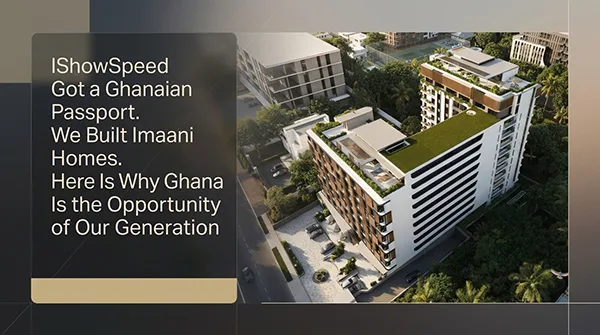
This is the intersection where Imaani Homes exists. Not as a transaction, but as the bridge between the feeling so many in the diaspora carry and the concrete act of claiming a place in the country that feeling points to.
Regalia Residence by Imaani Homes is built for the diaspora buyer ready to turn the pull of home into a place of their own. Located in Accra’s most prestigious address, it offers a way to own a piece of the city that the world is now watching.
The Timing Has Never Been Better, and That
Is Not Sentiment
The emotional case for coming home is powerful. What makes 2026 remarkable is that the financial case is just as strong.
Ghana’s economy has stabilised dramatically. Inflation has fallen to a multi-year low. The Bank of Ghana has cut its policy rate from a peak of 30 percent to 14 percent. The cedi has strengthened, and the country’s foreign reserves have reached record highs.
For property specifically, this matters in concrete ways. Prime apartments in the Airport Residential Area deliver rental yields between 7 and 22 percent depending on whether they're let long-term or run as professionally managed short-lets — far above the 3 to 5 percent typical of property in London, New York, or Toronto.
Prime Accra real estate is priced and transacted in US dollars, which means a diaspora buyer earning in foreign currency is protected from cedi movements entirely.
The homecoming, in other words, isn't a heart-over-head decision. It's one of the rare moments where the heart and the head point to exactly the same place.
How to Own a Piece of Home, the
Right Way
If you've ever felt that pull, Imaani Homes builds the homes that turn the feeling of coming home into the fact of owning one. For the practical mechanics of how this works from abroad, the guide on how Ghanaians abroad can buy property in Accra walks through every step.
You can explore Regalia Residence or call +233 595 959595. The pull is real, and it isn't new. But now, for the first time, it comes with a property that's built for you.