

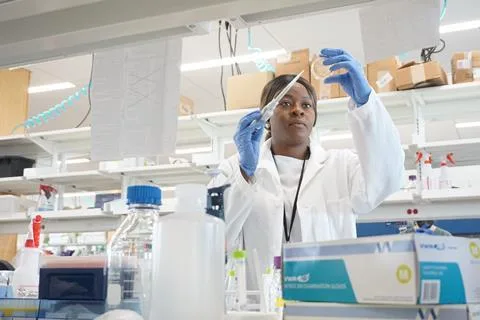
A Sierra Leone-born scientist has made history by becoming the world's first deaf Black woman to earn a PhD in a science, technology, engineering, or mathematics field. Amie Fornah Sankoh, an American Sign Language (ASL) user, was born in Sierra Leone but moved to the United States at a young age. She grew up in a household where English was not the primary language spoken, which made her hearing loss more challenging.
Sankoh lost her hearing at just three years old, but her father sent her to live with a family friend in the United States, who adopted her. In the States, she learned ASL and developed a passion for mathematics, which she found easier to grasp due to its visual nature. She went on to earn an associate degree and a bachelor's degree in biochemistry from Rochester Institute of Technology's National Technical Institute for the Deaf, where she worked as a lab technician before entering the PhD program at the University of Tennessee.
Sankoh's research focused on the effects of hormones on plant-pathogen interactions, and she has co-authored four scientific publications. Her journey has not been without its challenges, particularly during the COVID-19 pandemic, when communication became increasingly difficult.
The single sharpest fact in one or two punchy sentences. Who did what, where, when, and why it matters. Not a summary of everything — the one thing that makes someone stop scrolling. A reader who only reads this paragraph must understand what happened.
The 32-year-old scientist reflected on her journey, saying, "I feel very, very proud for persisting." She hopes her success will encourage other deaf scientists and serve as a role model for young women in STEM fields.
"Mathematics is just very visual, and I was able to enjoy that," Sankoh said in an interview.
Sankoh has taken up a postdoctoral position at the Danforth Plant Science Center in Missouri, where she plans to continue her research and advocacy work with the deaf community. With her trailblazing achievement, she aims to inspire the next generation of deaf scientists and show them the potential that lies within them.
Her father's decision to send her to the United States proved to be a turning point in Sankoh's life, allowing her to access education and language support that would have otherwise been inaccessible to her. She grew up in a household where English was not the primary language spoken, which made her hearing loss more challenging.