

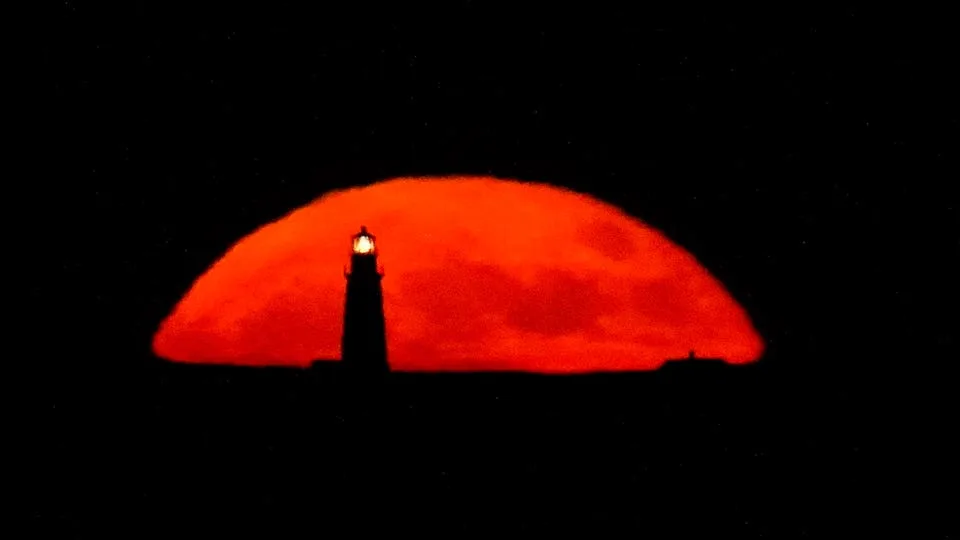
The full Strawberry Moon will turn full on Monday, June 29, 2026. This full moon is notable for three reasons: it's the first full moon of summer in the Northern Hemisphere, it will hang lower in the sky than any other full moon of 2026, and it will be the second-smallest full moon of the year.
And the best part is, you don't have to wait until the middle of the night to see it. The most beautiful views will come at moonrise, when the Strawberry Moon will appear low on the southeastern horizon during dusk. The Strawberry Moon reaches its exact full phase at 7:58 p.m. EDT on Monday, June 29, 2026. It's still below the horizon as seen from North America at that time.
This full moon occurs just a day after apogee, the point in the moon's 29-day orbit when it is farthest from Earth. Full moons that coincide with apogee are known as micromoons — the opposite of a supermoon — and appear about 12-14% smaller and dimmer than average. June's full moon is traditionally known as the Strawberry Moon, a name associated with seasonal harvests rather than the moon's color.
But what makes the Strawberry Moon special is its low position in the sky. It's the lowest-hanging full moon of 2026 in the Northern Hemisphere because of how the full moon mirrors the sun's position in the sky. A full moon is always opposite the sun, by definition. With the summer solstice occurring just days earlier on June 21, the sun is almost at its highest and longest daily arc across the sky.
As a result, the full moon traces the lowest possible arc, rising and setting far to the southeast and southwest. It never climbs very high. In practical terms, that means the Strawberry Moon stays close to the horizon for much of the night. Seen through a thicker layer of Earth's atmosphere, it often takes on warm yellow or orange tones. This geometry sets the stage for one of the most famous visual tricks in astronomy.
According to NASA, the moon illusion is a psychological effect in which the moon appears much larger when it's near the horizon than when it's high overhead, even though its actual size and distance haven't changed.
The Strawberry Moon is the seventh of 13 full moons in 2026, a year that includes an extra full moon because the lunar year is about 11 days shorter than the solar year. Of those full moons, three are supermoons — on Jan. 3, Nov. 24, and Dec. 24 — when the moon is near perigee and appears larger than average. By contrast, June's Strawberry Moon represents the opposite extreme: the ultimate micromoon of 2026. It's a unique sight that won't be repeated soon.
So, when is the best time to see the Strawberry Moon? The single best evening to watch the Strawberry Moon rise will be Monday, June 29, 2026 — the night of the full moon — at the exact time of moonrise where you are. To see the full moon at its best, find an elevated location, an open field, or a coastline with a clear view of the southeastern horizon. Moonrise will take place across North America in blue hour, when the sky is darkening but still retains color — perfect timing.
The night before, the moon rises before sunset while the sky is still very bright. The night after, it rises much later, when the sky is already dark. The Strawberry Moon is a special sight, and it's worth taking the time to see it. With its low position in the sky and its warm, yellow tones, it's a beautiful sight to behold. You won't want to miss it, so mark your calendars for June 29, 2026, and get ready to see the Strawberry Micromoon in all its glory.