

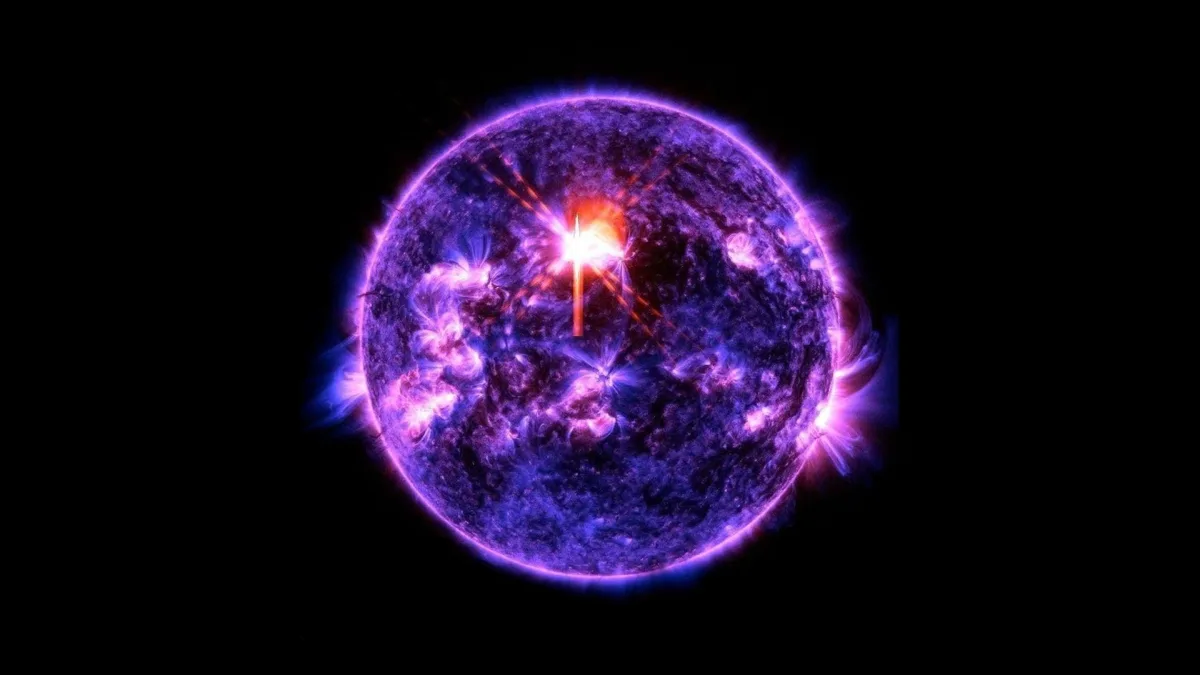
The sun is overdue for an 'S-class' solar flare, a powerful eruption that could disrupt satellites, power grids, and communications systems. Scientists at the National Autonomous University of Mexico have developed a probabilistic system to identify time periods and regions on the sun where extreme flares are more likely to occur. They've analyzed data collected between 1975 and 2025 from the Geostationary Operational Environmental Satellites.
They identified 37 S-class superflares across previous solar cycles. Every solar cycle since the late 1970s has produced at least one Earth-directed superflare, except the current one. The sun's current cycle, known as Solar Cycle 25, is still capable of producing powerful eruptions.
In May 2024, scientists detected several enormous flares erupting on the far side of the sun, hidden from Earth's direct view. They didn't have a direct view of these flares, but they were estimated to be X11.1 and X16.5-class eruptions, which are powerful enough to qualify as S-class superflares.
The researchers used machine learning to identify two primary windows during Solar Cycle 25 when an S-flare is most likely. One period spans mid-2025 through mid-2026. The other is forecast for early-to-mid 2027. The first period is associated primarily with the sun's southern hemisphere. The second shifts toward northern solar latitudes.
So, what happens if a superflare were to hit Earth? It could damage satellites. It could also interfere with GPS systems. It might disrupt radio communications, and it could potentially trigger large-scale electrical outages. The impact would be felt globally, with potential disruptions to critical infrastructure and services. The effects wouldn't be limited to one area - they'd be widespread.
The researchers aren't trying to predict the exact moment a flare will erupt. They're providing space weather operators and satellite managers with one to two years of advance warning of extreme events. This new method attempts to give them a heads-up, allowing them to take necessary precautions to mitigate the effects of a superflare. They won't be able to predict the exact time, but they can give an early warning.
The sun is currently waning from its 'solar maximum' period, the peak of its roughly 11-year cycle when its magnetic activity intensifies. Scientists at NOAA and NASA estimate the solar maximum occurred in October 2024. Sporadic intense magnetic activity is often observed in the two years following solar maximum. It's a time of heightened activity, and scientists are watching closely.
'Solar superflares are among the most dangerous forms of space weather,' said the researchers. 'A direct hit from a powerful eruption could damage satellites, interfere with GPS systems, disrupt radio communications, and potentially trigger large-scale electrical outages.' They're serious about the potential risks, and they're working to understand them better.
The researchers also suggested that heightened solar activity could influence future human spaceflight planning. With NASA's Artemis II mission now complete, the danger looks to have passed. The next test flight is Artemis III, a mission to test docking NASA's Orion spacecraft with a Blue Origin or SpaceX lunar lander in Earth orbit ahead of a lunar landing. They're moving forward with caution, and they're taking the sun's activity into account.
- The sun is overdue for an 'S-class' solar flare, a powerful eruption that could disrupt satellites and power grids.
- The researchers identified 37 S-class superflares across previous solar cycles.
- The sun's current cycle, Solar Cycle 25, is still capable of producing powerful eruptions.
- The researchers used machine learning to identify two primary windows during Solar Cycle 25 when an S-flare is most likely.
- A superflare could damage satellites, interfere with GPS systems, disrupt radio communications, and potentially trigger large-scale electrical outages.
The study's findings have significant implications for space weather forecasting and the potential impacts on global infrastructure. The study's findings are significant because they provide a new way to predict solar flares. As the sun continues its current cycle, scientists will be closely monitoring its activity, watching for signs of an impending superflare. They'll be looking for changes in the sun's magnetic field and other indicators of heightened activity. With the help of this new method, they may be able to provide critical warnings to help mitigate the effects of such an event.
They won't be able to prevent the superflare, but they can help prepare for it.