

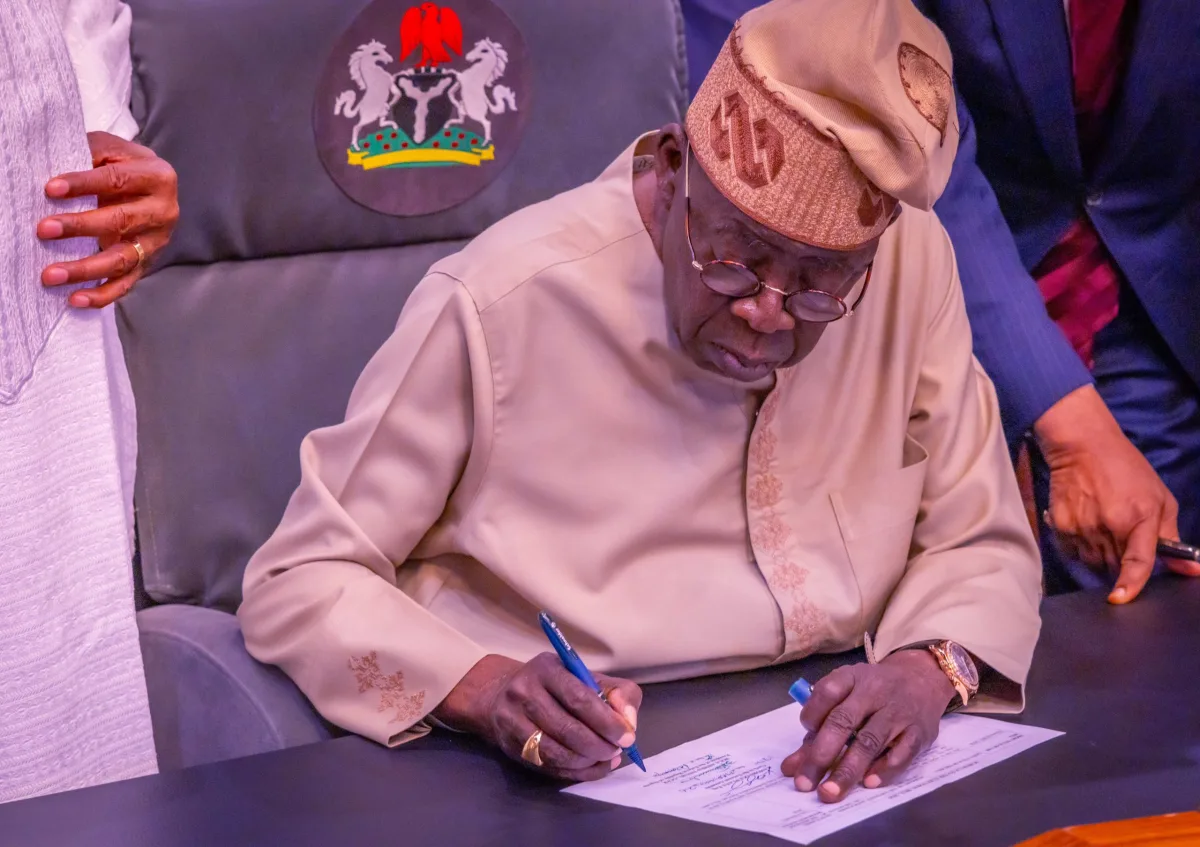
The single sharpest fact in one or two punchy sentences. Who did what, where, when, and why it matters. Not a summary of everything — the one thing that makes someone stop scrolling. A reader who only reads this paragraph must understand what happened. President Bola Ahmed Tinubu on Tuesday inaugurated the Presidential Working Group on the National Policing Bill to fast-track its implementation at the Presidential Villa in Abuja.
Tinubu emphasized that while the constitutional amendment creates the foundational framework for state policing, the National Policing Bill will provide the operational legal structure necessary for its full implementation. “The Constitution Amendment Bill establishes the framework for dual policing, but it does not operationalise it. That work is left to the National Policing Bill,” he said. The proposed legislation would address issues necessary for a smooth operationalisation of the State Police system, including minimum policing standards, state readiness certification, federal-state coordination, accountability, human rights safeguards, and fiscal conditions. The committee, according to the President, will produce an implementation-ready draft bill immediately after the constitutional amendment process.
The National Working Group, which will be chaired by Chief of Staff to the President, Femi Gbajabiamila, has other members including the Attorney-General of the Federation, the Inspector-General of Police, the President of the Nigerian Bar Association, the Chairman of the Nigeria Governors’ Forum, and the National Security Adviser. The group is expected to produce a technically robust, implementation-ready draft National Policing Bill for transmission to the National Assembly.
Gov. Dapo Abiodun of Ogun State, who pledged governors’ support for the speedy implementation of the reform, said the plan is for the 36 state governors to accelerate work on the bill once it reaches their respective Houses of Assembly and is passed unanimously.
Abiodun described the proposed state police as a response to Nigerians’ long-standing demand for community-based policing. “This bill has answered the cries of Nigerians about cascading policing and removing it from the Exclusive Legislative List,” he said.
If each state deploys about 6,000 personnel, we will add nearly 200,000 officers to complement the existing federal police,” the Governor said, commending President Tinubu for initiating implementation plans before the constitutional amendment process was completed. “This inauguration demonstrates the proactiveness of the Executive in preparing for effective implementation,” Abiodun said.
The Attorney-General of the Federation and Minister of Justice, Lateef Fagbemi, described the initiative as timely in view of Nigeria’s security challenges. “There is no denying the fact that we are in a critical moment security-wise, and all hands must be on deck,” he said. The Nigerian Bar Association President, Afam Osigwe, reaffirmed the association’s support for the state police initiative. “Nigeria can hardly be effectively policed by one national police. We fully support the constitutional amendment providing for state police,” he said.
Key Facts
- The Presidential Working Group on the National Policing Bill was inaugurated on 2026-07-08.
- The committee will produce an implementation-ready draft bill immediately after the constitutional amendment process.
- The proposed legislation will address issues necessary for a smooth operationalisation of the State Police system.
- The National Working Group has 7 members including Femi Gbajabiamila and Lateef Fagbemi.
- The plan is for the 36 state governors to accelerate work on the bill once it reaches their respective Houses of Assembly and is passed unanimously.