

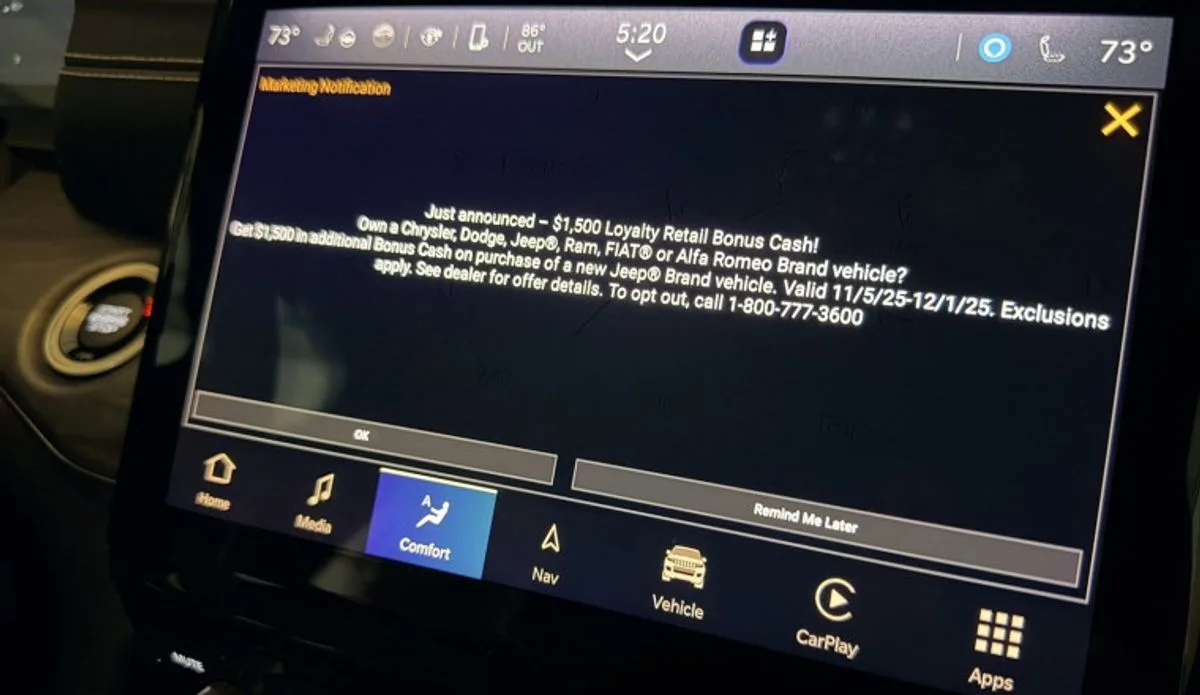
On the morning of November 24, 2025, automotive journalist Zerin Dube opened the door of his Jeep Grand Cherokee, settled into the driver’s seat, and pressed the start button. The dashboard came up, and the infotainment screen ran its boot animation, blinked to the home view, and then loaded an advertisement on top of the home view. Not a service reminder, not a recall notice, but a promotional offer: $1,500 in Loyalty Retail Bonus Cash toward the purchase of a new Jeep, timed to appear at startup, configured to linger for fifteen seconds, and programmed to return at the next ignition cycle if he failed to dismiss it quickly enough.
Dube photographed the screen and posted it to X, captioning it: “Late stage capitalism popping up on our Grand Cherokee.” The photograph captured something people had been watching develop in fragments but hadn’t yet seen stated plainly. Dube’s Jeep had not been hacked; nothing had gone wrong. The advertisement came from Stellantis, the company that built the truck, over the truck’s own cellular connection, to a screen in a vehicle the owner had paid for outright.
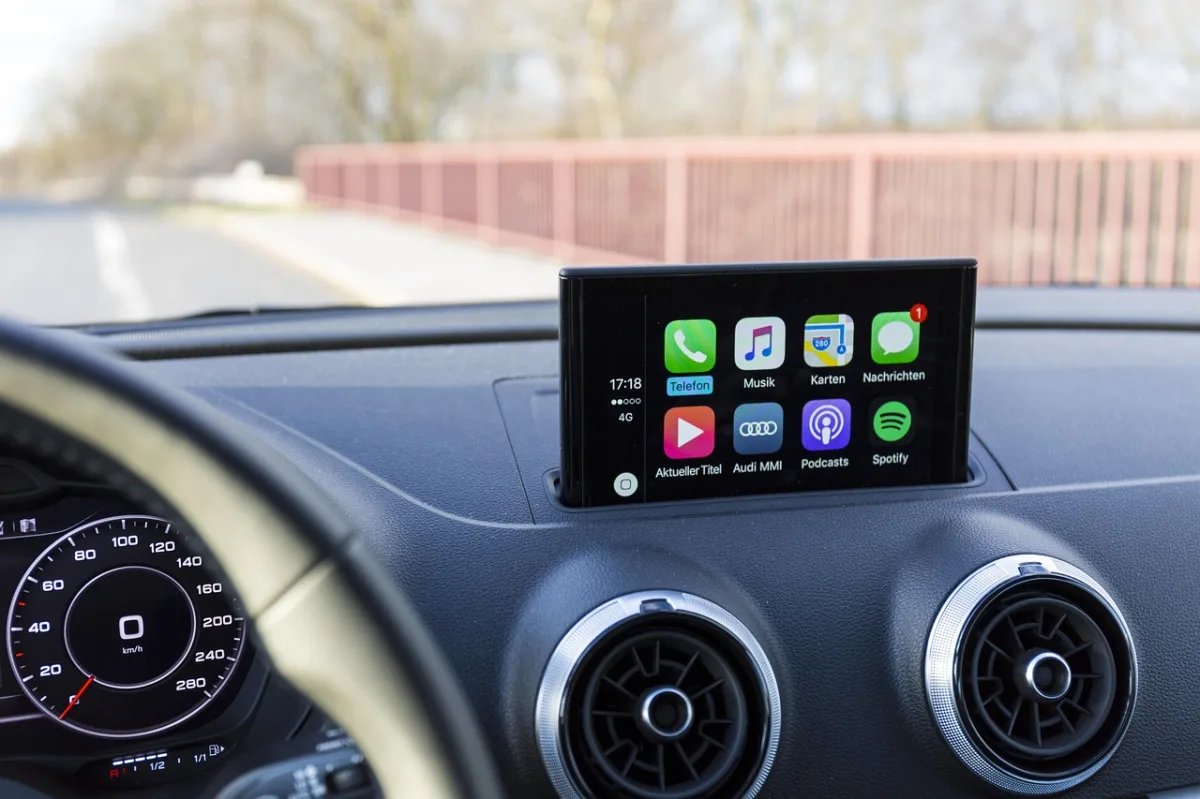
The concept of a car as a platform for advertising and data collection is not new, but it has become increasingly prevalent in recent years. The proliferation of screens and connected technology in vehicles has created new opportunities for manufacturers to collect data and deliver targeted advertising. This shift has been driven by the growing trend of cars becoming more like consumer electronics, with features like touchscreen infotainment systems and over-the-air software updates.
The transformation of cars into platforms for advertising and data collection has significant implications for users. On one hand, it allows manufacturers to provide more personalized and convenient experiences for drivers. On the other hand, it raises concerns about user privacy and the potential risks of remote attacks on vehicle systems. As cars become more connected, they also become more vulnerable to hacking and other forms of exploitation.
Key Facts
- Zerin Dube discovered a promotional offer on his Jeep Grand Cherokee's infotainment screen
- The advertisement was delivered by Stellantis, the company that built the truck
- The proliferation of screens and connected technology in vehicles has created new opportunities for manufacturers to collect data and deliver targeted advertising
- Cars are becoming more like consumer electronics, with features like touchscreen infotainment systems and over-the-air software updates
- The transformation of cars into platforms for advertising and data collection raises concerns about user privacy and the potential risks of remote attacks on vehicle systems
- Tesla introduced over-the-air software updates as a production feature with the Model S in 2012
- BMW, Ford, Volkswagen, and GM deploy over-the-air updates regularly
- The same mechanism that delivers improvements can remove features, restrict settings, and gate capabilities behind payment
- Tesla removed the adjustable regenerative braking setting from its vehicles in a 2020 update
- Tesla also removed Autopilot features from used vehicles, requiring new owners to repurchase capabilities the previous owner had paid for
- A class action lawsuit was filed against Tesla for reducing battery charging capacity in Model S vehicles
- Audi vehicles through at least 2024 shipped with software containing well-known vulnerabilities
- 92 percent of automotive cybersecurity incidents between 2023 and 2024 were remote attacks
The History of Connected Cars
The concept of a connected car is not new, but it has evolved significantly over the years. In the 1980s, General Motors introduced the Graphic Control Center, a touchscreen system that managed various vehicle functions. However, the system was not well-received by drivers, who found it distracting to navigate while driving. The idea of a connected car lay dormant for several years, until the introduction of the Tesla Model S in 2012. The Model S featured a 17-inch touchscreen display that controlled various vehicle functions, including climate control, navigation, and entertainment.

The success of the Model S paved the way for other manufacturers to introduce their own connected car systems. Today, many vehicles come equipped with touchscreen infotainment systems, over-the-air software updates, and other features that allow for greater connectivity and personalization. However, this increased connectivity also raises concerns about user privacy and the potential risks of remote attacks on vehicle systems.
The use of cellular modems and internet-connected infotainment systems has created new vulnerabilities in vehicle systems. In 2015, security researchers Charlie Miller and Chris Valasek demonstrated a remote attack on a Jeep Cherokee, which allowed them to control various vehicle functions, including the air conditioning, radio, and transmission. The attack highlighted the potential risks of connected cars and the need for manufacturers to prioritize cybersecurity.
The Role of Technology Companies
Technology companies like Google, Amazon, and Spotify have played a significant role in the development of connected car systems. Google, for example, has introduced its Android Automotive OS, which allows vehicles to run Google software at the level of the operating system. This has enabled manufacturers like Volvo and Polestar to integrate Google Maps, Google Assistant, and other Google services into their vehicles.
Amazon has also made significant inroads in the connected car space, with its Echo Auto device allowing drivers to control various functions, including music, navigation, and smart home devices, using voice commands. The Echo Auto has been integrated into various vehicle systems, including those from Acura, Alfa Romeo, and Audi.
Spotify, on the other hand, has taken a different approach, with its Car Thing device allowing drivers to control music playback using a touchscreen interface. However, the device was discontinued in 2022 due to poor sales, highlighting the challenges of developing successful connected car systems.
The Implications of Connected Cars
The implications of connected cars are far-reaching, with significant impacts on user privacy, cybersecurity, and the overall driving experience. As vehicles become more connected, they also become more vulnerable to hacking and other forms of exploitation. This has raised concerns about the potential risks of connected cars, including the possibility of remote attacks on vehicle systems.
The car is the largest and most consequential version of a phenomenon already well underway in the kitchen, the bathroom, and the gym bag. Everything is becoming a subscription with telemetry, and the vehicle is merely the highest-stakes implementation of that design philosophy.
The use of connected car systems also raises questions about user privacy, as manufacturers and technology companies collect vast amounts of data on driver behavior and preferences. This data can be used to deliver targeted advertising and other personalized experiences, but it also raises concerns about the potential misuse of this information.
The Future of Connected Cars
The future of connected cars is likely to be shaped by the ongoing evolution of technology and the growing demand for more personalized and convenient driving experiences. As vehicles become more connected, they will also become more integrated with other devices and systems, including smartphones, smart home devices, and wearable technology.
The development of autonomous vehicles will also play a significant role in shaping the future of connected cars, as manufacturers and technology companies work to create more sophisticated and integrated systems. However, this will also require significant investments in cybersecurity, as the potential risks of connected cars will only continue to grow.
The role of regulators and policymakers will also be critical in shaping the future of connected cars, as they work to establish clear guidelines and standards for the development and deployment of connected car systems. This will require a balance between promoting innovation and protecting user privacy and cybersecurity.
Conclusion
The transformation of cars into platforms for advertising and data collection has significant implications for users, manufacturers, and technology companies. As vehicles become more connected, they also become more vulnerable to hacking and other forms of exploitation, raising concerns about user privacy and cybersecurity.
The future of connected cars will be shaped by the ongoing evolution of technology and the growing demand for more personalized and convenient driving experiences. However, this will also require significant investments in cybersecurity and the development of clear guidelines and standards for the development and deployment of connected car systems.
The story of connected cars is complex and multifaceted, with many different actors and stakeholders playing important roles. As we move forward, it will be critical to prioritize user privacy, cybersecurity, and the overall driving experience, while also promoting innovation and the development of new technologies.