

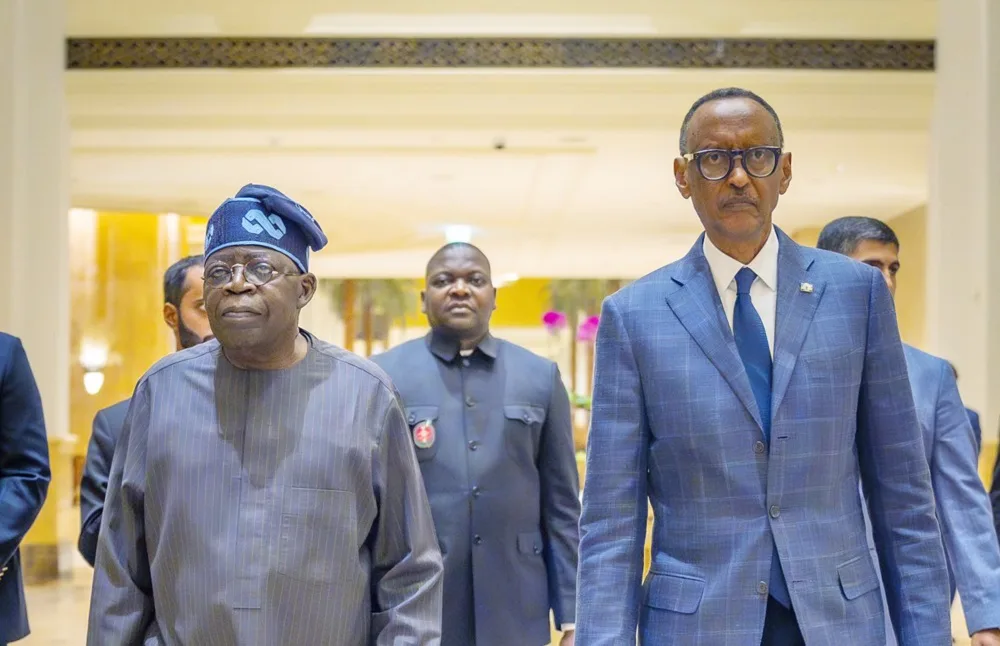
President Bola Tinubu met with Rwandan President Paul Kagame at the Urugwiro presidential villa to discuss granting Rwandans 30-day visa-free entry to Nigeria. This move is designed to boost bilateral trade and strengthen people-to-people connections. It's a reciprocal move. The discussions took place as Tinubu attended the Africa CEO Forum, which opened on Thursday, May 14.
The two leaders explored fresh ways to fully activate the African Continental Free Trade Agreement (AfCFTA) between their nations. They focused on dismantling barriers to goods, services, and labour mobility that directly support cross-border commerce. Rwanda remains one of only a few African Union member states that offer citizens of other AU countries a 30-day visa-free stay. They're one of the few countries that don't require a visa for AU citizens.
According to a statement released by presidential spokesman Bayo Onanuga, the discussions were fruitful and aimed at strengthening the relationship between Nigeria and Rwanda. The statement didn't reveal all the details, but it's clear that the talks were productive.
The African Continental Free Trade Area (AfCFTA) has delivered measurable gains in intra-African commerce, laying the groundwork for deeper economic integration across a 1.4-billion-person market worth $3.4 trillion today. Intra-African trade hit $220.3 billion in 2024. It was a robust 12.4% rebound. This growth was driven by tariff reductions, the rollout of the Pan-African Payment and Settlement System (PAPSS), and the Guided Trade Initiative, which is now active in nearly 40 countries.
Projections from Afreximbank point to a further 10% rise to $230 billion in 2026. This will push intra-African trade’s share of the continent’s total commerce toward 18%. Africa’s overall GDP growth accelerated to 4.2% in 2025. It's forecast to reach 4.3% in 2026. AfCFTA reforms are cited as a key stabilizer amid global headwinds. They're helping to stabilize the economy.
The agreement is shifting trade patterns toward manufactured goods, agri-food, and services. It's reducing reliance on commodity exports and building regional value chains. Long-term models from the World Bank and UNECA suggest full implementation could deliver a cumulative $450 billion GDP boost by 2035. It could also lift 30 million people out of extreme poverty and raise Africa’s exports to the rest of the world by up to 32%. This would be a significant boost to the economy.
It's what the countries are hoping for.
Sectoral wins are emerging. Manufacturing and digital trade are expanding. They're supported by new protocols on investment and e-commerce. PAPSS alone is slashing foreign-exchange conversion costs by an estimated $5 billion annually. This makes cross-border business more viable for SMEs. Countries like Kenya, Morocco, and Ethiopia have recorded improved export diversification indices. FDI inflows to AfCFTA states rose 17% between 2021 and 2023. This is a significant increase.
The two presidents reiterated the urgent need to revive the Joint Permanent Ministerial Commission (JPMC). It's the bilateral framework signed in 2021. They described it as the key platform for turning shared goals into concrete results. It's what they need to make progress. They won't be able to achieve their goals without it.
Yet, despite these efforts, a significant gap remains between policy goals and their practical implementation. Tinubu and Kagame must navigate the complexities of implementing the AfCFTA. They must ensure that its benefits are felt by all Nigerians and Rwandans. It won't be easy. They'll have to work hard to make it happen.
Nigeria and Rwanda are working towards granting 30-day visa-free entry to each other’s citizens. The African Continental Free Trade Area (AfCFTA) has delivered measurable gains in intra-African commerce. Intra-African trade hit $220.3 billion in 2024. Projections point to a further 10% rise to $230 billion in 2026. Africa’s overall GDP growth accelerated to 4.2% in 2025.
It's forecast to reach 4.3% in 2026. Full implementation of the AfCFTA could deliver a cumulative $450 billion GDP boost by 2035. It could lift 30 million people out of extreme poverty and raise Africa’s exports to the rest of the world by up to 32%. These are the key facts. They're what you need to know.
- Nigeria and Rwanda are working towards granting 30-day visa-free entry to each other’s citizens.
- The African Continental Free Trade Area (AfCFTA) has delivered measurable gains in intra-African commerce.
- Intra-African trade hit $220.3 billion in 2024, with projections pointing to a further 10% rise to $230 billion in 2026.
- Africa’s overall GDP growth accelerated to 4.2% in 2025 and is forecast to reach 4.3% in 2026.
- Full implementation of the AfCFTA could deliver a cumulative $450 billion GDP boost by 2035, lift 30 million people out of extreme poverty, and raise Africa’s exports to the rest of the world by up to 32%.