

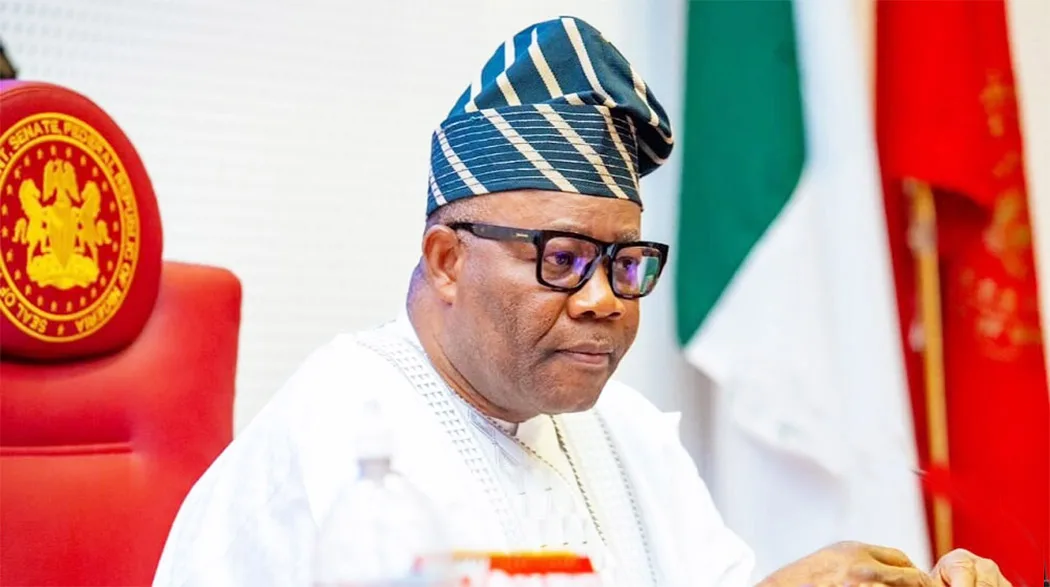
The future of agriculture in Nigeria won't be determined by hoes and cutlasses, but by research, technology, mechanisation, innovation, biotechnology, data systems, irrigation science, climate adaptation, and knowledge-driven productivity. Senate President Godswin Akpabio made this statement at the maiden National Legislative Summit and Expo on Agricultural Colleges and Institutions in Ibadan. He was represented by the Deputy Senate Majority Leader, Isa Ashiru.
Akpabio explained that the government alone can't transform agriculture. Educational institutions alone can't do it, and neither can farmers or the private sector alone. Transformation happens when government, academia, researchers, financial institutions, development partners, technology experts, agribusiness investors, and farmers work together within one integrated ecosystem. He also emphasized the need to dismantle institutional silos and build bridges between research and practice, between policy and implementation, and between innovation and accessibility.
The Senate President noted that the National Assembly remains committed to supporting initiatives that would promote food security, rural development, youth employment, and agricultural industrialisation. He added that a hungry nation can't be peaceful, and a hungry people can't be stable. Akpabio explained that hunger weakens productivity, fuels social tension, deepens poverty, and threatens national cohesion. Hunger has severe consequences. It affects people's lives and the country's stability.
But beyond feeding ourselves, Nigeria must think bigger, he said. We must move from being merely consumers to becoming exporters. This is a crucial step. We must move from raw production to agro-processing. This will add value to our products. We must move from dependence to competitiveness. This will make us self-sufficient. We must move from potential to performance. This is the only way to achieve our goals.
In his address, the Director General of the International Institute of Tropical Agriculture (IITA), Simeon Ehui, said that through various collaborations in implementing bold reforms and initiatives on food security, Nigeria will achieve multiple successes worthy of celebration. He stated that IITA is a non-profit organisation that develops agricultural technologies to address Africa's most pressing concerns, including hunger, malnutrition, poverty, and natural resource degradation. IITA's work is critical. It helps to improve people's lives.
The IITA Director General explained that the organisation works with a variety of partners across and beyond Africa to improve lives, food and nutrition security, increase employment, and protect natural resource integrity. He noted that recent initiatives include a partnership with the Nigerian government to establish 774 soil testing laboratories. This is a significant initiative. It will help to improve soil quality. The focus is also on youth agribusiness development, with the MoU signed with the Federal Ministry of Agriculture and Food Security and the Ministry of Youth Development, respectively.
The Chairman, Senate Committee on Agricultural Colleges and Institutions, Sharafadeen Alli, said the summit brought together lawmakers, policymakers, heads of institutions, development partners, researchers, private sector stakeholders, investors, students, and key actors within the agricultural value chain from across Nigeria and beyond. He stated that the gathering is not merely ceremonial, but a platform for meaningful dialogue, strategic partnerships, legislative engagement, exploring innovation exchange, and for actionable policy recommendations that will strengthen agricultural colleges and institutions across the country. This platform is essential. It will help to drive change.
Akpabio's call for collaboration is significant, given Nigeria's current food security challenges. The country is still heavily reliant on imported food products, and its agricultural sector is in need of modernisation. By working together, stakeholders can help to transform the sector and make it more productive, competitive, and sustainable. This will have a positive impact. It will improve food security. It will also create jobs, stimulate economic growth, and reduce poverty.
The National Assembly's commitment to supporting initiatives that promote food security, rural development, youth employment, and agricultural industrialisation is a step in the right direction. However, more needs to be done to address the challenges facing the agricultural sector, including the lack of access to credit, inadequate infrastructure, and limited access to technology. These challenges are significant. They won't be easy to overcome.
The IITA's partnership with the Nigerian government to establish soil testing laboratories and promote youth agribusiness development is a positive development. Soil testing is critical for determining the nutrient content of the soil and identifying the appropriate fertilisers to use. This can help to improve crop yields, reduce soil degradation, and promote sustainable agriculture practices. It's a crucial step. It will help to improve soil quality.
The focus on youth agribusiness development is also important, given the high levels of youth unemployment in Nigeria. Agriculture can provide a viable source of employment and income for young people, especially in rural areas. By providing training, funding, and other forms of support, the government and other stakeholders can help to empower young people to start their own agricultural businesses and contribute to the country's food security. This is essential. It will help to reduce unemployment.
Akpabio's call for collaboration to transform Nigeria's agric sector is a timely and necessary intervention. It highlights the need for stakeholders to work together to address the challenges facing the sector and promote sustainable agriculture practices. By doing so, Nigeria can improve its food security, create jobs, stimulate economic growth, and reduce poverty. This is the only way forward.
Key Facts
- The National Legislative Summit and Expo on Agricultural Colleges and Institutions was held in Ibadan.
- Senate President Godswin Akpabio called for collaboration to transform Nigeria's agric sector.
- The IITA is partnering with the Nigerian government to establish 774 soil testing laboratories.
- The focus is on promoting youth agribusiness development and improving food security.
- The National Assembly is committed to supporting initiatives that promote food security, rural development, youth employment, and agricultural industrialisation.
The way forward is clear: stakeholders must work together to transform Nigeria's agric sector. This will require a coordinated effort from the government, private sector, civil society, and other stakeholders. By doing so, Nigeria can unlock the potential of its agricultural sector and promote sustainable development. It won't be easy. It will take time and effort.
But it's essential for the country's future. Nigeria's agricultural sector has a lot of potential. It can drive growth and development. But it needs support and investment. The government and other stakeholders must work together to provide this support.