

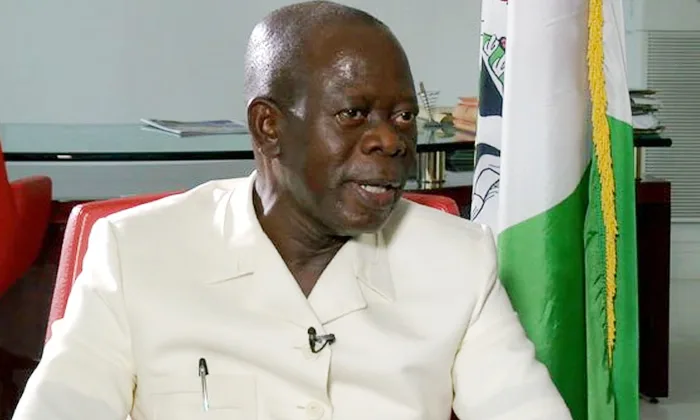
Senator Adams Oshiomhole, representing Edo North district in the 10th National Assembly, has called for economic sanctions against South Africa following the recurring xenophobic attacks on Nigerians in the country. In an interview on Channels Television, Oshiomhole argued that successive Nigerian governments have failed to respond firmly to the crisis. He stated that Nigeria can't continue with what he described as “old-fashioned diplomacy” while Nigerians and their businesses remain targets of attacks and looting in South Africa.
The senator contended that South African businesses in Nigeria shouldn't be shielded from economic blowback, pointing out that the Nigerians targeted in South Africa are private individuals, not government officials. “Those Nigerians being killed in South Africa whose shops have been looted are not Nigerian government-owned businesses. They're owned by Nigerian citizens,” he said.
Oshiomhole maintained that Nigeria must adopt stronger economic tools to protect its citizens and interests abroad. He also criticised previous administrations for what he described as weak diplomatic responses centred on meetings, communiqués and appeals without concrete consequences.
According to him, Nigeria's foreign policy should place Nigerians and Nigerian interests at the centre of diplomatic engagement. Oshiomhole argued that Nigerians possess the entrepreneurial and managerial capacity to run major corporations operating in the country. He dismissed suggestions that local investors can't manage multinational businesses.
He cited Nigerian telecommunications giant, Globacom, owned by Mike Adenuga, as an example of a successful indigenous company competing in a sector dominated by foreign firms. Oshiomhole insisted that the Nigerian state has a responsibility to defend its citizens and businesses wherever they're threatened.
This isn't the first time Oshiomhole has called for tougher economic measures against South African interests in Nigeria. He made a similar call last week following renewed xenophobic attacks targeting Nigerians and their businesses in South Africa.
As a former Edo State governor, Oshiomhole has been vocal about his stance on protecting Nigerian interests abroad. His latest call for economic sanctions against South Africa highlights the need for a stronger response to the xenophobic attacks that have plagued Nigerians in the country for years.
The impact of these xenophobic attacks on Nigerian businesses and citizens can't be overstated. Many have lost their livelihoods, and some have even lost their lives. It's time for the Nigerian government to take a firmer stance in protecting its citizens abroad.
Oshiomhole's suggestion to adopt stronger economic tools to protect Nigerian citizens and interests abroad is a step in the right direction. By doing so, Nigeria can demonstrate its commitment to defending its citizens and businesses, regardless of where they're in the world.
In the context of Nigeria's foreign policy, Oshiomhole's call for economic sanctions against South Africa serves as a reminder that the country's diplomatic efforts must be guided by a strong sense of nationalism and a commitment to protecting Nigerian interests.
The situation will continue to unfold, and it will be interesting to see how the Nigerian government responds to Oshiomhole's call for economic sanctions against South Africa. The Nigerian government must take a firmer stance in protecting its citizens abroad, and Oshiomhole's suggestion is a step in the right direction.
Key Facts
- Senator Adams Oshiomhole called for economic sanctions against South Africa due to xenophobic attacks on Nigerians.
- Oshiomhole argued that Nigeria can't continue with old-fashioned diplomacy while its citizens are targets.
- He cited Globacom as an example of a successful indigenous company competing in a sector dominated by foreign firms.
- Oshiomhole insisted that the Nigerian state has a responsibility to defend its citizens and businesses wherever they're threatened.
- He made a similar call last week following renewed xenophobic attacks targeting Nigerians and their businesses in South Africa.
The call for economic sanctions against South Africa is a complex issue that requires careful consideration. On one hand, it could serve as a deterrent to prevent further xenophobic attacks against Nigerians. On the other hand, it could have unintended consequences on the Nigerian economy and its relations with South Africa.
The Nigerian government must weigh its options carefully and consider the potential impact of economic sanctions on both Nigeria and South Africa. Oshiomhole noted that the Nigerian state has a responsibility to defend its citizens and businesses wherever they're threatened, and it's time for the government to take a firmer stance in protecting its citizens abroad. The government should assess the situation and take necessary actions to protect Nigerian interests.