

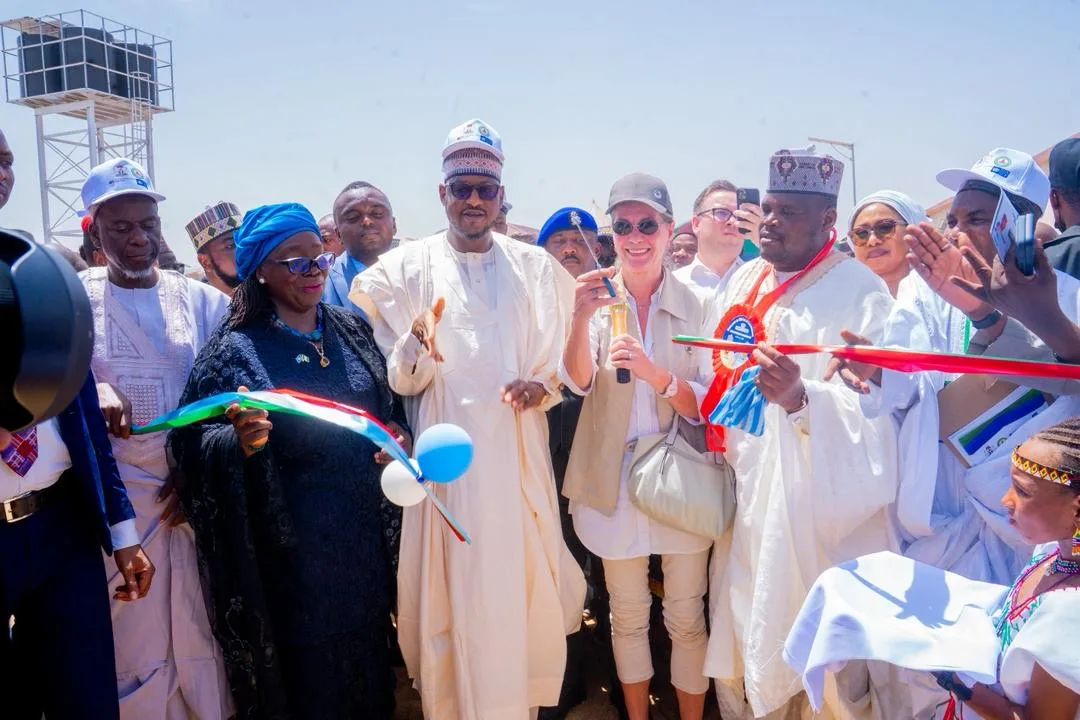
Katsina State Governor Dikko Umaru Radda on Thursday cut the tape on a 152-unit mass housing scheme for internally displaced persons in Jibia Local Government Area. The project includes climate peace hubs and a solar mini grid.
Radda said the housing project is the fruit of partnership between the state government, the United Nations Development Programme (UNDP), the German government through GIZ, and the Norwegian government.
“What was then a vision is today a living reality. Recall vividly, we gathered in October 2024 to flag-off these projects. That is what hope, partnership, and resolute action can build together,” the governor said.
The state government provided land, perimeter walls, a worship centre, a school, drainage systems, access roads, and furniture. The government also channelled ₦500 million as free grants to 500 Jibia indigenes through the Katsina State Enterprises Development Agency to revive small businesses and restore livelihoods.
Radda said Jibia LGA hasn't recorded a single deliberate attack or kidnapping over the past year. “Farmers have returned to their fields. Markets are reopening. Children are back in school. Prices of staple foods are easing,” he said.
“Across the state, productivity has risen and hope is rising where fear once reigned. The insecurity plaguing the region will be consigned to history,” he further stated.
The governor called on communities to guard the fragile peace. “Peace isn't the work of government alone. It's built in every household, every market, every mosque and church, every classroom,” he said.
He also extended an olive branch to armed elements. “There's a better way. The doors of dialogue, repentance, and reintegration remain open. Lay down your arms. Come back to your families. Come back to your communities,” the governor urged them.
Elsie G Attafuah, Resident Representative of UNDP Nigeria, commended the Katsina State Government’s leadership and commitment. He highlighted the state’s co-financing contributions as proof of local ownership.
“Today’s investments aren't the end of the story. They're the foundation for what comes next. They're helping to create the conditions for recovery, resilience and long-term development,” Attafuah said.
He noted that development itself is one of the ways peace is built. The two are inseparable. Investment in housing, livelihoods, and opportunity becomes an anchor for stability.
German Ambassador Anneth Gunther appreciated Katsina State Government’s substantial matching fund towards the completion of the project. She assured the state of Germany’s continued commitment to strengthening collaboration with UNDP and the state government in expanding stabilization, recovery, resilience, and prevention programming across Katsina State and the Northwest region.
Earlier, Abdulhameed Ahmed Mani, Commissioner for Rural and Social Development, detailed the project’s scope. Construction began in October 2024 and was completed around mid-2025. Each of the 152 houses consists of two bedrooms, a toilet, a bathroom, and a large courtyard for small orchards and animal rearing—reflecting local practice.
“The estate includes four main water fetching points, access roads, street lights, and worship centres. Infrastructure supports daily life. It supports dignity,” Mani, a professor, said.
He said beneficiary selection was rigorous and transparent. A committee comprising traditional rulers, elders, civil society representatives, youth, and government officials screened applicants from all eleven wards in the local government. No bias. No favouritism.
“Beyond housing, the government pursued complementary initiatives. Two thousand beneficiaries received livelihood support in agriculture and small business grants. The Jibia cattle market was upgraded. A new veterinary clinic was constructed. Border security personnel received training on cross-border trade relations. Local government staff were trained in counselling support services for banditry victims,” the commissioner noted.
He disclosed that a special committee has been formed to oversee the estate after commissioning. Their mandate: ensure proper maintenance and peaceful coexistence among residents.
The National Security Adviser was represented by the Director Preventing and Countering Violent Extremism at the National Counter Terrorism Centre (NCTC).