

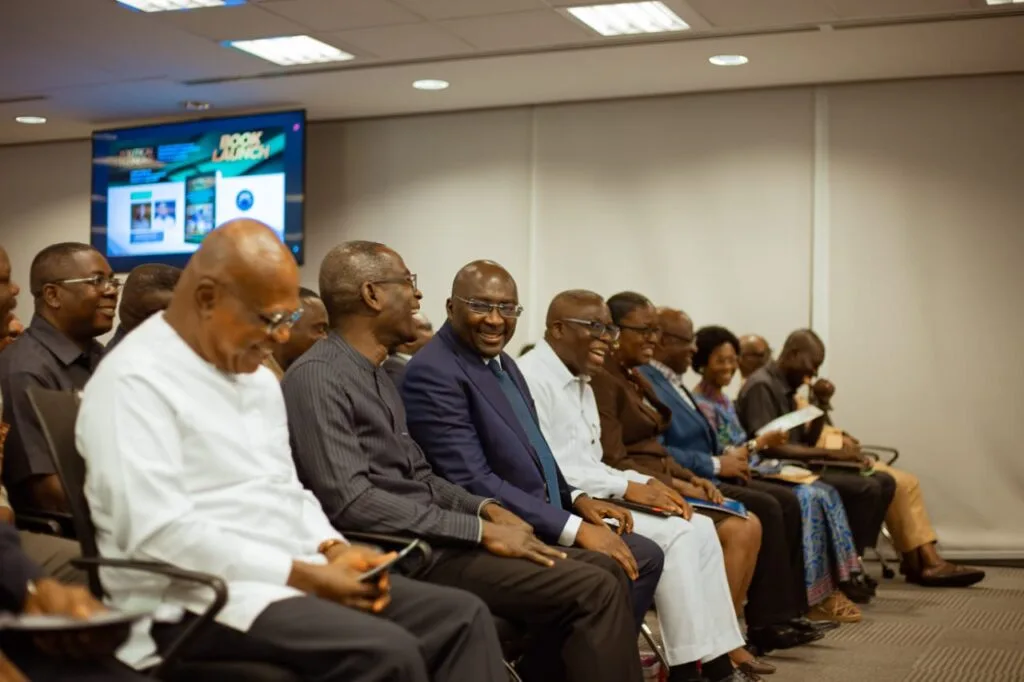
The World Bank Country Office in Accra was packed on Wednesday, 10 June 2026, as policymakers, academics, and development practitioners gathered for the launch of Political Economy of Institutionalising Monitoring & Evaluation Practice in Africa: 21st Century Perspectives. The book, written by Professor Kwaku Appiah-Adu and Mr. Andrew Osei Asibey, argues that strong monitoring and evaluation (M&E) systems are key to better governance and development in Africa.
But the authors made it clear: technical expertise alone won't cut it. Political commitment, visionary leadership, supportive institutional cultures, and active stakeholder engagement are just as essential. Without those, even the best M&E frameworks remain on paper.
"Learning from evidence is no longer optional but essential," said Dr. Mahamudu Bawumia, Ghana's Vice President from 2017 to 2025, who was the Guest of Honour. He warned that without evidence, well-designed policies risk becoming mere aspirations instead of instruments of transformation.
The event was chaired by Mr. Patrick Awuah, founder of Ashesi University. He argued that technology alone can't guarantee development without effective governance and capable institutions. He called for a shift from compliance to learning, from reporting to impact, and from data collection to informed decision-making. He stressed that the launch should be the beginning of a conversation, not the end.
Representing the World Bank, Mr. Smile Kwawukume noted that M&E has become a central pillar of effective governance and development planning. He said governments, development agencies, and civil society increasingly depend on robust M&E systems to monitor performance, measure impact, and ensure accountability in the use of public resources.
The book was reviewed by Mr. Djabanor Narh, an Alumnus Partner of Ernst & Young (EY). He described it as a timely contribution that outlines the political and institutional realities influencing M&E reforms, while providing practical guidance on embedding evidence-based decision-making within public institutions.
During an interview with MC Winston Amoah, the authors acknowledged the financial support of Twende Mbele, a Pan-African organisation hosted by the University of Witwatersrand in Johannesburg. They also thanked the Institute of Monitoring and Evaluation Practitioners, Ghana, for creating platforms that enriched their knowledge.
Emerita Professor Isabella Quakyi, President of the Ghana Academy of Arts and Sciences, delivered the closing address. She urged participants to continue the conversation on M&E beyond the event and to apply its lessons in their organisations. She emphasised accountability, continuous improvement, and the need to keep pushing for better governance.
The book explores the political, institutional, and socio-economic factors that shape the successful institutionalisation of M&E systems in Africa. Drawing on contemporary experiences and 21st-century realities, it highlights how stronger evidence-based policymaking can improve governance, public sector performance, and long-term development outcomes.
- Book title: Political Economy of Institutionalising Monitoring & Evaluation Practice in Africa: 21st Century Perspectives
- Authors: Professor Kwaku Appiah-Adu and Mr. Andrew Osei Asibey
- Launch date: 10 June 2026
- Venue: World Bank Country Office, Accra
- Chair: Mr. Patrick Awuah, founder of Ashesi University
- Guest of Honour: Dr. Mahamudu Bawumia, former Vice President of Ghana (2017–2025)
- Financial supporter: Twende Mbele (Pan-African organisation hosted by University of Witwatersrand)
- Closing address: Emerita Professor Isabella Quakyi, President of the Ghana Academy of Arts and Sciences