

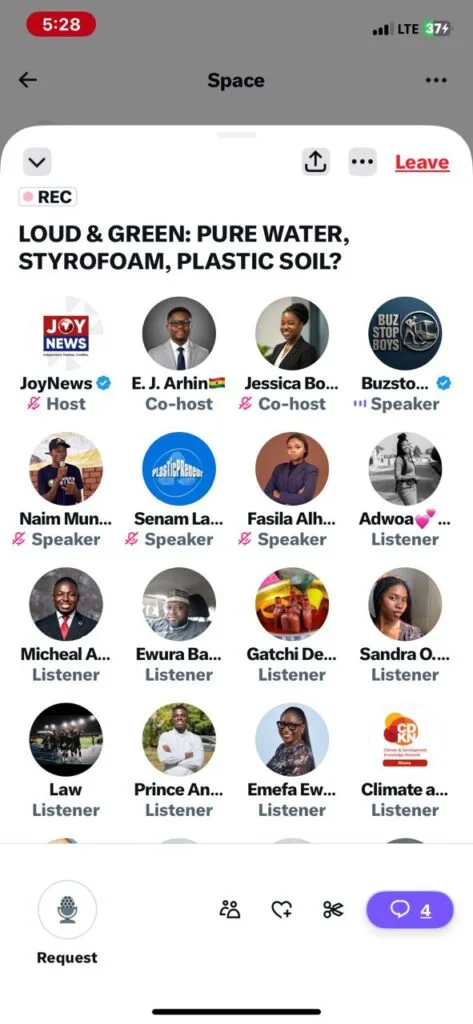
Plastic isn't the enemy. The enemy is the guy who drops it anywhere.
That's the blunt message from Heneba Koduah Saforo of Bus Stop Boys, speaking at the second edition of the Loud and Green XSpaces on JoyNews' X platform. He and other young environmental advocates argue that Ghana's devastating floods aren't natural disasters — they're behavioural ones.
For decades, heavy rainfall and climate change have taken the blame. But these advocates say the real problem starts long before the rains arrive. Indiscriminate waste disposal, poor sanitation habits, and a growing dependence on single-use plastics turn manageable rainfall into annual disasters that destroy homes, livelihoods, and infrastructure.
“Plastic isn't the enemy for me. The enemy is the guy who drops it anywhere,” Saforo said.
He argued that Ghana's flood challenges stem from attitudes towards the environment and a lack of sustained public education. He pointed out that flooding was already making news in 1960, yet the country is still talking about it today without addressing the root cause: mindset.
“If you look at everything we're talking about in terms of pollution today, it started from mindset. There was news about flooding in 1960, and we're still here today talking about flooding. We aren't actually trying to delve into how exactly the mindset of the people is contributing to the persistent flooding issue,” he said.
Saforo also noted that many Ghanaians see sanitation and environmental protection as the government's job alone. “In most cases, citizens feel it's only the responsibility of politicians or leaders who are supposed to fix everything. But we all have a common thing to build, and that is Ghana,” he stated.
His comments come weeks after heavy rains submerged parts of Accra and other communities, exposing longstanding problems with drainage systems and waste management.
Youth climate advocate Fasila Alhassan sees the problem up close in her community of Aboabo. “Whenever it rains and the place gets flooded, if you look at the surface of the water, the only thing you find are plastics,” she said. She blamed the widespread use of disposable plastic products like sachet water bags and bottles.
“Plastics have become part of us. Everybody is using them. If we can encourage things that people can use over and over again, it'll help reduce the number of plastics we have,” she noted.
Abdul Na-eem Muniru, a National Geographic Society Young Explorer and Founder of the Ocean Harmony Project, warned that plastic pollution goes beyond flooding. “Plastic pollution affects everywhere, ecosystems, wildlife, livelihoods, humans and the ocean,” he said. He explained that plastics discarded on land end up in rivers and oceans, threatening marine life and eventually returning to humans through the food chain. “When fish ingest plastics and humans consume them, those plastics eventually enter the human body,” he said.
The advocates maintain that while climate change may increase the intensity of rainfall, human actions determine whether those rains become disasters. Their message: tackling Ghana's flood crisis requires more than better drainage infrastructure. It demands a change in attitudes, stronger environmental education, and greater individual responsibility for waste management.
As Ghana continues to battle recurring floods, the advocates argue that the solution lies not just in responding to disasters but in addressing the behaviours that make communities vulnerable in the first place.