

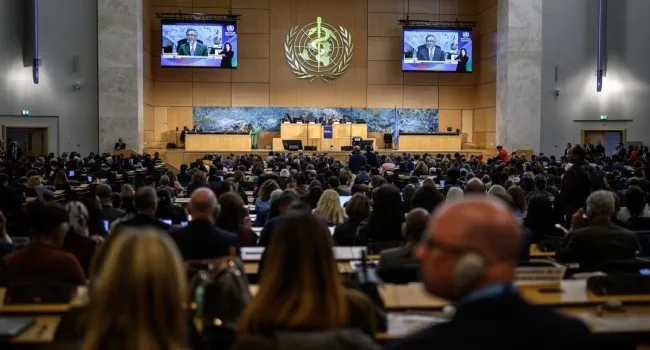
The UN General Assembly is set to vote on a draft resolution that outlines states' obligations to combat climate change. This move comes after the International Court of Justice (ICJ) ruled last year that states are obliged to tackle climate change under international law. The ICJ's decision exceeded climate advocates' expectations. However, the draft resolution has been significantly altered after negotiations among states.
The resolution welcomes the ICJ opinion as an authoritative contribution to the clarification of existing international law. It calls on states to comply with their respective obligations to protect the global climate. The resolution also emphasizes the measures needed to keep global warming limited to 1.5C above pre-industrial levels. It highlights the importance of transitioning away from fossil fuels in energy systems. Ralph Regenvanu, Vanuatu's climate minister, said that for Vanuatu and many climate-vulnerable states, this is ultimately about survival.
It's also about whether multilateralism can still respond to reality with unity.
The draft resolution was initially proposed by Vanuatu in January, following the ICJ's ruling. The text was altered significantly after negotiations among states. Climate change took a back seat to national security or industrial interests in many countries. The creation of an International Register of Damage, which was initially proposed to compile evidence of damage, loss, or injury attributable to climate change, has vanished from the current text. It was meant to be a key component of the resolution.
However, it didn't make it to the final version.
'Let me also be clear about what the resolution does not do. It does not create new legal obligations. It does not adjudicate disputes. It does not attribute responsibility to any state,' Regenvanu said, describing the text as 'a careful and balanced response to the Court's guidance.' He emphasized that the resolution doesn't go as far as some might have hoped. However, it's still a step in the right direction.
Despite the watered-down draft, the resolution is unlikely to be adopted by consensus, according to diplomatic sources. Joie Chowdhury, a senior attorney at the Center for International Environmental Law, said that the current version of the resolution is still a strong text. It really matters that it passes. Climate advocates hope that the concept of a damage registry can be brought to the table in the future via the UN secretary-general. The draft resolution calls on the UN chief to submit a report to the General Assembly containing ways to advance compliance with all obligations from the ICJ ruling.
This could be a crucial step towards achieving the goals of the Paris Agreement.
The resolution's adoption will be a crucial step in the global effort to combat climate change. The ICJ's ruling last year marked a significant shift in the international community's approach to climate change. The adoption of this resolution will be a testament to the perseverance of climate advocates. The resolution's emphasis on transitioning away from fossil fuels and limiting global warming to 1.5C above pre-industrial levels is a crucial step towards achieving the goals of the Paris Agreement. It's a significant move towards reducing greenhouse gas emissions.
The vote on the resolution is expected to take place on Wednesday, and the outcome is uncertain. However, it's clear that the international community's response to climate change will have a significant impact on the future of our planet. As Regenvanu said, this is ultimately about survival. It's also about whether multilateralism can still respond to reality with unity. The international community can't afford to fail on this issue. It won't be easy, but it's a challenge that must be met.
Key Facts
- The UN General Assembly will vote on a draft resolution on climate change obligations.
- The resolution calls on states to comply with their climate commitments.
- The International Court of Justice ruled last year that states are obliged to tackle climate change under international law.
- The draft resolution has been significantly altered after negotiations among states.
- The creation of an International Register of Damage has vanished from the current text.
- The resolution is unlikely to be adopted by consensus, according to diplomatic sources.
The impact of climate change is already being felt in many parts of the world. The adoption of this resolution will be a crucial step towards mitigating its effects. The international community must come together to address this global challenge. The UN General Assembly's vote on this resolution will be a significant step in the right direction. It's a chance for the international community to show that it's committed to addressing climate change.
They're not going to give up on this issue. They'll keep pushing for a better future.
The UN General Assembly's vote on the climate change resolution is a critical moment in the global effort to combat climate change. The resolution's adoption will be a significant step towards achieving the goals of the Paris Agreement. It will be a testament to the perseverance of climate advocates. The international community must continue to work together to address this global challenge. The adoption of this resolution will be a crucial step in the right direction.
It's a step towards a more sustainable future. They won't stop fighting for this cause. It's too important to give up on. The international community will keep working towards a better future, and the adoption of this resolution is a key part of that effort.