

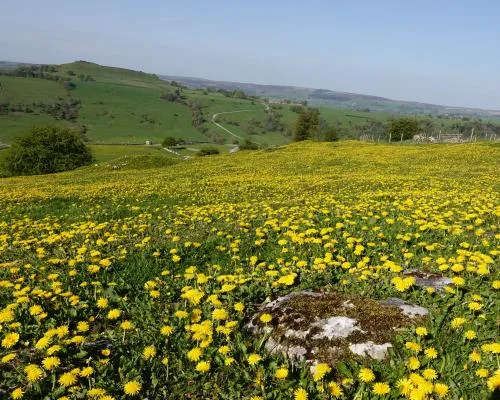
Mark Cocker, a seasoned observer of the natural world, has witnessed something remarkable this spring. As he drove out of upper Dovedale, he caught a glimpse of a blanket of gold running over the slope, with dandelions covering the land like a carpet. This wasn't just a small patch - the entire hillside was covered in these bright yellow flowers, stretching as far as the eye could see. They're a common sight, but not usually on this scale.
But what's even more remarkable is that this isn't the only time Cocker has seen such an explosion of dandelions this spring. In February, it was snowdrops that were blooming in extraordinary numbers, and last month, it was dandelions again. This time, however, it was on a much larger scale, with the flowers covering entire fields and hillsides. Cocker notes that while dandelions may seem like a single type of flower, there are actually around 240 species in Britain. He's in awe of his friend Baz Scampion, who co-published a book on the dandelions of Shetland, finding an impressive 130 species on the archipelago.
That's a remarkable number, and it shows just how diverse the natural world is.
As Cocker monitored who was enjoying the dandelions, he noticed that it wasn't just humans who were appreciating the display. Bumblebees and solitary bees in the genus Andrena were also making the most of the flowers. They're able to feed on the nectar, and it's a crucial source of food for them. Cocker was treated to the sight of entire fields glittering with the air-filled silver of dandelion clocks at dawn. It was a breathtaking sight, and one that he won't forget.
The dandelion clocks are a beautiful sight, and they're a reminder of the beauty of the natural world.
I paced out across the fields, because as far as you could see to the hill crown and beyond were flowering buttercups in hundreds of thousands. The three common species don’t observe any concern for equal height and thus their showing is more a vast gold-stippled canvas – more Seurat, perhaps, than the dandelion’s Rothko-like sweep of colour – but it was so beautiful I wanted to raise my hands aloft and swirl around. It's a feeling that's hard to describe, but it's one of pure joy and wonder.
Cocker's observations are a testament to the incredible diversity and beauty of the natural world. They're a reminder that there's still so much to discover and appreciate. While many of us may take these flowers for granted, they're an important part of the ecosystem, providing a source of food for bees and other insects. And as Cocker notes, the experience of witnessing such an explosion of color and life is truly unforgettable. It's an experience that can't be replicated, and it's one that will stay with him forever.
The experience of walking through fields of blooming flowers is something that many of us can appreciate. The smell of the flowers is sweet and intoxicating, and it's a scent that's hard to forget. The sound of the bees buzzing from one bloom to the next is a soothing noise, and it's a reminder of the beauty of nature. The sight of the colorful petals swaying in the breeze is a beautiful thing to see, and it's a sight that's full of life and energy. All these things combine to create a truly immersive experience.
And as Cocker's observations show, this spring has been particularly special, with the dandelions and buttercups putting on a display that will be remembered for a long time to come. It's a display that won't be forgotten, and it's one that will be talked about for years.
- 240 species of dandelions in Britain
- 130 species found on the Shetland archipelago
- Dandelions and buttercups blooming in record numbers this spring
- Bumblebees and solitary bees in the genus Andrena are enjoying the flowers
- The display of flowers is not just beautiful, but also important for the ecosystem
As the seasons change and the flowers begin to fade, it's a good time to appreciate the beauty and diversity of the natural world. Whether it's a blanket of gold dandelions or a sea of colorful buttercups, these displays are a reminder of the incredible beauty that surrounds us. They're a reminder of the importance of preserving and protecting the natural world for future generations. We can't afford to lose this beauty, and we must take steps to protect it. It's a responsibility that we all share, and it's one that we can't ignore.
In the end, Cocker's observations are a reminder that even in a world that is increasingly urbanized and technologically driven, there is still beauty and wonder to be found in the natural world. It's a world that's full of surprises, and it's a world that's full of life. As we go about our daily lives, it's worth taking a moment to stop and appreciate the small things - like a field of blooming flowers - that can bring us joy and inspiration. They're a reminder of the beauty of the world, and they're a reminder of the importance of preserving it. We won't regret taking the time to appreciate these things, and we'll be richer for it.