

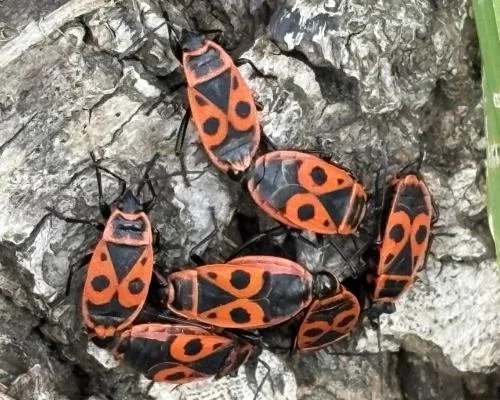
A broken fence or a fallen tree is noticed almost immediately on the farm, thanks to the extra pairs of eyes from people strolling, horse riding, or picnicking from dawn till dusk. Recently, Laura, a regular dog walker and keen photographer, shared something new - a colony of firebugs congregating on the sunny side of an old lime tree.
There are 50 or so firebugs, clustered together, like flames flickering up the trunk. Each is nearly a centimetre long, with ember-bright red backs marked by bold, symmetrical black shapes. These aggregations, typically on lime or mallow, are for mating and feeding. A firebug eats seeds, aphids, or even its dead relatives, sucking out moisture with its proboscis. At first glance, they could be mistaken for the unrelated cinnamon bug. Although their patterns are similar, the firebugs are block printed with geometric precision, whereas the cinnamon bug's markings look like the work of soft, painterly brushstrokes.
Firebugs were once very rare in the UK, with just one population in Devon. Now, though, they're chasing the spreading warmth, and they can be found in most of southern England, their range pushing ever northwards, like a slow-burning blaze. They're harmless to people, trees, and gardens. Birds and amphibians sometimes ignore their stark attempt at warning and eat them anyway. They don't seem to care that firebugs are trying to warn them off.
A few pairs of firebugs are connected, end to end, as if glued together. Their mating can go on for hours. Unlike many prolific insects, they produce just one new generation a year. The nymphs often remain gathered at the hatching site as they mature. The warmth of the sun draws them upwards, while the shade sends them down to the leaf litter below.
The busy spring afternoon continues, with swallow acrobatics in full force over the meadows. The swifts haven't arrived yet, but they will any second now, and I probably won't be the first to notice.
Under the Changing Skies: The Best of the Guardian’s Country Diary, 2018-2024, is available now at guardianbookshop.com
Kate Blincoe, the author of the country diary, notes that public access is crucial in discovering new species and observing their behavior. The fact that firebugs are now found in most of southern England is a testament to the changing climate and its effects on wildlife. This change is having a profound impact on the environment, and it's essential to understand it.
As the firebugs continue to spread, it'll be interesting to see how they adapt to their new environments and how they interact with other species. For now, they remain a fascinating sight to behold, a reminder of the beauty and complexity of the natural world. They're a great example of how wildlife can thrive in new areas.
Firebugs are insects that congregate on lime or mallow trees for mating and feeding. They're harmless to people, trees, and gardens. Firebugs were once rare in the UK, but they're now found in most of southern England. They produce just one new generation a year. The nymphs often remain gathered at the hatching site as they mature.
The discovery of firebugs in southern England is a significant finding, as it highlights the impact of climate change on wildlife. The world is continuing to warm, and it's essential to monitor the spread of species like the firebug. We need to understand their role in the ecosystem, and how they'll affect the environment in the long term. This knowledge will help us prepare for the future, and it's crucial that we take action to protect the natural world.