

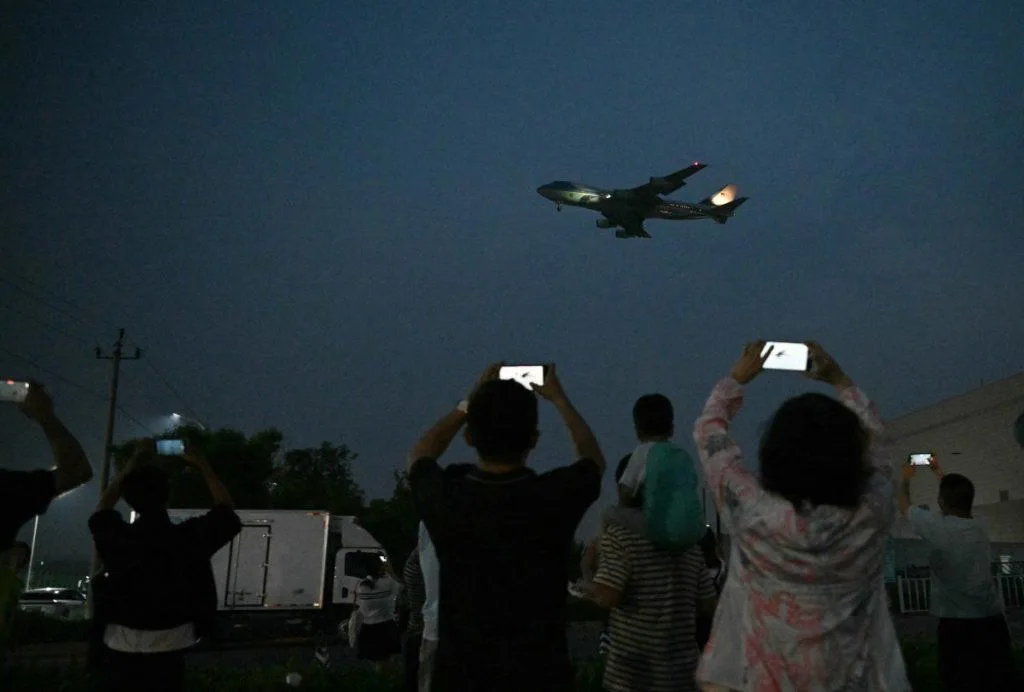
US President Donald Trump landed in Beijing on Wednesday for a high-stakes summit with Chinese leader Xi Jinping aimed at easing deep tensions between the rival superpowers. Beginning the first visit to China by a US president in nearly a decade, Trump touched down on Air Force One at Beijing Capital International Airport at 7:50 pm (1150 GMT) after the long flight from Washington.
The summit comes at a critical time, with ructions over Iran, trade, and Taiwan looming large. Trump had already delayed the meeting from March because of the war in the Middle East. But Trump appeared firmly focused on business deals, with Nvidia chief Jensen Huang boarding the plane at the last minute in Alaska and Tesla's Elon Musk also travelling on the presidential jet.
As the global AI race hots up, China is currently banned from purchasing the cutting-edge chips that Huang's company produces under US export rules that Washington says are to protect national security. Trump said in a social media post en route that he would be 'be asking President Xi, a Leader of extraordinary distinction, to 'open up' China so that these brilliant people can work their magic'.
Visiting China for the first time since 2017 during his first term, Trump is expected to receive a lavish welcome from Chinese authorities and will have a packed itinerary. Trump and Xi will hold talks at 10:00 am (0200 GMT) on Thursday in Beijing's opulent Great Hall of the People, where they will also enjoy a state banquet in the evening.
On Friday, they are set to have tea and a working lunch before the US president heads home. As he departed the White House, Trump said he expected a 'long talk' with Xi about the joint US-Israeli war with Iran, which sells most of its US-sanctioned oil to China. But he also downplayed disagreements, telling reporters that 'I don't think we need any help with Iran' from China and that Xi had been 'relatively good' on the topic.
The Chinese foreign ministry said Wednesday it 'welcomes' Trump's visit and that 'China stands ready to work with the United States… to expand cooperation and manage differences'. Yet Beijing is growing impatient for peace, with Foreign Minister Wang Yi urging his Pakistani counterpart on Tuesday to step up mediation efforts between Iran and the United States.
Key Facts
- Date: 2026-05-13
- Location: Beijing, China
- Leaders involved: Donald Trump (US President), Xi Jinping (Chinese leader)
- Agenda: Trade, Iran, Taiwan
- Companies involved: Nvidia, Tesla
The tense buildup to the summit was already visible on the streets of Beijing, with police monitoring major intersections and checking the ID cards of passengers on the metro. 'It's definitely a big deal,' said Wen Wen, a 24-year-old woman travelling from the eastern city of Nanjing. 'Some progress will certainly be made,' she said, noting that she hopes China and the United States can ensure 'lasting peace' despite 'recent instability in the global situation'.
Trump has repeatedly touted a strong personal relationship with Xi, which he insisted on Monday would prevent a Chinese invasion of Taiwan. Trump's trip will be closely scrutinised by Taiwan and Asian allies for any sign of weakening US support.
The long-simmering trade war between the two countries will also be top of the agenda, after Trump's sweeping tariffs last year triggered tit-for-tat levies that exceeded 100 percent. Trump and Xi are set to discuss extending a one-year tariff truce, which the two leaders reached during their last meeting in South Korea in October, although a deal is far from certain.
China's controls on rare earth exports and agriculture exports are also expected to be on the menu. Trump's visit comes as the US and China are navigating complex issues, including the US arms sales to Taiwan, which China claims as its own territory.
The meeting between Trump and Xi is a critical moment in the complex relationship between the two superpowers. The outcome of the summit could have significant implications for global trade, security, and stability.
Donald Trump, the 45th President of the United States, has had a long and complex relationship with China. He has been critical of China's trade practices and has imposed several tariffs on Chinese goods. Xi Jinping, the President of China, has been in office since 2013 and has consolidated his power through various economic and military reforms.
The US-China relationship has been under strain in recent years, with tensions over trade, security, and human rights. The two countries have had a complex relationship, with periods of cooperation and competition. The summit between Trump and Xi is an opportunity for both leaders to discuss their differences and find areas of common ground.
The global community is watching the summit closely, with many countries hoping for a positive outcome. A stable and cooperative relationship between the US and China is critical for global peace and stability.