

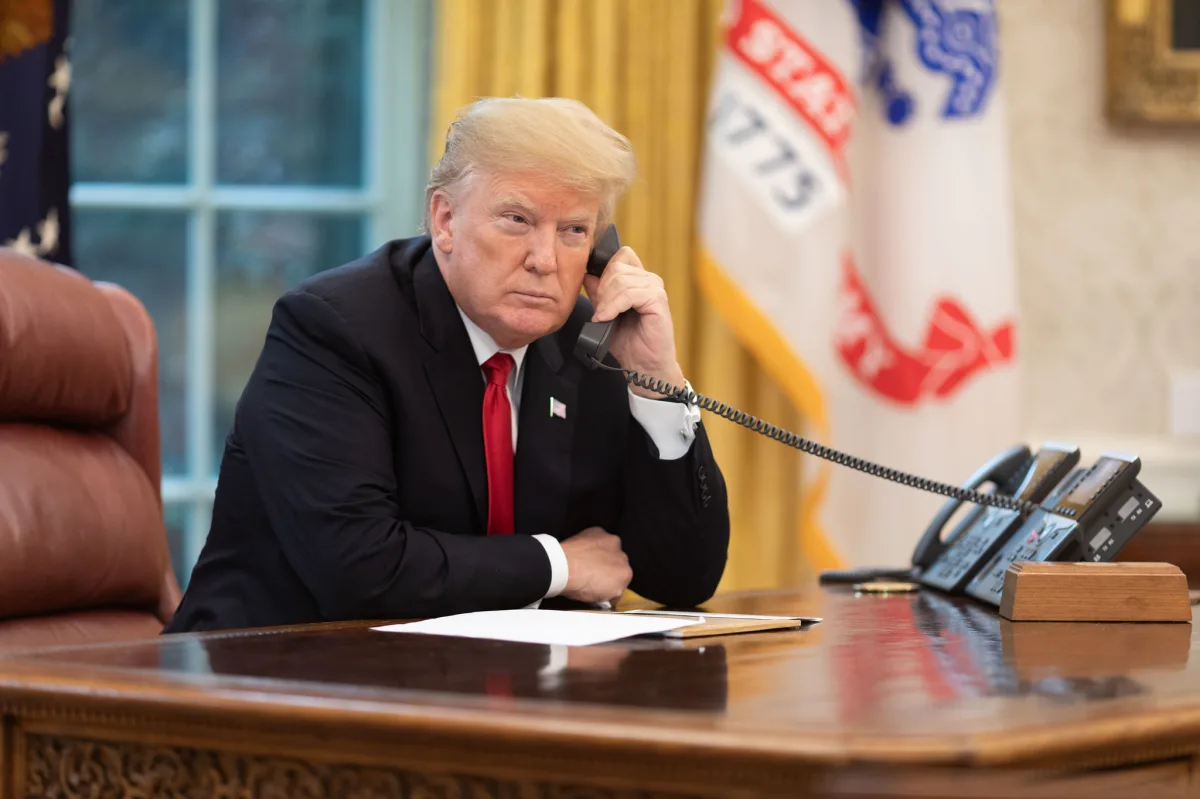
The US President, Donald Trump, says he's holding off a military attack on Iran that was planned for Tuesday after appeals by Qatar, Saudi Arabia, and the UAE. This development shows that the Gulf states are trying to prevent a war between the US and Iran. They're playing a key role in mediating the conflict.
Donald Trump, the 45th President of the United States, made this announcement in a post on Truth Social. He said the leaders of these Gulf countries asked him to pause the planned attack and allow for “serious negotiation.” Trump hasn't always called off an attack after appeals from other countries, but he's threatened to attack Iran before. It's not the first time he's done so.
Mr Trump said he had been informed that a deal that's “very acceptable” to the US would be reached, and that there would be “NO NUCLEAR WEAPONS FOR IRAN!” The US is still pushing for Iran to give up its nuclear program. The US has been trying to get Iran to agree to a new nuclear deal since the old one was scrapped in 2018. They're pushing for a deal that meets their demands.
“Based on my respect for the above-mentioned Leaders, I have instructed Secretary of War, Pete Hegseth, The Chairman of The Joint Chiefs of Staff, General Daniel Caine, and The United States Military, that we will NOT be doing the scheduled attack on Iran tomorrow,” he said. This statement indicates that the US is willing to listen to the Gulf states and consider their appeals.
Mr Trump, however, warned that the US military would be prepared to launch a full, large-scale assault of Iran on a moment’s notice if talks failed to produce a deal. This means that the threat of war is still very real. The US isn't backing down from its demands. They're still pushing for a deal that meets their requirements.
The fragile truce between the US and Iran has been increasingly strained as negotiations drag on and both countries exchange proposals without reaching an agreement. Iran's reported 14-point proposal called for an immediate ceasefire across all fronts. It also called for the lifting of the US naval blockade on Iranian ports, and assurances that no further attacks would be launched against Iran. The proposal demanded compensation for damages caused by the conflict. It reaffirmed Iran's sovereignty over the Strait of Hormuz.
The Strait of Hormuz is a vital waterway for oil exports. Any disruption to it could have serious consequences for the global economy. An attack by either the US, Iran, or Israel will shatter the month-long ceasefire. It could lead to a continuation of the Middle East war, which began on 28 February after the US and Israel launched an unprovoked attack on Iran. The war has led to the deaths of 3,468 people. It's injured about 26,500 others in the region.
The situation is still developing, and it's not clear what will happen next. The US and Iran are still very far apart, and it will take a lot of work to reach a deal that satisfies both sides. They don't see eye to eye on many issues.
- The US planned to attack Iran on Tuesday.
- The attack was called off after appeals from Qatar, Saudi Arabia, and the UAE.
- The US is pushing for Iran to give up its nuclear program.
- The fragile truce between the US and Iran has been increasingly strained.
- The war in the Middle East has led to the deaths of 3,468 people and injured about 26,500 others.
For the people directly affected by the conflict, the threat of war is still very real. They'll be watching the situation closely to see what happens next. The international community will also be watching. It's likely that there will be a lot of pressure on both sides to reach a deal. They'll be pushing for a resolution to the conflict.
The US and Iran are still negotiating, and it's not clear what the outcome will be. The situation is still very volatile, and it could escalate at any moment. The US and Iran are still far apart, and it will take time to reach a deal. They're not close to an agreement yet.
The role of the Gulf states in preventing a war between the US and Iran is significant. It shows that they're trying to play a mediating role in the conflict. They're willing to work with both sides to find a solution. This is a positive development, and it could help to reduce tensions in the region. The Gulf states are taking a proactive approach to resolving the conflict.
In the end, it's up to the US and Iran to reach a deal. But with the help of the Gulf states, it's possible that they can find a way to resolve their differences and prevent a war. The US and Iran need to find common ground. They need to be willing to compromise and work together. The outcome is uncertain, but the US and Iran are still talking.
The people who are caught in the middle of the conflict are the ones who will suffer the most if a war breaks out. They're the ones who will lose their homes, their families, and their livelihoods. They're the ones who will be forced to flee their countries and seek refuge elsewhere. They're in a difficult situation, and they need help. The international community needs to support them.
It's a tragic situation, and it's one that needs to be resolved as quickly as possible. The US and Iran need to find a way to resolve their differences and prevent a war. The international community needs to put pressure on both sides to reach a deal. The people who are caught in the middle of the conflict need to be protected and supported. They need assistance and aid to get through this difficult time.
The situation is still developing, and it's not clear what will happen next. The US and Iran are still very far apart, and it will take a lot of work to reach a deal that satisfies both sides. They don't see eye to eye on many issues, and it's going to take time to resolve their differences. The US and Iran are still negotiating, and they're still talking. They haven't given up yet, and that's a positive sign.