

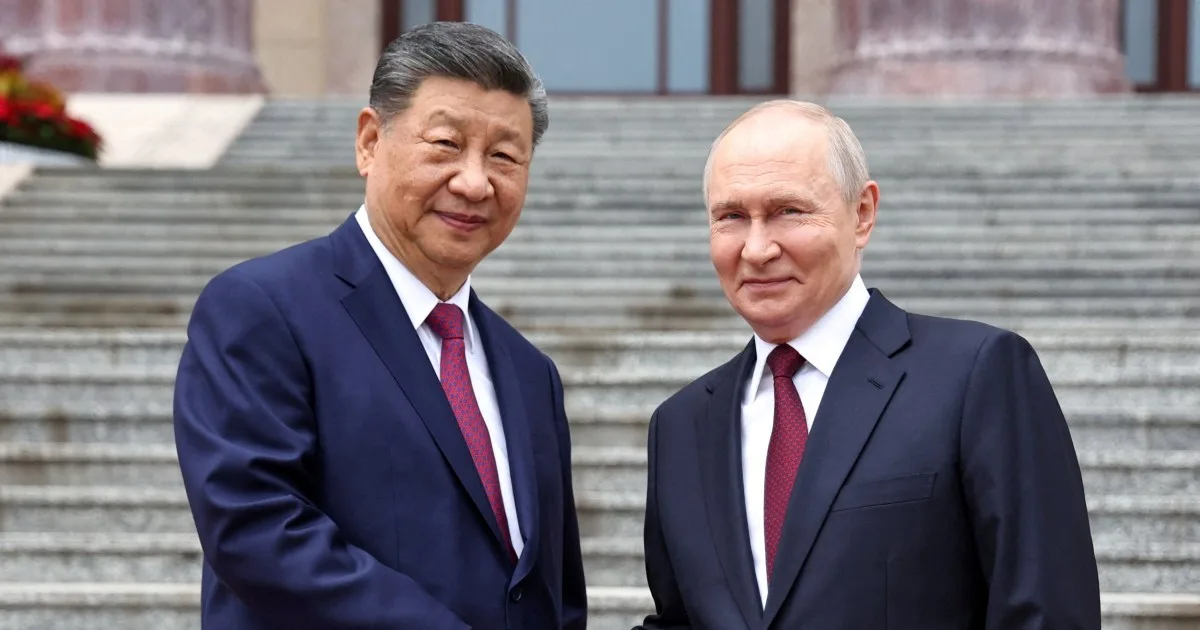
Russia and China have reached an understanding on the Power of Siberia 2 (POS-2) pipeline project, a proposed 2,600km natural gas pipeline that would carry Russian gas from western Siberia through Mongolia to China. The agreement was announced during a meeting between Presidents Vladimir Putin and Xi Jinping. They didn't announce all the details, but it's clear they've made progress.
The pipeline is expected to have a capacity of 50 billion cubic metres per year. This is equivalent to about 525 terawatt-hours of energy. It's nearly twice the United Kingdom's annual electricity consumption. The pipeline's capacity is nearly as large as Nord Stream 1, one of Russia's most important former gas export routes to Europe. Nord Stream 1 had a design capacity of 55 billion cubic metres per year.
For Russia, the pipeline is a way to replace revenue lost since European countries slashed their gas imports from Russia after Moscow's full-scale invasion of Ukraine in February 2022. Russia can't rely on European countries for gas exports like it used to. The pipeline would provide a major new market for gas that was originally intended for Europe. This would help state-controlled energy giant Gazprom recover part of the revenue it has lost. Gazprom won't recover all its lost revenue, but it's a start.
“The president said during the talks that, overall, there is already a shared understanding of the main parameters for Power of Siberia 2,” Kremlin spokesman Dmitry Peskov told Russian media. He didn't say what those parameters are, but it's clear they're making progress.
China, on the other hand, sees the pipeline as a more secure alternative to imported liquefied natural gas (LNG). LNG is cooled into liquid form and transported by ship. Most of China's LNG imports must be shipped through strategic chokepoints, such as the Strait of Hormuz and the Strait of Malacca. China doesn't like relying on these routes. They're not secure, and they're not reliable.
The project, however, isn't without its challenges. Analysts say that significant hurdles remain before the project can become a reality. Jack Sharples, senior research fellow at the Oxford Institute for Energy Studies, notes that the pipeline is logistically feasible. However, it takes several years to complete a pipeline. It's not a quick process.
The first Power of Siberia (POS-1) pipeline, which carries gas from two eastern Siberian fields to the Russia-China border, began construction after a 2014 agreement. Its first deliveries started in 2019, and it reached full capacity in 2024. Despite being slightly shorter than POS-1 and not requiring the development of new gas production, POS-2 is slated to cross a third country – Mongolia. This adds complexity to the project.
Seb Kennedy, CEO and founder of the independent energy market analysis publication Energy Flux, says that the discussions about “main parameters” are “diplomatic code” for a lack of agreement on price. Analysts agree that this is the primary stumbling block. China isn't in a hurry to reach a deal, but Russia is. Russia needs the revenue, and it needs it now.
For Russia, the pipeline would provide a major new market for gas, helping Gazprom recover part of the revenue it has lost. However, Russia's urgent need for revenue has given China the upper hand in negotiations. Go Katayama, principal insights analyst for LNG and natural gas at the analytics firm Kpler, notes that Beijing is pushing for heavily discounted pricing linked to domestic benchmarks. Russia, on the other hand, needs higher prices to justify the enormous infrastructure costs. It's a delicate balance.
The negotiations ultimately reflect a balance between Russia's need for revenue stability and China's desire for secure, low-cost supply. The project may take a decade from start of construction to full capacity, according to Sharples. It's a long-term project, and it requires patience.
- The pipeline will have a capacity of 50 billion cubic metres per year.
- It will carry Russian gas from western Siberia through Mongolia to China.
- The pipeline is expected to provide a major new market for gas that was originally intended for Europe.
- China sees the pipeline as a more secure alternative to imported liquefied natural gas (LNG).
- The project is expected to take a decade to complete.
The pipeline is a strategically attractive prospect for China as the country seeks to diversify its energy supplies and reduce its reliance on seaborne LNG imports. Beijing is wary of the immediate risks posed by maritime chokepoints such as the Strait of Hormuz. LNG imports also rely on a complex global supply chain involving multiple suppliers, shipping routes, and receiving terminals. It's not a simple process.
Mongolia, a landlocked nation between China and Russia, would be unlikely to object to collecting hundreds of millions of dollars a year in transit fees. The project reflects a broader effort by Russia and China to build closer economic ties and reduce their dependence on a Western-led international order that both countries increasingly view as fractured and unreliable. They don't want to rely on the West, and they're taking steps to reduce their dependence.
The negotiations between Russia and China are a delicate balance of power and economics. Russia needs the pipeline to replace lost revenue, while China wants a secure and low-cost supply of energy. The outcome of these negotiations will have significant implications for the global energy market and the relationships between these two major powers. It's a complex situation, and it's hard to predict what will happen next.