

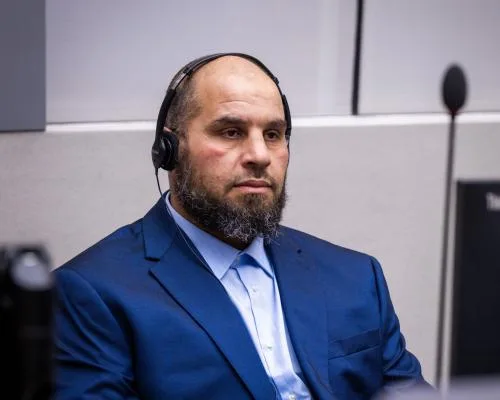
A former Libyan militia commander, Khaled Mohamed Ali El Hishri, is set to appear at the International Criminal Court (ICC) on Tuesday for a hearing that could mark a crucial step towards justice for refugees who have suffered abuses in Libya, as it's the first prosecution to reach a courtroom. El Hishri, who was arrested in Germany last year, is accused of war crimes and crimes against humanity, including murder, rape, enslavement, and torture, during his time as a senior officer in the Special Deterrence Force, a powerful armed group that ran detention sites in western Libya. He's alleged to have committed these crimes between 2014 and at least 2020.
The Special Deterrence Force, which is allied to the internationally recognized Government of National Accord (GNA) in Tripoli, has been accused of imposing brutal regimes at detention sites, including the Mitiga prison in Tripoli, where El Hishri is alleged to have committed the crimes. The conditions at the prison are harsh, and El Hishri's alleged crimes didn't go unnoticed.
The ICC's investigation into crimes in Libya has been ongoing for over 15 years, and it's taken a long time to get to this point. El Hishri's prosecution is the first to reach a courtroom, and the hearing will determine whether there's sufficient evidence to proceed with a trial. The ICC won't tolerate abuses, and it's taking steps to hold perpetrators accountable.
Now that El Hishri is in front of the court, it sends a strong message to perpetrators wherever they are that they'll be brought to account and justice will be delivered, even if it takes a long time, said David Yambio, a survivor of abuse in Libya who accuses El Hishri of beating him. Yambio didn't mince words, and he's calling for justice.
El Hishri's alleged crimes took place during a time when thousands of detainees were held in overcrowded and unhygienic cells at the Mitiga prison. Human Rights Watch (HRW) has described the conditions at the prison as harrowing, with detainees being systematically subjected to violent assaults, including being shot, confined in small metal boxes, and beaten with cables. It's a dire situation, and the detainees didn't deserve to be treated this way.
The ICC's chief prosecutor will present evidence that there are reasonable grounds to believe El Hishri personally killed one detainee, while a significant number of people died during his time at the prison due to torture, being left outside in winter, untreated injuries, or starvation. The evidence won't be easy to hear, but it's necessary to bring El Hishri to justice.
El Hishri's defense lawyers are expected to challenge the ICC's jurisdiction and have called for his release. However, campaigners say that the case against El Hishri is a crucial step towards holding perpetrators of abuses in Libya accountable. They won't back down, and they're pushing for justice.
The case has also highlighted the role of European countries in supporting the Libyan coastguard, which has been accused of intercepting refugees and migrants and returning them to detention centers in Libya, where they face abuse and exploitation. It's a complicated issue, and European countries can't ignore it.
- Khaled Mohamed Ali El Hishri is a 47-year-old former militia commander accused of war crimes and crimes against humanity.
- He was arrested in Germany last year and is set to appear at the ICC on Tuesday.
- The ICC's investigation into crimes in Libya has been ongoing for over 15 years.
- El Hishri's prosecution is the first to reach a courtroom from the ICC's Libya investigation.
- Thousands of detainees were held in overcrowded and unhygienic cells at the Mitiga prison in Tripoli.
The ICC's ability to prosecute El Hishri has been welcomed by campaigners, who say that it marks a crucial step towards justice for refugees who have suffered abuses in Libya. However, the case has also highlighted the challenges faced by the ICC in holding perpetrators of abuses accountable, particularly in cases where they are supported by powerful armed groups or governments. It's not an easy task, but the ICC is up for the challenge.
As the hearing gets underway, attention will be focused on the ICC's ability to deliver justice for the victims of El Hishri's alleged crimes, and to hold perpetrators of abuses in Libya accountable for their actions. The ICC won't tolerate abuses, and it's taking steps to hold perpetrators accountable. The hearing is a crucial step towards justice, and it's been a long time coming.
The ICC's chief prosecutor has said that the case against El Hishri is a crucial step towards holding perpetrators of abuses in Libya accountable, and that it marks a significant milestone in the ICC's investigation into crimes in Libya. The prosecutor is confident that the ICC can deliver justice, and they're working hard to make it happen.
The case has also sparked calls for European countries to end their support for the Libyan coastguard, which has been accused of intercepting refugees and migrants and returning them to detention centers in Libya, where they face abuse and exploitation. It's a serious issue, and European countries can't ignore it. They're being called upon to take action, and they can't afford to wait.
In a statement, David Yambio called for an end to European programmes that support the Libyan militias, saying The EU is complicit in these crimes. Yambio didn't mince words, and he's calling for action. The EU can't ignore the situation, and they need to take responsibility for their actions.
The ICC's investigation into crimes in Libya has been ongoing for over 15 years, and El Hishri's prosecution is the first to reach a courtroom. The hearing will determine whether there's sufficient evidence to proceed with a trial. It's a crucial step towards justice, and it's been a long time coming. The ICC won't give up, and they're pushing for justice.
The case against El Hishri has been welcomed by campaigners, who say that it marks a crucial step towards justice for refugees who have suffered abuses in Libya. However, the case has also highlighted the challenges faced by the ICC in holding perpetrators of abuses accountable, particularly in cases where they are supported by powerful armed groups or governments. It's not an easy task, but the ICC is up for the challenge. They're working hard to deliver justice, and they won't back down.
The ICC's ability to prosecute El Hishri has been welcomed by campaigners, who say that it marks a crucial step towards justice for refugees who have suffered abuses in Libya. As the hearing gets underway, attention will be focused on the ICC's ability to deliver justice for the victims of El Hishri's alleged crimes, and to hold perpetrators of abuses in Libya accountable for their actions. The ICC is taking a crucial step towards justice, and it's been a long time coming. They're confident that they can deliver justice, and they're working hard to make it happen.
The case has also sparked calls for European countries to end their support for the Libyan coastguard, which has been accused of intercepting refugees and migrants and returning them to detention centers in Libya, where they face abuse and exploitation. It's a serious issue, and European countries can't ignore it. They're being called upon to take action, and they can't afford to wait. The ICC is pushing for justice, and they won't back down.