

The Rediscovery of Ancient Rock Art in Wales
Archaeologists have made a groundbreaking discovery in south Wales, uncovering 17,100-year-old rock art in the Bacon Hole cave. The red pigment rock art, previously dismissed as a natural phenomenon in 1928, has been reclassified as the oldest example of cave art in Britain and north-western Europe.
Archaeologists uncover 17,100-year-old rock art in the Bacon Hole cave.
The discovery was made by a team led by Dr. George Nash, a British specialist in prehistoric art. The original rock art was discovered in 1912 by professors William Sollas and Henri Breuil, who hailed it as 'the first specimen of prehistoric cave painting ever discovered in England'. However, the full extent of the imagery was not understood due to a layer of graffiti painted by a local fisherman in 1894, which covered part of the cave.
The rock art was initially discovered in 1912 by professors William Sollas and Henri Breuil. They described the discovery as 'the first specimen of prehistoric cave painting ever discovered in England'. Unfortunately, the full extent of the imagery was obscured by a layer of graffiti painted by a local fisherman in 1894.
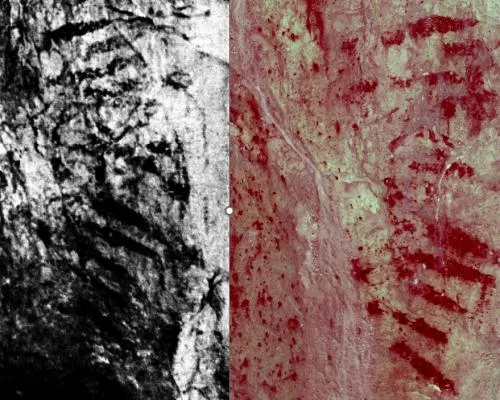
The paint was applied using fingers, as analysis of pigment samples revealed a mixture of calcite, consistent with the limestone geology of the region, and clay residues within a pigment recipe. Based on field observations and laboratory examination of the pigment samples, the team concluded that the pigmented lines were intentionally created by human agency, rather than resulting from natural processes. They added: 'Based on the evidence, we concur with the original interpretation proposed by Breuil and Sollas in 1912… The painted lines are arranged horizontally and are equidistant from one another, indicating a deliberate and structured pattern.'
The team concluded that the pigmented lines were intentionally created by human agency. The lines are arranged horizontally and equidistant from one another, indicating a deliberate and structured pattern.
The researchers, led by Dr. George Nash, used uranium-thorium dating to verify the age of the rock art. 'This is the earliest prehistoric art we have in Britain', Dr. Nash said. 'We've got data 17,100 years before present, which makes it the oldest rock art in the British Isles. I was taken aback that we were able to date it and analyse the pigments. This is an exciting rediscovery, significant in understanding what was going on in Wales in the deep past.'
The uranium-thorium dating confirms that the rock art is 17,100 years old. Dr. Nash believes this is the earliest prehistoric art in Britain, and the oldest rock art in the British Isles.
But what about the significance of this discovery? The researchers believe that, about 17,100 years ago, Wales was emerging from a severe cold phase of the Devensian glaciation. The area now occupied by the Bristol Channel, where the cave lies, served as a catchment for migratory megafauna grazing during the summer months. Bacon Hole and other caves would have offered suitable habitation sites for hunter-fisher-gatherer groups.
Wales was emerging from a severe cold phase of the Devensian glaciation about 17,100 years ago. The area now occupied by the Bristol Channel served as a catchment for migratory megafauna grazing during the summer months. Bacon Hole and other caves would have offered suitable habitation sites for hunter-fisher-gatherer groups.
Although the cave is not protected as a 'scheduled monument', the team argues that it should now be. The National Trust of Wales, who manage the cave, will officially announce the research this week.
Dr. George Nash believes the cave should be protected as a 'scheduled monument'. The National Trust of Wales will officially announce the research this week.
'This is the earliest prehistoric art we have in Britain. We've got data 17,100 years before present, which makes it the oldest rock art in the British Isles.' – Dr. George Nash
The team's research was published in the journal Quaternary, with the lead authors including Dr. Nash, along with colleagues from the universities of Southampton and Swansea. Support for the project came from the National Trust and the Bradshaw Foundation.
The team's research was published in the journal Quaternary. The lead authors include Dr. Nash, along with colleagues from the universities of Southampton and Swansea. The project received support from the National Trust and the Bradshaw Foundation.
In an area of outstanding natural beauty, the rediscovery of this ancient rock art offers a unique glimpse into the lives of our ancestors. Although it may be old news to those familiar with the history of prehistoric art, this discovery is a testament to the enduring significance of our cultural heritage.
The rediscovery of ancient rock art in an area of outstanding natural beauty offers a unique glimpse into the lives of our ancestors. This discovery is a testament to the enduring significance of our cultural heritage.