

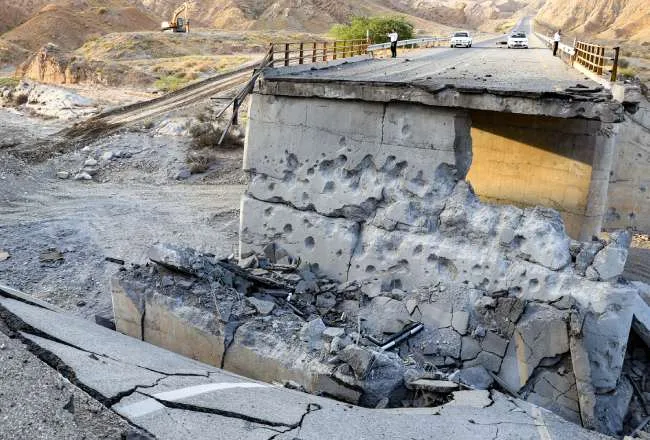
Iran's Supreme Leader Mojtaba Khamenei vowed to teach the United States 'unforgettable lessons' on Saturday, as Washington reported its first military deaths since renewing its hostilities with the Islamic republic. Heavily-damaged bridge which was hit by a US strike is pictured along the road connecting Roudan and Bandar Abbas in southern Iran on July 18, 2026. Photo by AMIR HOSSEIN KHORGOOEI/AFP
The conflict escalated after Iran struck infrastructure around the Gulf in retaliation for a week of intensifying US attacks, which Iran said had hit an airport, a railway station, and bridges. Tehran also launched fresh strikes in Jordan, where the US military's Central Command said two service members were killed Friday as they 'defended against Iranian ballistic missile and drone attacks.'
Iran's Supreme Leader Mojtaba Khamenei said the ongoing attacks on his country 'once again demonstrated to everyone the worthlessness of the American president's signature'. He warned that the US should know that the 'dear Iranian nation and the axis of resistance have unforgettable lessons to offer it.'
Iran's energy ministry has urged citizens to reduce electricity use and switch off air conditioners in peak hours after the power grid was hit. The health ministry said Friday that 50 people had been killed since the renewed fighting broke out and more than 500 injured. Kuwait accused Tehran of targeting civilian sites and vital infrastructure, with residents voicing fears that the renewed hostilities might drag on.
In a statement carried by state TV, Iranian supreme leader Mojtaba Khamenei said: 'Now that the American enemy seeks to incite war and bear its most serious consequences, it should know that the dear Iranian nation and the axis of resistance have unforgettable lessons to offer it.'
Major General Mohsen Rezaei, a senior military adviser to Khamenei, warned that Tehran would resume 'full-scale offensive operations' if US strikes continued in the coming days. 'Iran will no longer limit itself to retaliatory, like-for-like responses,' Mohsen said, according to state media.
Kuwait accused Tehran of targeting civilian sites and vital infrastructure, with residents voicing fears that the renewed hostilities might drag on. A heavily-damaged bridge which was hit by a US strike is pictured along the road connecting Roudan and Bandar Abbas in southern Iran on July 18, 2026. Photo by AMIR HOSSEIN KHORGOOEI/AFP
Vehicles wait in traffic near a heavily-damaged bridge that was hit by a US strike along the road connecting Roudan and Bandar Abbas in southern Iran on July 18, 2026. Photo by AMIR HOSSEIN KHORGOOEI/AFP
Iran's energy ministry has urged citizens to reduce electricity use and switch off air conditioners in peak hours after the power grid was hit. The health ministry said Friday that 50 people had been killed since the renewed fighting broke out and more than 500 injured.
Iran also said the supply of drinking water to several villages in the south had been cut off, accusing the US of striking power facilities and desalination plants in the village of Bonji, according to Tasnim.
Major General Mohsen Rezaei, a senior military adviser to Khamenei, warned that Tehran would resume 'full-scale offensive operations' if US strikes continued in the coming days. 'Iran will no longer limit itself to retaliatory, like-for-like responses,' Mohsen said, according to state media.
In a statement carried by state TV, Iranian supreme leader Mojtaba Khamenei said: 'Now that the American enemy seeks to incite war and bear its most serious consequences, it should know that the dear Iranian nation and the axis of resistance have unforgettable lessons to offer it.'
Iranian state news agency IRNA reported Saturday that US attacks killed three people and wounded eight in the southern province of Hormozgan. In Khuzestan province, the deputy provincial governor said eight people had been killed over the past 10 days, according to Iran's Tasnim news agency.