

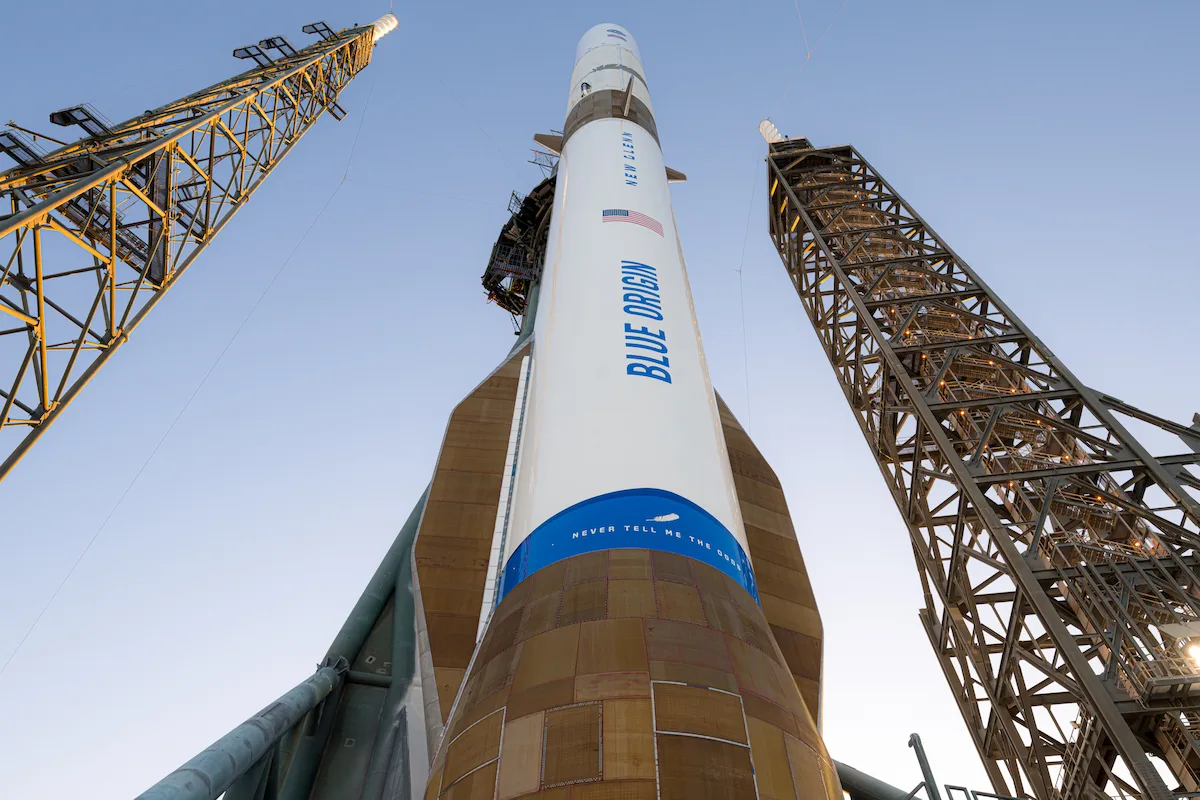
The Federal Aviation Administration has cleared Blue Origin's New Glenn mega-rocket to fly again after it failed to deliver a commercial payload during an April launch. This decision comes after Blue Origin submitted a report to the FAA and took corrective measures, though the company didn't detail what those measures were, and it's unclear what specific steps they took to address the issue.
Blue Origin's New Glenn upper stage experienced an off-nominal thermal condition during the April launch, causing one of the three rocket engines to produce lower-than-expected thrust. As a result, the AST SpaceMobile satellite that Blue Origin was supposed to put into orbit instead burned up in Earth's atmosphere. AST SpaceMobile had insurance coverage that covered the cost of the lost satellite, which won't leave the company with a significant financial burden.
The New Glenn rocket is a crucial part of Blue Origin's plans to launch commercial satellites and even humans into space. It's a massive rocket, with a height of over 300 feet. The rocket has a payload capacity of over 45,000 kilograms, making it a valuable asset for the company. The rocket is powered by seven BE-4 engines, which are also being developed by Blue Origin, and they're a key component of the rocket's design.
Jeff Bezos, the founder of Blue Origin, has been investing heavily in the company's spaceflight program. He's a well-known entrepreneur who made his fortune with Amazon. He's been using some of that wealth to fund Blue Origin's ambitious plans, and he's committed to making the company a success. Bezos has said that he wants Blue Origin to play a major role in the development of space technology, and the New Glenn rocket is a key part of those plans, as it will enable the company to launch a wide range of payloads.
The failure of the April launch was a setback for Blue Origin, but the company has been working hard to identify the cause of the problem and fix it. The company didn't announce what the problem was, but it's been working to resolve the issue. The FAA's clearance to fly again is a major step forward for the company. It paves the way for future launches, and it's a significant milestone for Blue Origin. Blue Origin hasn't announced a date for the next launch, but it's likely to happen soon, as the company is eager to get back to launching payloads.
The New Glenn rocket is an important part of the growing commercial space industry. More and more companies are launching satellites and other spacecraft into orbit. They need reliable rockets to do it, and Blue Origin is competing with other companies like SpaceX and United Launch Alliance to provide those rockets. The New Glenn is a major part of its offering, and it's a key differentiator for the company.
The loss of the AST SpaceMobile satellite was a significant setback for the company. It had insurance coverage to mitigate the loss, which helped to minimize the financial impact. The satellite was supposed to provide mobile broadband services, and its loss will be felt by the companies that were relying on it. However, the failure of the launch also highlights the risks involved in spaceflight. There's a need for companies like Blue Origin to have robust testing and safety protocols in place, as they can't afford to make mistakes.
We're committed to getting it right, and we're working hard to make sure that our next launch is a success, said a Blue Origin spokesperson, though the company didn't provide further details on what went wrong or how it's been fixed. The spokesperson didn't elaborate on the company's plans, but it's clear that they're focused on making the next launch a success.
The New Glenn rocket is a complex system, and it requires a lot of testing and validation before it can be certified for flight. Blue Origin has been working with the FAA to make sure that the rocket meets all the necessary safety standards. The company has been conducting a series of tests to validate its performance, and it's been working to ensure that the rocket is safe to fly.
The clearance to fly again is a major milestone for Blue Origin, and it paves the way for the company to start launching commercial satellites and other spacecraft. It's an exciting time for the space industry, and companies like Blue Origin are at the forefront of the action, driving innovation and pushing the boundaries of what's possible.
Key Facts
- The New Glenn rocket is over 300 feet tall
- It has a payload capacity of over 45,000 kilograms
- The rocket is powered by seven BE-4 engines
- The April launch failure was caused by an off-nominal thermal condition
- The AST SpaceMobile satellite was lost in the failed launch
The future of spaceflight is looking bright, and companies like Blue Origin are leading the charge. With the New Glenn rocket cleared to fly again, the company is one step closer to achieving its ambitious goals. It's an exciting time for the space industry, and we can't wait to see what's next, as there are many possibilities and opportunities for growth and innovation. Blue Origin won't stop here, and it will continue to push the boundaries of space technology, making new discoveries and achieving great things.