

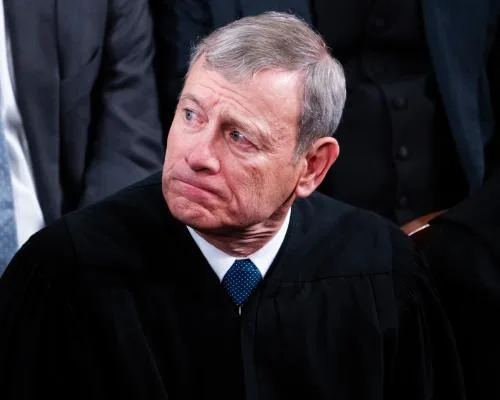
The US Supreme Court has been at the center of controversy in recent weeks, with its decision to undermine the Voting Rights Act sparking outrage and accusations of political bias. Chief Justice John Roberts has come to the defense of the court, insisting that its judges are not 'political actors' and that their decisions are based on the law, not personal opinions. Roberts made these comments at a conference for judges and lawyers in Hershey, Pennsylvania, where he acknowledged that some of the court's decisions may spark controversy, but emphasized that they are necessary to uphold the law.
The Voting Rights Act decision has been particularly contentious, with many critics arguing that it will lead to the disenfranchisement of minority voters and undermine the democratic process. The court's ruling has greenlit a scramble by Republican-led states to enact new congressional maps that will break up districts drawn to elect Black lawmakers, who tend to be Democrats. This could have significant implications for the balance of power in the US House of Representatives and could amount to a major blow to the Democratic Party's long-term chances of controlling the chamber.
The Supreme Court has been a key player in shaping the US political landscape in recent years, with its decisions having far-reaching consequences for the country. The court's conservative majority, which has been in place since 2020, has handed down several decisions that have benefited Donald Trump and his allies, including the expansion of the 'shadow docket' process, which allows the court to temporarily pause lower court rulings against the Trump administration. The court has also overturned landmark rulings, such as the constitutional right to abortion, and has given presidents some immunity for official acts.
The tensions between the conservative and liberal justices on the court have been palpable, with Justice Ketanji Brown Jackson, a liberal justice appointed by Joe Biden, dissenting from the court's decision to allow Louisiana to begin redrawing its congressional maps. Jackson's dissent was rebuked by Justice Samuel Alito, a conservative justice, who described her arguments as 'trivial at best, and … baseless and insulting'. The exchange highlights the deep divisions within the court and the intense scrutiny that its decisions are under.
Key Facts
- The US Supreme Court has undermined the Voting Rights Act, sparking controversy and accusations of political bias.
- Chief Justice John Roberts has defended the court, insisting that its judges are not 'political actors'.
- The court's decision has greenlit a scramble by Republican-led states to enact new congressional maps that will break up districts drawn to elect Black lawmakers.
- The Voting Rights Act was enacted in 1965 to protect the voting rights of minority citizens.
- The Supreme Court has a conservative majority, which has been in place since 2020.
- The court has handed down several decisions that have benefited Donald Trump and his allies.
- Justice Ketanji Brown Jackson, a liberal justice, dissented from the court's decision to allow Louisiana to begin redrawing its congressional maps.
- Justice Samuel Alito, a conservative justice, rebuked Jackson's dissent, describing her arguments as 'trivial at best, and … baseless and insulting'.
The Supreme Court's Recent Decisions
The Supreme Court has been making headlines in recent years with its decisions, which have had far-reaching consequences for the country. The court's conservative majority has been instrumental in shaping the US political landscape, with its decisions often benefiting Donald Trump and his allies. One of the most significant decisions was the overturning of the constitutional right to abortion, which has had a profound impact on women's rights and reproductive health. The court has also expanded the use of the 'shadow docket' process, which allows it to temporarily pause lower court rulings against the Trump administration.
The 'shadow docket' process has been criticized for being opaque and allowing the court to make decisions without fully considering the implications. The process has been used to pause lower court rulings on issues such as immigration and environmental protection, which has had significant consequences for the country. The court's use of the 'shadow docket' has also raised concerns about the erosion of the rule of law and the undermining of the democratic process.
The Supreme Court's decisions have not been without controversy, with many critics arguing that they are politically motivated and undermine the integrity of the court. The court's conservative majority has been accused of being biased towards Donald Trump and his allies, with its decisions often benefiting the Republican Party. The tensions between the conservative and liberal justices on the court have been palpable, with many critics arguing that the court is no longer a neutral arbiter of the law.
The Voting Rights Act
The Voting Rights Act was enacted in 1965 to protect the voting rights of minority citizens. The act was a landmark piece of legislation that aimed to prevent racial discrimination in voting and ensure that all citizens had an equal opportunity to participate in the democratic process. The act has been amended several times since its enactment, with the most significant amendments being made in 1982 and 2006.
The Voting Rights Act has been instrumental in protecting the voting rights of minority citizens, particularly in the Southern states where racial discrimination was prevalent. The act has also been used to challenge discriminatory voting practices, such as gerrymandering and voter ID laws, which have been used to disenfranchise minority voters. The Supreme Court's decision to undermine the Voting Rights Act has sparked controversy and raised concerns about the erosion of voting rights.
The Voting Rights Act is a critical piece of legislation that has helped to ensure that all citizens have an equal opportunity to participate in the democratic process. The act has been instrumental in protecting the voting rights of minority citizens and has helped to prevent racial discrimination in voting. The Supreme Court's decision to undermine the act has significant implications for the balance of power in the US House of Representatives and could amount to a major blow to the Democratic Party's long-term chances of controlling the chamber.
The Implications of the Supreme Court's Decision
The Supreme Court's decision to undermine the Voting Rights Act has significant implications for the balance of power in the US House of Representatives. The decision has greenlit a scramble by Republican-led states to enact new congressional maps that will break up districts drawn to elect Black lawmakers, who tend to be Democrats. This could have significant consequences for the Democratic Party's long-term chances of controlling the chamber and could undermine the democratic process.
The decision has also raised concerns about the erosion of voting rights and the disenfranchisement of minority voters. The Voting Rights Act was enacted to protect the voting rights of minority citizens, and the Supreme Court's decision to undermine it has sparked controversy and accusations of political bias. The decision has significant implications for the country and could have far-reaching consequences for the democratic process.
The Supreme Court's decision has also highlighted the deep divisions within the court and the intense scrutiny that its decisions are under. The exchange between Justice Ketanji Brown Jackson and Justice Samuel Alito has highlighted the tensions between the conservative and liberal justices on the court. The decision has also raised concerns about the integrity of the court and the erosion of the rule of law.
The Role of the Supreme Court
The Supreme Court plays a critical role in shaping the US political landscape, with its decisions having far-reaching consequences for the country. The court is the highest court in the land and has the final say on matters of law and the Constitution. The court's decisions are binding and have significant implications for the country.
The Supreme Court's role is to interpret the law and ensure that it is applied fairly and equally to all citizens. The court's decisions are based on its interpretation of the Constitution and the law, and it is not supposed to be influenced by personal opinions or political bias. However, the court's conservative majority has been accused of being biased towards Donald Trump and his allies, with its decisions often benefiting the Republican Party.
The Supreme Court is not a political body, and its decisions should be based on the law, not personal opinions or political bias. The court's role is to interpret the law and ensure that it is applied fairly and equally to all citizens. The court's decisions have significant implications for the country, and it is critical that they are made with the utmost care and consideration.
The Future of the Supreme Court
The future of the Supreme Court is uncertain, with many critics arguing that it is no longer a neutral arbiter of the law. The court's conservative majority has been accused of being biased towards Donald Trump and his allies, with its decisions often benefiting the Republican Party. The tensions between the conservative and liberal justices on the court have been palpable, with many critics arguing that the court is no longer a neutral institution.
The Supreme Court's decision to undermine the Voting Rights Act has sparked controversy and raised concerns about the erosion of voting rights. The decision has significant implications for the balance of power in the US House of Representatives and could amount to a major blow to the Democratic Party's long-term chances of controlling the chamber. The decision has also highlighted the deep divisions within the court and the intense scrutiny that its decisions are under.
The future of the Supreme Court will depend on the actions of its justices and the ability of the court to regain the trust of the American people. The court's decisions have significant implications for the country, and it is critical that they are made with the utmost care and consideration. The court's role is to interpret the law and ensure that it is applied fairly and equally to all citizens, and it is critical that it remains a neutral arbiter of the law.
Conclusion
The US Supreme Court's decision to undermine the Voting Rights Act has sparked controversy and raised concerns about the erosion of voting rights. The decision has significant implications for the balance of power in the US House of Representatives and could amount to a major blow to the Democratic Party's long-term chances of controlling the chamber. The decision has also highlighted the deep divisions within the court and the intense scrutiny that its decisions are under.
The Supreme Court plays a critical role in shaping the US political landscape, with its decisions having far-reaching consequences for the country. The court's role is to interpret the law and ensure that it is applied fairly and equally to all citizens. The court's decisions are binding and have significant implications for the country.
The future of the Supreme Court is uncertain, with many critics arguing that it is no longer a neutral arbiter of the law. The court's conservative majority has been accused of being biased towards Donald Trump and his allies, with its decisions often benefiting the Republican Party. The tensions between the conservative and liberal justices on the court have been palpable, with many critics arguing that the court is no longer a neutral institution.