

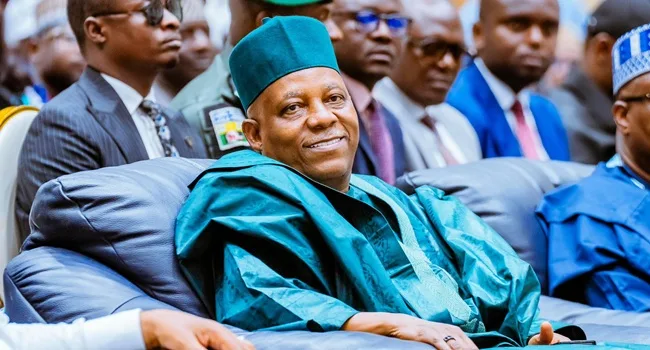
Today, Vice President Kashim Shettima formally submitted President Bola Tinubu's expression of interest and nomination forms for the 2027 presidential election. This move is a critical step in Tinubu's journey towards potentially securing another term in office. Shettima, in his remarks, praised Tinubu's economic stewardship, suggesting that the president has demonstrated his ability to handle the country's economic challenges. The economic landscape of Nigeria has been a subject of concern for many, with issues like inflation and unemployment posing significant challenges. Tinubu's administration has been working to address these issues, with various policies aimed at stimulating economic growth and reducing poverty.
The submission of the nomination forms by Shettima on behalf of Tinubu underscores the strategic partnership between the two leaders. Their collaboration has been seen as a key factor in the administration's efforts to tackle Nigeria's complex problems. Shettima's defense of Tinubu's economic decisions highlights the confidence the administration has in its policies. However, not everyone shares the same level of optimism about the government's economic strategies. Critics argue that more needs to be done to address the pressing issues facing the average Nigerian.
Despite these criticisms, Tinubu's team remains committed to their economic agenda, believing it will yield positive results in the long term.
Nigeria's economic challenges are multifaceted, ranging from a significant reliance on oil exports to a large informal sector. The country has also been grappling with security issues, particularly in the north, which have hindered economic development in those regions. Tinubu's administration has been under pressure to deliver on its promises of economic growth and job creation. The upcoming 2027 presidential election will likely be a referendum on the administration's performance, especially its handling of the economy. As the campaign season approaches, Nigerians will be watching closely to see how the different candidates propose to tackle the country's economic woes.
The political landscape in Nigeria is always dynamic, with alliances forming and shifting. The submission of Tinubu's nomination forms is a clear indication that he is serious about seeking re-election. His supporters point to his experience and the reforms he has initiated as reasons why he deserves another term. On the other hand, his opponents are gearing up to challenge him, citing unfulfilled promises and the need for change. The election is expected to be highly contested, with various candidates from different political parties vying for the top seat.
Key Facts
- Vice President Kashim Shettima submitted President Bola Tinubu's expression of interest and nomination forms for the 2027 presidential election.
- The submission took place on 2026-05-08.
- Tinubu's administration has been working to address Nigeria's economic challenges, including inflation and unemployment.
- Critics argue that the government's economic strategies have not done enough to address the pressing issues facing the average Nigerian.
- The 2027 presidential election is expected to be highly contested, with various candidates challenging Tinubu.
Economic Context
Nigeria's economy has been through several challenges in recent years, including a recession and significant fluctuations in the price of oil, its main export. The country has been trying to diversify its economy, with a focus on agriculture and manufacturing. However, these efforts are still in their early stages, and the economy remains heavily reliant on oil. The administration's economic policies have been designed to stimulate growth and reduce poverty, but their implementation has been slow. There's a general consensus that more needs to be done to create jobs and improve living standards for Nigerians.
The economic decisions made by Tinubu's administration have been under scrutiny. While some praise the efforts to reform the economy, others criticize the pace of change. The government has introduced several initiatives aimed at supporting small businesses and entrepreneurs, seen as crucial for job creation. Yet, the impact of these initiatives is still being felt, and many are waiting to see tangible results. The upcoming election will provide an opportunity for Nigerians to assess the administration's economic performance and decide if they want to continue on the same path.
Nigeria's economic future is closely tied to its political stability. Investors are often deterred by political uncertainty, which can hinder economic growth. Therefore, the outcome of the 2027 presidential election will be watched closely, not just by Nigerians but also by the international community. A stable and predictable political environment is essential for attracting investment and promoting economic development. As the campaign heats up, candidates will need to articulate clear visions for Nigeria's economic future, including how they plan to address the country's deep-seated challenges.
Political Implications
The submission of Tinubu's nomination forms marks the beginning of what promises to be a lively and competitive election season. Political alliances are being formed, and campaign strategies are being developed. The election will not only be a test of Tinubu's popularity but also a referendum on his administration's performance. The opposition is likely to focus on the government's handling of the economy, among other issues, in their bid to unseat Tinubu.
Tinubu's decision to seek re-election is not surprising, given his experience and the reforms his administration has initiated. However, the road to victory will not be easy. He will face challenges from within his own party, as well as from opposition candidates. The political landscape in Nigeria is known for its unpredictability, and anything can happen between now and the election. As the campaigns begin, Nigerians will be treated to a flurry of promises and counter-promises, each candidate trying to outdo the others in their pledges to improve the country.
"The president has proved his mettle in navigating Nigeria's economic challenges," Shettima said, defending Tinubu's economic decisions. This statement reflects the confidence the administration has in its economic policies. However, not everyone agrees that the president's decisions have been beneficial for the country. The debate over the government's economic strategies will continue to be a central theme in the lead-up to the election.
Historical Perspective
Nigeria has a long history of political instability, which has hindered its economic development. The country has experienced periods of military rule, and its transition to democracy has been marked by challenges. Despite these challenges, Nigerians have consistently shown their commitment to democratic principles, participating in elections and demanding accountability from their leaders. The 2027 presidential election will be another test of Nigeria's democratic institutions and the resilience of its people.
The political history of Nigeria is complex, with various factors influencing the country's development. Colonial legacy, ethnic diversity, and economic conditions have all played roles in shaping the nation's political landscape. Understanding this history is crucial for grasping the current political dynamics and the challenges faced by the country. As Nigeria moves towards another election, it's essential to reflect on its past, learning from both the successes and the failures.
Nigeria's future is intricately linked with its ability to manage its diversity and address its economic challenges. The country has the potential to become a leading economic power in Africa, given its large population and natural resources. However, realizing this potential will require careful planning, strategic investment, and a commitment to good governance. The next presidential election will be a critical moment in Nigeria's journey towards achieving its aspirations.
International Perspective
The international community is watching Nigeria's political developments with interest. As the largest economy in Africa, Nigeria's stability and growth have implications for the continent. The country's economic policies and political decisions are scrutinized by investors, international organizations, and other nations. A stable and prosperous Nigeria is seen as essential for regional security and economic development.
Nigeria's relationships with other countries are multifaceted, involving trade, security, and diplomatic cooperation. The country is a member of various international organizations, including the African Union and the United Nations. Its participation in these organizations reflects its commitment to global cooperation and its desire to play a leadership role in African affairs. As Nigeria prepares for its presidential election, the international community will be observing the process closely, hoping for a peaceful and credible outcome.
The global economy is interconnected, and Nigeria's economic performance can have ripple effects beyond its borders. The country's large market and natural resources make it an attractive destination for foreign investment. However, investors are cautious and look for stability and predictability. The outcome of the 2027 presidential election will send a signal to the international community about Nigeria's commitment to democracy and its potential for economic growth.
Conclusion
The submission of President Bola Tinubu's nomination forms for the 2027 presidential election marks the beginning of an exciting and potentially transformative period in Nigerian politics. As the campaign season unfolds, Nigerians will have the opportunity to engage with the candidates, assess their policies, and decide the future direction of the country. The election will be a test of Nigeria's democratic institutions, the resilience of its people, and the viability of its economic strategies. Whatever the outcome, the 2027 presidential election will be a significant moment in Nigeria's history, shaping the country's trajectory for years to come.
The road to the 2027 presidential election will be long and challenging, with many twists and turns. Candidates will face numerous hurdles, from securing their party's nomination to convincing the electorate of their vision for Nigeria. The election will also be a moment of reckoning for the current administration, as Nigerians pass judgment on its performance. Regardless of who wins, the election must be seen as free, fair, and credible, to ensure that the outcome is accepted by all and that Nigeria can move forward in unity.
As Nigeria prepares for this critical election, the world watches with anticipation. The country's journey towards democracy and economic development is not without its challenges, but the resilience and determination of its people are undeniable. The 2027 presidential election will be a defining moment in this journey, a chance for Nigerians to shape their future and for the country to reaffirm its commitment to democratic values. It's a moment that will be filled with hope, uncertainty, and the promise of a better tomorrow.