

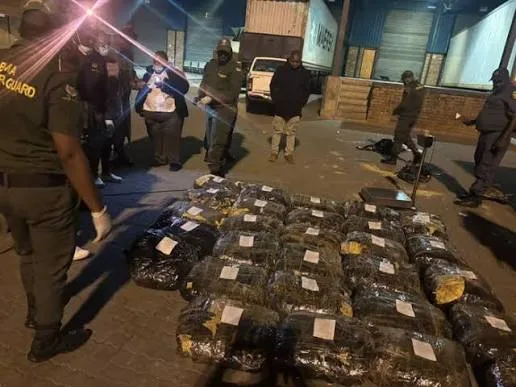
It isn't every day that a routine border check turns into the largest drug seizure in recent memory, but that's exactly what happened at the Beitbridge Port of Entry this Tuesday. What started as a standard scan for an incoming truck from Malawi transformed into an exhaustive eight-hour physical search that left officials stunned by the sheer volume of contraband they discovered.
Inside the vehicle, security teams found 713 kilograms of methaqualone—a precursor chemical used to manufacture Mandrax tablets. Known on the street as ABBA, this substance is a potent sedative-hypnotic that has fueled addiction battles across southern Africa for decades. The street value of this specific haul was calculated at R998.2 million, narrowly missing the billion-rand mark by a hair's breadth.
This interception proves that South Africa’s borders aren't a safe passage for organised criminal activities.
These were the words of Dr Michael Masiapato, the Commissioner of the Border Management Authority (BMA), who praised the vigilance of the guards involved. The operation relied heavily on non-intrusive cargo scanning technology, which flagged the initial anomalies that the naked eye might have missed. Once the alert was triggered, the manual search process became a grueling task for the officers on the ground.
Three suspects were taken into custody immediately following the discovery and are currently being held at the Musina Police Station. They face imminent court appearances to answer for their roles in what investigators suspect could be a massive transnational trafficking syndicate. The South African Police Service (SAPS) K-9 Unit and the Directorate for Priority Crime Investigation, widely known as the Hawks, have stepped in to handle the forensic work.
Beitbridge remains the busiest land crossing on the entire African continent, acting as a critical artery for regional trade. Because of its constant flow of goods and people, it has long been a magnet for smuggling networks trying to move everything from contraband cigarettes to prohibited chemicals. The BMA has been under immense pressure to modernise its infrastructure. This success demonstrates that new tech and intelligence-sharing between agencies are effective.
While the investigation digs deeper into the intended destination of the methaqualone, the focus remains on dismantling the supply chain behind this massive shipment. The sheer scale of this interception shows that the illegal drug trade has become lucrative and entrenched in our region. For those who live and travel through Harare and beyond, this seizure highlights the hidden dangers moving along the same highways used by daily traders and commuters.
Methaqualone isn't just a chemical; it's the raw fuel for an underground market that causes devastating social consequences in local communities. When these chemicals successfully bypass border controls, they're typically moved to clandestine laboratories where they're pressed into tablets and sold to users across the continent. By stopping this specific batch at the gate, authorities have prevented a significant amount of potential harm before it even entered the domestic pipeline.
The logistical challenge of moving 713 kilograms of powder across multiple borders suggests a high level of coordination among those behind the operation. These syndicates often use legitimate transport networks as a front to mask their activities. This makes the task for border guards even more difficult. The successful cooperation between the BMA, the Hawks, and the SAPS signals a change in how law enforcement agencies are coordinating to catch these groups mid-transit.