

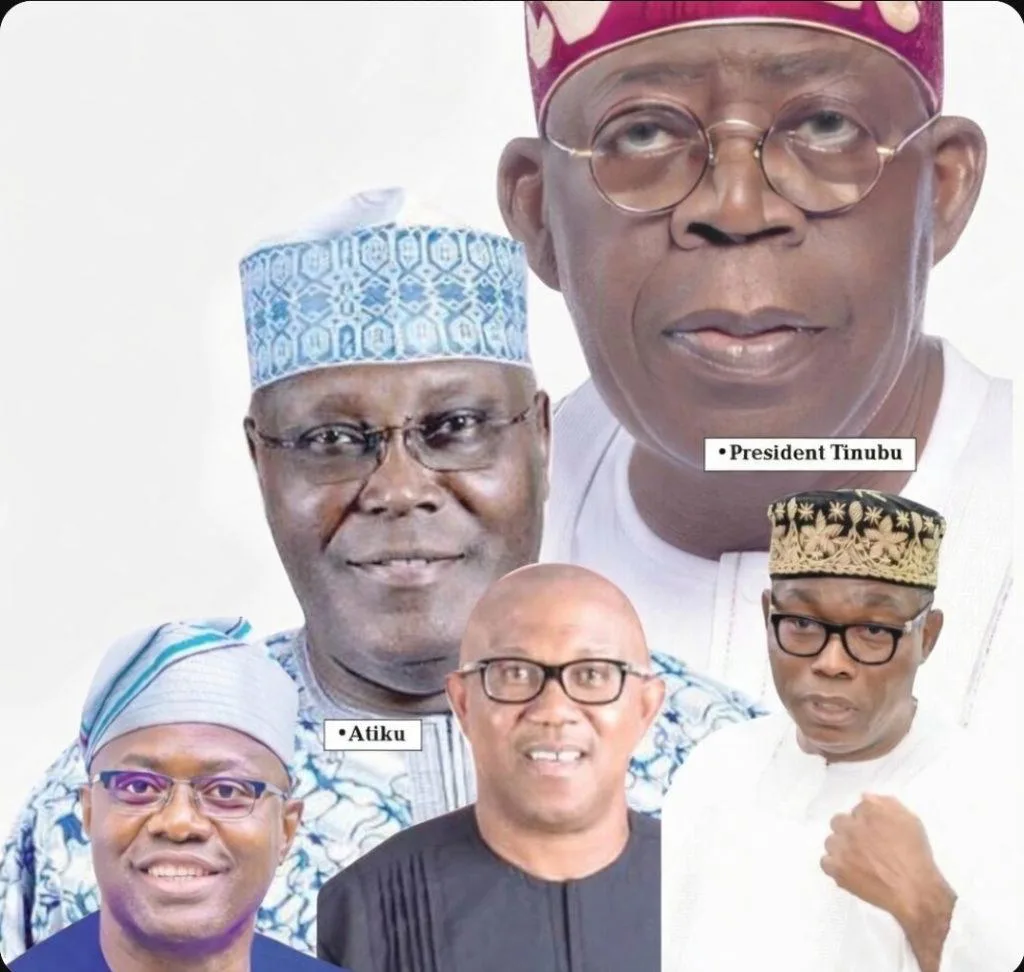
The race for the presidency is heating up as 12 aspirants, including Atiku Abubakar and Goodluck Jonathan, have expressed interest in replacing President Bola Tinubu. This comes exactly 237 days to the January 16, 2027 presidential polls. Unless the Independent National Electoral Commission (INEC) re-tools its timeline, the window for primaries, submission of party membership registers, and others may be extended to September.
Currently, only 13 aspirants, including President Tinubu, are in the presidential race, and none of them is a woman. The contenders include Atiku Abubakar of the African Democratic Congress (ADC), Mohammed Hayatu-Deen of the ADC, Rotimi Amaechi of the ADC, Bola Tinubu of the All Progressives Congress (APC), Osifo Stanley of the APC, Peter Agada of the Labour Party (LP), Samuel Nwaigwe of the LP, Peter Obi of the Nigeria Democratic Congress (NDC), Goodluck Jonathan of the Peoples Democratic Party (PDP), Seyi Makinde of the PDP/Allies People's Movement (APM), Sandy Onor of the PDP, Abimbola Atanda of the Social Democratic Party (SDP), and Adewole Adebayo of the SDP.
Atiku Abubakar, a former Vice President, has been a recurring figure in Nigeria's presidential politics. He's contested for the presidency six times since 1993 and appears set for a seventh attempt in 2027, which he says will be his last attempt. His political journey began in the transition years of the late 1980s under the late Shehu Musa Yar'Adua's political machine. Atiku first sought the presidency during the aborted Third Republic under the Social Democratic Party but stepped down for late Chief MKO Abiola after intervention from Yar'Adua.
He didn't stop there. Atiku's been a persistent presidential aspirant in Nigeria's democratic history. He was elected governor of Adamawa State in 1999 but was immediately picked as running mate to former President Olusegun Obasanjo. As vice president between 1999 and 2007, Atiku supervised Nigeria's privatization programme and built strong political networks across the country. However, his relationship with Obasanjo later collapsed over succession politics and the controversial third-term agenda.
That disagreement triggered Atiku's first major defection from the PDP to the Action Congress (AC) in 2006.
Former President Goodluck Jonathan has also returned to the centre of political calculations. He's in court to fight the eligibility rule, which his opponents are latching on to stop him. The Tanimu Turaki-led PDP has already granted him a waiver from screening and endorsed him as a presidential aspirant. Next week, May 26, a Federal High Court will rule on whether or not Jonathan is eligible based on the constitutional amendment that bars anyone sworn-in twice as president, vice president, governor, and deputy governor from contesting the same position.
The ruling APC insists President Tinubu remains its undisputed candidate for 2027, but it has to convince another aspirant, Osifo Stanley, who also bought a form to step down or accept consensus. The party has scheduled its presidential primaries in 8,809 wards of the country. At the moment, no fewer than 12 aspirants and potential contenders have openly indicated interest in the presidency across the PDP, ADC, NDC, LP, and SDP.
Among the prominent names in the race are former Vice President Atiku Abubakar, former President Goodluck Jonathan, former Rivers State Governor Rotimi Amaechi, former Anambra State Governor and 2023 LP Presidential Candidate Peter Obi, Oyo State Governor Seyi Makinde, SDP candidate in the 2023 election Adewole Adebayo, businessman Stanley Osifo, and a handful of technocrats and businessmen seeking to leverage the growing dissatisfaction with Nigeria's economic situation.
Political analysts say the emerging contest may eventually boil down to three major factors — coalition politics, regional calculations, and the ability of aspirants to build broad national alliances capable of matching the APC's structure and incumbency advantage. Atiku's long road to Aso Rock isn't without its challenges. His greatest challenge may not even be Tinubu but how to unite a fragmented opposition around a single candidacy.
The SDP has again presented Adewole Adebayo as its consensus presidential candidate while a rival faction chose Abimbola Atanda. Adebayo, who flew the party's flag in 2023, says Nigeria urgently needs an inclusive government focused on poverty reduction, industrial revival, and job creation. He's repeatedly warned against attempts to turn Nigeria into a one-party state and urged opposition parties to unite.
Beyond established political heavyweights like President Bola Tinubu, Atiku Abubakar, Peter Obi, and Rotimi Amaechi, a number of lesser-known politicians, technocrats, and businessmen are also positioning for the 2027 presidential race. Though many political analysts regard some of them as long shots, they insist they possess the ideas and leadership qualities needed to reposition Nigeria.
Among them are Stanley Osifo of the APC, Sandy Onor of the PDP, economist Mohammed Hayatu-Deen of the ADC, and Labour Party aspirants Peter Agada and Samuel Nwaigwe. Osifo challenges the APC establishment. The businessman has consistently argued that every qualified Nigerian has the constitutional right to contest for the presidency, irrespective of endorsements for incumbents.
The Labour Party has also attracted new presidential hopefuls ahead of its 2027 primaries. Among them is Abuja-based businessman and architect Peter Agada, who became the first aspirant to purchase the party's presidential nomination forms. Agada, a former Director of Finance of the Obedient Movement, says his ambition was driven by patriotism and the desire to restore Nigeria's global standing.
Under his 'Labour Direct' blueprint, he identified insecurity, unemployment, naira depreciation, infrastructure decay, and public distrust in governance as key national challenges. He proposed community-based intelligence systems backed by technology to tackle insecurity and promised industrial hubs across the geopolitical zones to create jobs through agro-processing and solid minerals development. 'Nigeria needs execution, not excuses,' Agada declared while unveiling his programme.
Another Labour Party aspirant, businessman and philanthropist Samuel Nwaigwe from Ebonyi State, has also entered the race after purchasing the party's nomination forms. Nwaigwe, Chief Executive Officer of Omni Group, is known for philanthropic activities and grassroots support initiatives in Ebonyi State and parts of the South-East.
Technocrat and banker Mohammed Hayatu-Deen is equally positioning within the ADC as a reform-minded candidate focused on economic restructuring and institutional reforms. Oyo State Governor Seyi Makinde, last week joined the race on the plank of an alliance between the PDP and Allies People's Movement (APM).
Makinde's growing national profile, financial strength, and southern support base have placed him among possible consensus figures if opposition parties pursue a fresh face strategy. That will depend on his pending Jonathan in the race for the Turaki-led PDP ticket and who eventually emerges as the authentic PDP when the dust settles.
The post-2027 presidential election is already heating up with various aspirants coming out to challenge President Tinubu. The election is expected to be one of the most competitive in Nigeria's history, with many aspirants hoping to unseat the incumbent president. The outcome of the election won't be known until it happens.
Key Facts
- 12 aspirants have expressed interest in the presidential election
- Atiku Abubakar has contested for the presidency six times since 1993
- Goodluck Jonathan is in court to fight the eligibility rule
- The APC has scheduled its presidential primaries in 8,809 wards of the country
- The SDP has presented Adewole Adebayo as its consensus presidential candidate
'Nigeria needs execution, not excuses,' Agada declared while unveiling his programme.
The 2027 presidential election is expected to be a defining moment in Nigeria's history. The aspirants are gearing up for the election, and the campaign is expected to be intense. The outcome of the election will determine the direction of the country for the next four years.
As the election approaches, Nigerians are eagerly waiting to see who will emerge as the next president. The aspirants are working hard to convince the electorate to vote for them. The election is expected to be free and fair, and the winner will be determined by the votes of the people.
The 2027 presidential election is an opportunity for Nigerians to choose their leader. The aspirants are presenting their programmes and policies to the electorate. The election is expected to be a turning point in Nigeria's history, and the outcome will determine the future of the country.
As the campaign heats up, the aspirants are engaging in debates and discussions. They're presenting their visions for the country and explaining how they plan to address the challenges facing Nigeria. The electorate is listening carefully, and they'll make their decision based on the programmes and policies presented by the aspirants.
The 2027 presidential election is a crucial moment in Nigeria's history. The outcome will determine the direction of the country for the next four years. The aspirants are working hard to convince the electorate to vote for them. The election is expected to be free and fair, and the winner will be determined by the votes of the people. The country's future is at stake, and Nigerians won't know what it holds until the election is over.