

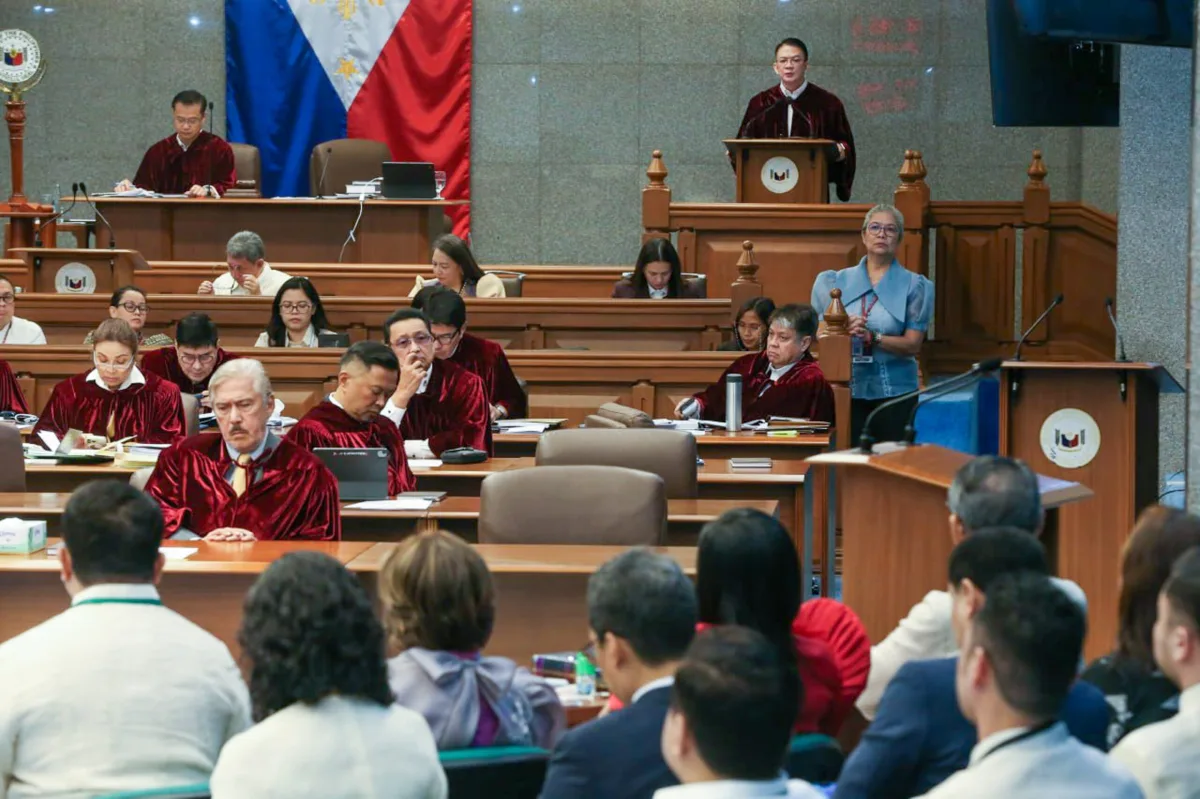
The impeachment trial of Vice President Sara Duterte kicked off on July 6, 2026, with a surprise move from presiding officer Chiz Escudero. He set the conviction threshold at 16 votes, citing a 2000 Supreme Court ruling, Bayan v Zamora, in which the court upheld the constitutionality of the Visiting Forces Agreement (VFA) between the Philippines and the United States.
In the Bayan v Zamora case, the Supreme Court emphasized the required two-thirds vote of all members of the Senate to enable the treaty. The ruling also cited Article VII, Section 21, which states that no treaty or international agreement shall be valid and effective unless concurred in by at least two-thirds of all the members of the Senate. The Senate, on May 27, 1999, concurred with then-president Joseph Estrada's ratification of the VFA by a two-thirds vote, with only 23 out of 24 senators present.
According to the ruling, the Senate 'shall be composed of 24 senators.' In determining a majority or a quorum, those disqualified by law because of suspension from office cannot be counted. Therefore, without a tinge of doubt, two-thirds of this figure, or not less than 16 members, favorably acting on the proposal is an unquestionable compliance with the requisite number of votes mentioned in Section 21 of Article VII.
This ruling was used by Escudero to justify his interpretation of the impeachment court conviction threshold. He noted that any party who disagrees may seek judicial relief and that the impeachment court's position is that one senator only loses his membership when they die, when they are removed by finality, or when they resign. Trial lead prosecutor Jinky Luistro, who previously suggested lowering the conviction threshold to 14, acknowledged after the trial day on June 6 that the topic is highly debatable.
Senators Rodante Marcoleta and Jinggoy Estrada are in jail over non-bailable plunder cases, while Senator Ronald 'Bato' dela Rosa is in hiding amid an active International Criminal Court warrant over his role in the Duterte bloody drug war. What the Constitution states is: 'No person shall be convicted without the concurrence of two-thirds of all the Members of the Senate.' The traditional view is that the phrase 'all members' refers to 24 senators, in accordance with Article VI, Section 2 of the charter.
'It behooves all of us to observe the same fidelity with the Constitution in this trial, which affects not only a mere ratification of a treaty, but more so affects the substantial rights of the respondent, and the sovereign will of the people.'
The senator-judge added that any party who disagrees may seek judicial relief and that the impeachment court's position is that one senator only loses his membership when they die, when they are removed by finality, or when they resign. This move has sparked debate among senators and legal experts, with some questioning the legitimacy of the conviction threshold.
Key Facts
- The Supreme Court ruled in 2000 that two-thirds of the 24 senators, or at least 16 favorable votes, suffice to render compliance with the strict constitutional mandate of giving concurrence to the subject treaty.
- Article VII, Section 21, states that no treaty or international agreement shall be valid and effective unless concurred in by at least two-thirds of all the members of the Senate.
- The Senate, on May 27, 1999, concurred with then-president Joseph Estrada's ratification of the VFA by a two-thirds vote, with only 23 out of 24 senators present.
- Senators Rodante Marcoleta and Jinggoy Estrada are in jail over non-bailable plunder cases, while Senator Ronald 'Bato' dela Rosa is in hiding amid an active International Criminal Court warrant.
- The impeachment court's position is that one senator only loses his membership when they die, when they are removed by finality, or when they resign.