

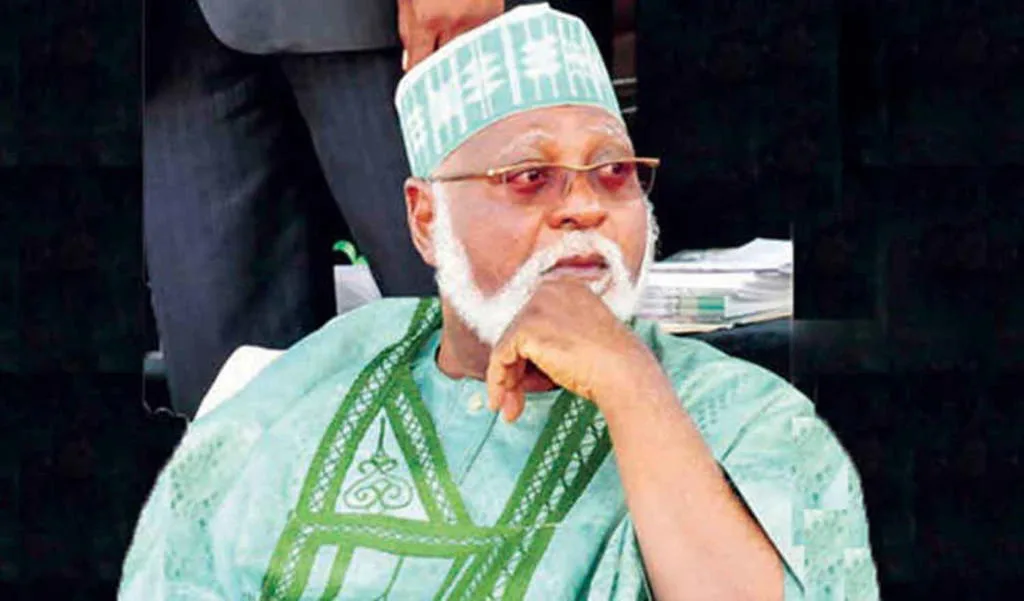
Former Head of State, General Abdulsalami Abubakar, has revealed why Emeka Odumegwu Ojukwu refused to recognise Yakubu Gowon as Nigeria's head of state after the 1966 coup — it was about military hierarchy.
In his autobiography "Call of Duty", presented on his 84th birthday in Abuja, Abubakar writes that after Major General Aguiyi Ironsi was killed by Northern military officers, Ojukwu insisted the next in command should have been Brigadier Babafemi Ogundipe, the Chief of Staff, Supreme Headquarters. Ojukwu refused to pledge loyalty to Gowon, who was a Lt. Colonel.
The book traces the tension back to the January 1966 coup led by Kaduna Nzeogwu, which saw prominent Northern leaders killed. Abubakar writes that there were "complaints about the reported hubris over the killing of the northern leaders" and that some Northern officers complained Igbos were being promoted above others.
"Quickly anti-Igbo sentiments exploded in the North, leading to protests against Aguiyi-Ironsi, mainly in Kano, Kaduna and Jos," Abubakar writes. "Riots broke out, and Igbos were targeted and killed, with their properties set on fire in places like Kano, Sokoto and Kaduna."
After Ironsi's murder, Gowon became head of state. But Ojukwu, then Governor of the Eastern Region, refused to recognise him. Tensions escalated. Communal killings continued in the North, Igbos were evacuated back East, and revenge killings also happened in the East.
On 30 May 1967, Ojukwu declared the Republic of Biafra, saying Igbos were being victimised and marginalised. All efforts to prevent secession failed — including the Aburi Accord, meetings, and economic sanctions. War began in 1967.
"To this day, I believe that the Civil War, like most other conflicts in life, could have been prevented," Abubakar writes. "I feel that rising tempers, anger, and the cycle of retaliation didn't leave room for understanding and reconciliation."
Abubakar says Nigeria was "lucky to survive the war" and that the country learned valuable lessons. "I want to hedge a bet that we would never go to war again," he writes.
The costliest mistake at Awka
Abubakar recalls what he calls the "costliest mistake" made by Nigerian troops after capturing Awka in present-day Anambra State. He says capturing Awka was one of the toughest battles they fought.
After capturing Onitsha in February 1968, Colonel Muhammed — their division commander — believed victory was certain. He lined up vehicles and ordered all troops and ammunition to move. It was a tactical error.
"We didn't know the Biafrans had other plans, attacking us with rocket fire and bombs," Abubakar writes. "Our vehicles caught fire. The tankers supplying us with fuel for our operational vehicles also exploded. It was a most terrifying scene. Many soldiers died. I was lucky to escape."
The ambush that nearly killed him
Abubakar also narrates how he nearly lost his life after a Biafran ambush. After capturing Awka, he was returning from briefing Colonel Femi Daramola, Commander of the 8th Brigade, when the attack happened. He doesn't give further details in the excerpt.
The autobiography was publicly presented on Abubakar's 84th birthday. He was Nigeria's military head of state from June 1998 to May 1999, overseeing the transition to civilian rule. He succeeded General Sani Abacha after his sudden death.