

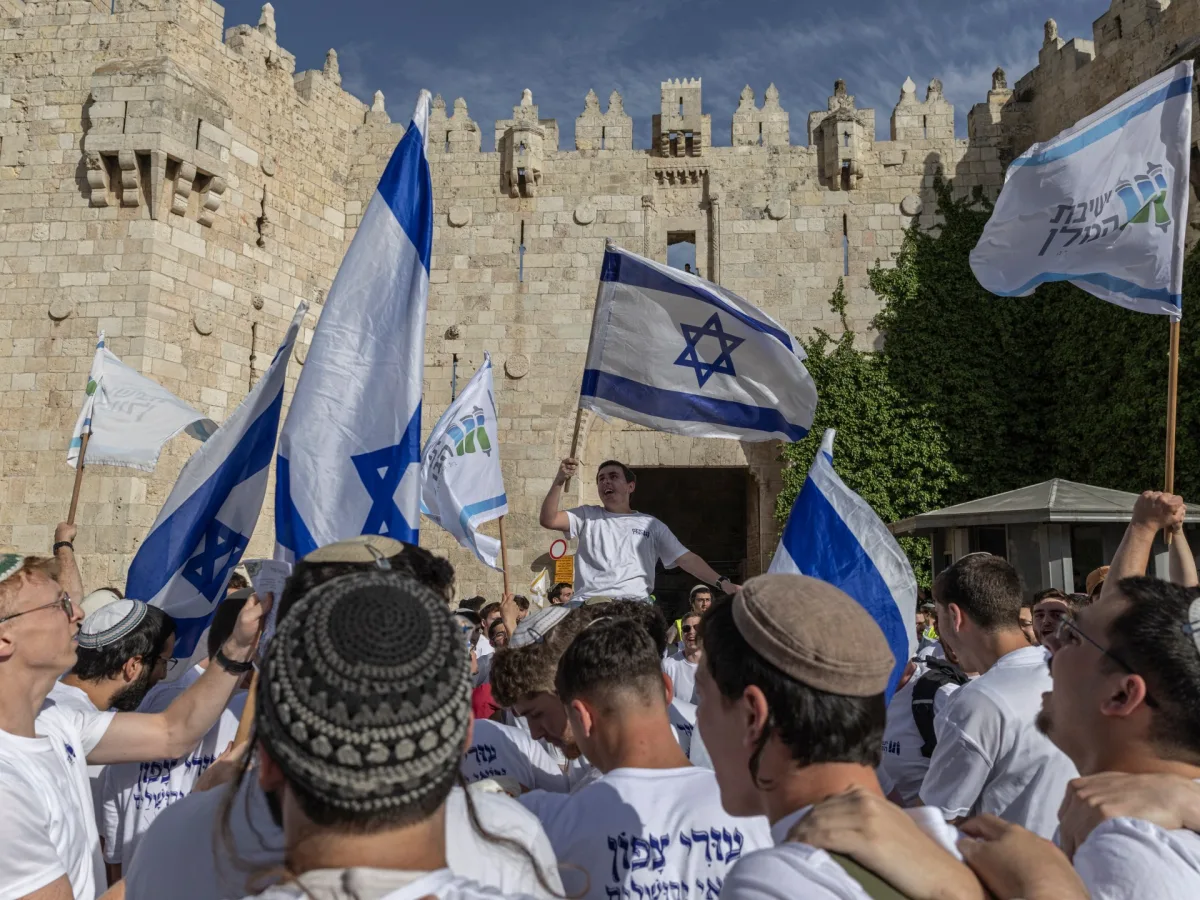
Tens of thousands of far-right Jewish marchers stormed East Jerusalem's Old City on Thursday, attacking Palestinians and leaving many injured. The march, known as the 'Flag March', was marked by anti-Palestinian slogans and violence, with many marchers chanting 'May your village burn' and 'Death to Arabs'. They didn't chant these slogans quietly, either - they were loud and clear, and they won't be forgotten.
The marchers, many of whom were young teenagers, vandalised property and attacked Palestinian shop owners, forcing them to close their businesses. The Israeli police, who were overseeing the event, didn't do much to prevent the attacks, and few Jewish Israelis have been punished for the crimes they committed. This lack of action won't help to reduce tensions between the two communities.
Uri Weltmann, the national field director for Standing Together, an organisation of Jewish and Palestinian peace activists, said that the violence and anti-Palestinian rhetoric that characterised the 'Flag March' have been increasing in recent years. Weltmann, who was present at the march, said that the event has become an opportunity for far-right Jewish groups to attack Palestinians and assert their dominance over the city. He's seen this trend firsthand, and he knows it's not going to improve on its own.
The 'Flag March' has been a source of tension between Jewish and Palestinian communities in Jerusalem for many years. The march is held annually to commemorate 'Jerusalem Day', which marks the 1967 capture and occupation of the city by Israel. However, the event has become increasingly associated with far-right Jewish nationalism and anti-Palestinian violence. It's a celebration that many Palestinians don't want to see happen.
This year's march was particularly notable for the presence of Israeli National Security Minister Itamar Ben-Gvir, who led a group of Jewish Israelis into the Al-Aqsa Mosque compound and displayed the Israeli flag in front of the Dome of the Rock. The move was widely condemned by Palestinian and international leaders, who accused Ben-Gvir of provoking violence and undermining peace efforts. They won't forget this incident anytime soon.
Jordan, which runs the Jerusalem Waqf Department, condemned Ben-Gvir's actions, calling them a 'blatant violation of international law' and a 'flagrant breach of the historical and legal status quo'. The Jordanian government also accused Israel of attempting to change the status quo in Jerusalem and undermine Palestinian rights. They're not going to let this issue drop.
The 'Flag March' has also been criticised by Israeli peace activists and left-wing politicians, who accuse the government of encouraging violence and extremism. Ofer Cassif, a member of the left-wing Hadash party, accused the Israeli government of 'fascist' policies and of encouraging the violence and racism that characterised the march. He's not alone in his criticism, either.
Aviv Tatarsky, a researcher at the Ir Amim activist group, said that the 'Flag March' was not an isolated event, but rather part of a broader trend of rising far-right nationalism in Israel. Tatarsky accused the Israeli government of prioritising the removal of Palestinians from Jerusalem and other parts of the country, and of using violence and intimidation to achieve this goal. It's a goal that won't be easy to achieve, though.
'Ben-Gvir is not a clown. He's Israel: 2026,' Tatarsky said. 'He's part of a government and society that, despite wars with Iran and Lebanon, still prioritises the removal of Palestinians wherever they may be above everything else.' This statement says a lot about the current state of Israeli society.
The 'Flag March' has significant implications for the Middle East peace process and for the future of Jerusalem. The event has highlighted the deep divisions between Jewish and Palestinian communities in the city and has raised concerns about the potential for further violence and extremism. It's a situation that won't improve on its own.
And yet, despite the violence and tension, there are still many Israelis and Palestinians who are working towards peace and reconciliation. Organisations such as Standing Together and Ir Amim are promoting dialogue and cooperation between the two communities, and are working to challenge the far-right nationalism and extremism that characterises the 'Flag March'. They're making a real effort to improve the situation.
But the road to peace is long and difficult, and it will require significant efforts from both Israelis and Palestinians to overcome the deep-seated tensions and divisions that exist between them. The 'Flag March' has highlighted the need for a new approach to the Israeli-Palestinian conflict, one that prioritises dialogue, cooperation, and mutual respect. It's an approach that won't be easy to implement, though.
Key Facts
- Tens of thousands of far-right Jewish marchers stormed East Jerusalem's Old City on Thursday
- The marchers attacked Palestinians, vandalised property, and chanted anti-Palestinian slogans
- Israeli National Security Minister Itamar Ben-Gvir led a group of Jewish Israelis into the Al-Aqsa Mosque compound and displayed the Israeli flag
- The Jordanian government condemned Ben-Gvir's actions, calling them a 'blatant violation of international law'
- The 'Flag March' has been a source of tension between Jewish and Palestinian communities in Jerusalem for many years
As the situation in Jerusalem continues to deteriorate, it's clear that a new approach is needed to address the deep-seated tensions and divisions between Israelis and Palestinians. The 'Flag March' has highlighted the need for dialogue, cooperation, and mutual respect, and it's up to both communities to work towards a more peaceful and equitable future. They can't do it alone, though.
The Israeli government has said that it will continue to support the 'Flag March' and other events that celebrate Jewish nationalism and sovereignty in Jerusalem. However, this approach is unlikely to reduce tensions or promote peace, and it may even exacerbate the conflict. It's a risk that they're willing to take, apparently.
Therefore, it's essential that the international community plays a more active role in promoting dialogue and cooperation between Israelis and Palestinians. This could involve supporting organisations such as Standing Together and Ir Amim, which are working to challenge far-right nationalism and extremism, and promoting mutual respect and understanding between the two communities. It's a task that won't be easy, but it's necessary.
It's a difficult task, but it's one that is essential for the future of Jerusalem and the Middle East. The 'Flag March' has highlighted the need for a new approach to the Israeli-Palestinian conflict, one that prioritises dialogue, cooperation, and mutual respect. It's time for both Israelis and Palestinians to work towards a more peaceful and equitable future, and for the international community to support them in this effort. They'll need all the help they can get.