

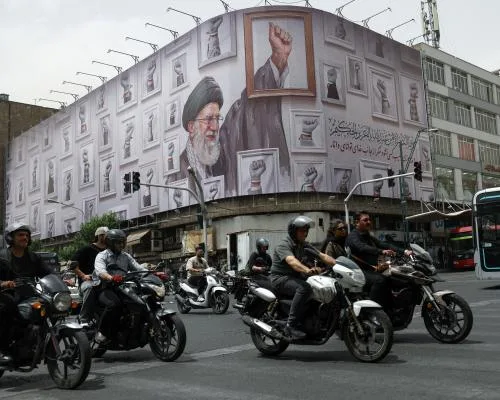
Iran's Islamic Revolutionary Guard Corps (IRGC) has threatened to extend a renewed war beyond the Middle East if the US resumes attacks against Tehran. Donald Trump had threatened to strike Iran again if it didn't accept a deal to end the conflict. It's a warning that hasn't been taken lightly by Tehran.
And in a related development, Israeli warplanes have struck the Lebanese town of Jebchit overnight, despite an ongoing fragile ceasefire. The country's state news agency reported an additional strike targeted the vicinity of an international school in Habboush. They're saying this strike didn't cause any casualties, but it's still a cause for concern.
Yet the recent attacks aren't limited to these areas. Israeli aircraft also struck the town of Kherbet Silem earlier today. They're targeting multiple locations, including two separate raids that targeted Kfara in Bint Jbeil district. The National News Agency (NNA) said another Israeli airstrike hit a house in the town of Toura, though no casualties were reported. This doesn't mean they won't happen in the future, though.
But what led to this escalation? Israeli airstrikes on southern Lebanon on Tuesday killed at least 19 people, including four women and three children. Lebanon's health ministry said this is the latest in near-daily attacks from both sides that haven't stopped despite a fragile, US-brokered ceasefire. It's clear that the situation is volatile and can't be ignored.
So who are the key players in this conflict? Israel's military didn't immediately comment on the casualties or specific incidents. However, they said that between Monday afternoon and Tuesday afternoon, they had targeted more than 25 sites of Hezbollah infrastructure in southern Lebanon. They're trying to weaken the group's grip on the region.
The Chinese president, Xi Jinping, has held talks with Russia's Vladimir Putin in Beijing today. The leaders discussed conflict in the Middle East. Russia has sought to cash in on the global energy crisis and soaring gas prices triggered by the Iran war and the effective closure of the strait of Hormuz. This is a strategic move by Russia to gain more influence in the region.
"A comprehensive ceasefire is of utmost urgency, resuming hostilities is even more inadvisable and maintaining negotiations is particularly important," Xi told Putin during talks today, according to Chinese state media. Xi's statement emphasizes the need for a peaceful resolution.
The US Senate has advanced a war-powers resolution that would end the Iran war unless Trump obtains Congress' authorisation. The vote on a procedural measure to advance the resolution was 50 to 47. Four of Trump's fellow Republicans voted with every Democrat but one in favour. This means that Trump won't be able to act unilaterally in the region.
And what about the economic implications of this conflict? A South Korean oil tanker is passing through the strait of Hormuz, marking the first such case involving a Korea-managed ship since the Iran war began. The vessel is carrying 2m barrels of crude oil. It's a significant shipment, and it's not going unnoticed.
- Iran's IRGC threatens to extend war beyond the Middle East if the US resumes attacks
- Israeli airstrikes on southern Lebanon killed at least 19 people, including four women and three children
- The US Senate advances a war-powers resolution to end the Iran war unless Trump obtains Congress' authorisation
- A South Korean oil tanker passes through the strait of Hormuz, carrying 2m barrels of crude oil
- The Chinese president, Xi Jinping, holds talks with Russia's Vladimir Putin to discuss the conflict in the Middle East
The situation remains volatile, with both sides exchanging threats and attacks. The international community is watching closely, as the conflict has the potential to escalate into a wider war. It's a complex situation, and it's hard to predict what'll happen next. But one thing's for sure: the world is waiting with bated breath to see how this conflict unfolds. The implications are far-reaching, and they won't be limited to the Middle East.
The global economy is already feeling the strain, and it's likely to get worse if the conflict doesn't get resolved soon.