

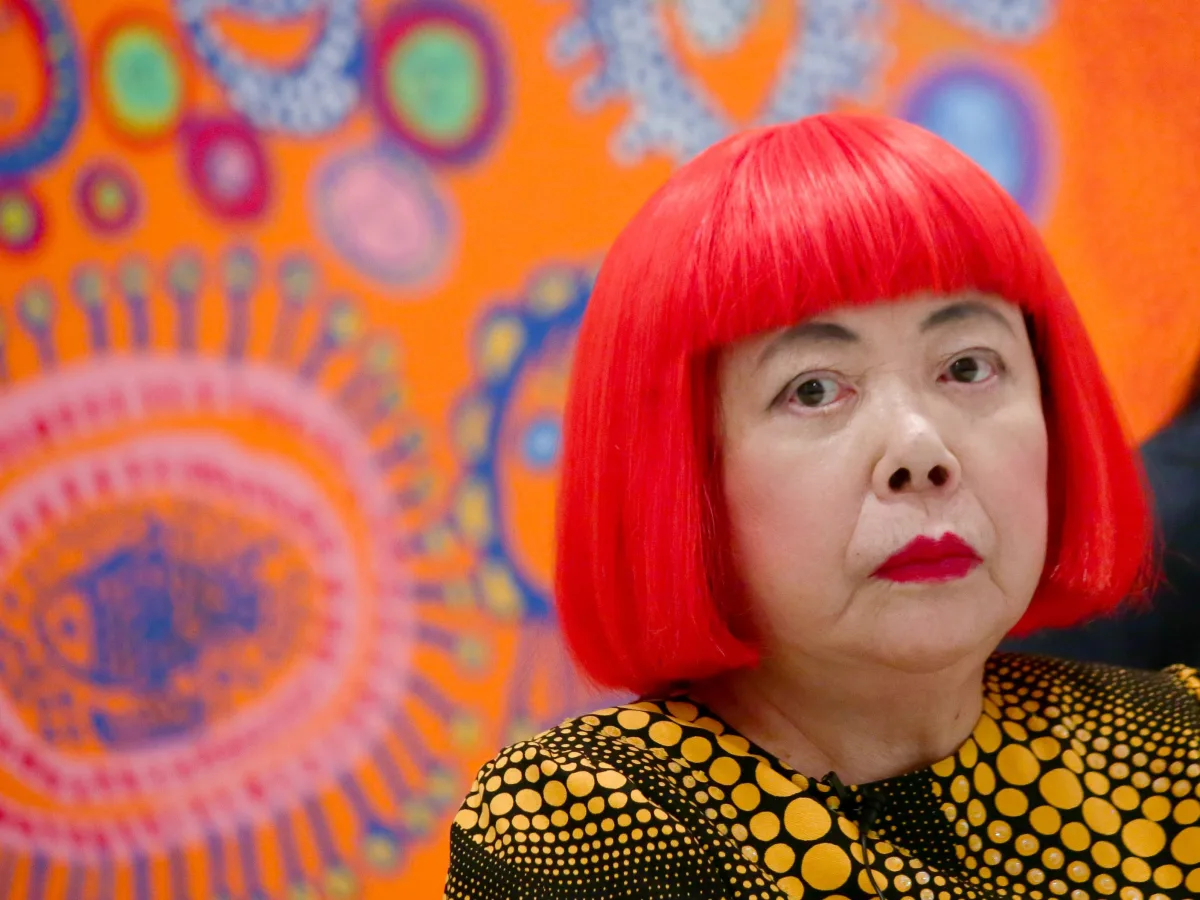
Japanese artist Yayoi Kusama, the visionary behind a universe of polka dots and dazzling mirrored rooms, has died. She was 97 years old. Her representative, David Zwirner, confirmed she passed away on August 14th in a Tokyo hospital due to multiple organ failure.
Kusama's art was her lifeline, a way to navigate the hallucinations and intense anxieties that had plagued her since childhood. Growing up in Matsumoto, Japan, where her family ran a seed nursery, her early life was shaped by the long hours working in a parachute factory during World War II and her mother's disapproval of her constant drawing. She famously wrote that she'd sketch her visions to cope, only to have her art supplies confiscated.
Her big break came after she wrote to Georgia O'Keeffe, the famous American artist. O'Keeffe, despite warning her about the financial struggles of being an artist in the U.S., encouraged Kusama to come to America and show her work. So, in the late 1950s, Kusama packed her bags and headed for New York City.
She plunged headfirst into the city's avant-garde scene, becoming a fearless provocateur. During the Vietnam War, she staged public happenings where she would paint polka dots on the naked bodies of protestors. In a bold move, the 28-year-old Kusama even penned an open letter to President Richard Nixon proposing they have sex to end the war. "As we soar through the heavens, we'll paint each other with polka dots, lose our egos in timeless eternity, and finally discover the naked truth: You can't eradicate violence by using more violence," she wrote.
Her dealer in the 1960s, Richard Castellane, told NPR that she "shocked the living daylights out of people." He recalled one of her famous Infinity Rooms, filled with mirrored walls and twinkling lights, creating a disorienting, infinite space. The effect was overwhelming, with lights bouncing endlessly, making viewers lose all sense of dimension. It was something completely new, mesmerizing and baffling audiences.
But breaking into the male-dominated art world was a steep climb. Curator Mika Yoshitake noted that Kusama was often exoticized for her appearance, something she didn't shy away from, often wearing kimonos. Despite the critical acclaim and the buzz she generated, making a consistent living remained a struggle. The hallucinations and panic attacks continued, and by the early 1970s, she returned to Japan, eventually checking herself into a psychiatric institution where she would live for the remainder of her life.
Yet, her creative fire never dimmed. From her studio near the hospital, Kusama continued to produce a prolific body of work. Her popularity surged internationally in the decades that followed, with major exhibitions at prestigious institutions like the Smithsonian's Hirshhorn and the Tate in London. In 2017, the dedicated Yayoi Kusama Museum opened in Tokyo, a testament to her enduring impact.
Her signature motifs, from the giant, polka-dotted pumpkins to the vast, repeating patterns on her "infinity net" paintings, became instantly recognizable symbols of her unique vision. These aren't just pretty dots; for Kusama, they represented her struggle for survival, turning personal obsessions into a universal language that invited viewers to contemplate their own place in the immense universe. "Our earth is only one polka dot among a million stars in the cosmos," she once wrote. Her designs even found their way onto everyday items like cellphone cases and clothing, bringing her art to an even wider audience.
Kusama's legacy is one of resilience, a powerful reminder that art can be both deeply personal and profoundly universal, transforming inner turmoil into breathtaking beauty that resonated across the globe.