

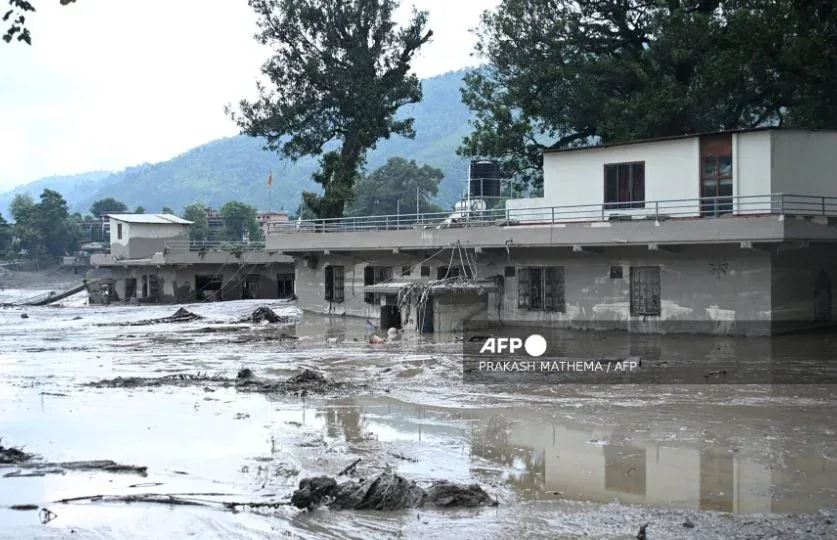
The majestic Himalayas have turned deadly. A catastrophic surge of floodwater, mud, and debris has swept through valleys in Nepal and Tibet, leaving at least 160 people dead and a staggering 647 missing. The disaster struck communities on both sides of the China-Nepal border, catching hundreds off guard.
The missing count includes 391 people reported lost in Nepal, with 291 of those being foreign nationals. In Tibet, Chinese state media reports 265 people are unaccounted for. This brings the grim total of those lost to the floods and mudslides to 647, with 160 confirmed fatalities.
Search and rescue operations are in full swing, with authorities scrambling to find hundreds of people. They aren't just tourists; many were pilgrims heading to sacred sites like Mount Kailash and Lake Manasarovar in Tibet. These sites are revered by Hindus, Buddhists, and Jains. Local Nepali pilgrims were also en route to the sacred Gosaikunda Lake for religious observances. Hundreds of travellers bound for Kailash were reportedly waiting to cross into Tibet when disaster struck.
Among the missing are over 100 Indian nationals. Visitors from Britain, the United States, Australia, the Netherlands, Malaysia, and South Africa are also among those unaccounted for. The Isha Foundation, a spiritual organisation, reported that 77 of its pilgrimage participants were at an immigration centre near the Nepal-Tibet border when the flooding hit.
In Tibet, the Gyirong border port, a crucial crossing between China and Nepal, was devastated by a mudslide. Footage from Chinese state media showed a terrifying torrent of water and mud obliterating buildings, tearing up trees, and wiping out roads. Nepal's side of the border also suffered extensive damage. At least 19 vehicle bridges and about 40 kilometres of roads were washed away. Schools and hydropower facilities were also battered by the floodwaters.
Initially, authorities were puzzled about what had triggered such a sudden and massive flood. This was especially true given the lack of heavy rain in Nepal. Nepal's Foreign Minister, Shisir Khanal, mentioned preliminary information pointed to an avalanche. This was later supported by the US Geological Survey. They detected ground movement equivalent to a 5.2-magnitude earthquake, which was later reclassified as a landslide event.
Scientists now believe an ice avalanche likely set off the catastrophic flooding.
The Nepalese Army is leading the massive rescue efforts. They're deploying 12 helicopters and setting up a temporary hospital in the affected region. So far, at least 114 people have been airlifted to safety. Additionally, 25 critically injured individuals have been evacuated to Kathmandu for medical treatment.
This disaster highlights the vulnerability of communities and infrastructure in the Himalayas to sudden natural hazards. While flash floods often follow heavy rain, landslides can also displace huge volumes of water. This creates similar destructive surges. Scientists have repeatedly warned that climate change, with its accelerating glacier melt in the Himalayas, could increase the risk of such dangerous flooding events. Nepal has seen severe floods and landslides in recent years.
However, this event's scale and suddenness present a unique and urgent challenge.
The affected region is a vital corridor for religious journeys. Thousands of people travel through Nepal towards the revered Mount Kailash in Tibet each year. The sudden inundation has disrupted these sacred journeys. It has also placed immense strain on rescue services.
"There was no rain in Nepal, so we weren't expecting anything like this,” said Narendra Pariyar, the chief district officer of Rasuw, highlighting the unexpected nature of the disaster.