

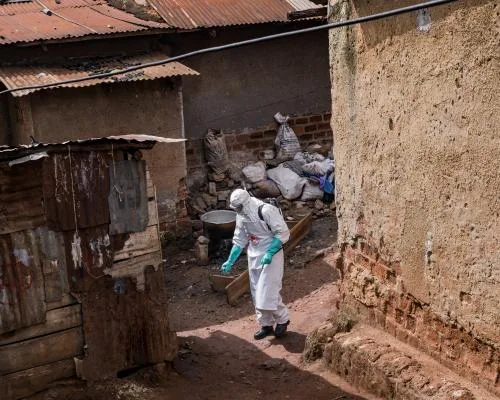
Ebola Outbreak in the DRC
The single sharpest fact is that at least 240 people have died in the DRC Ebola outbreak since it began earlier this month. The virus has spread to Uganda and other regions in eastern DRC.
Dr. Papys Lame, the Ebola outbreak response coordinator in Ituri for the NGO Alima, has been working tirelessly to contain the outbreak. 'We don't have a specific treatment for Ebola right now, but we can save people if they come very early,' Lame says.
The rapid response infrastructure from previous Ebola outbreaks has been stripped back so much of it is barely fit for purpose, hampering efforts to save lives. 'The system took a long time to build, but it only took a short time to dismantle,' says Selena Victor, senior director of policy and advocacy for Mercy Corps.
There have been attacks on healthcare facilities, with some in Ituri province thinking that the virus does not exist or it has been brought in by humanitarian workers. Dr. Lame explains: 'The death of a young footballer from suspected Ebola shocked the community and his family.' The death sparked anger and frustration against the loss of an important person in the community, with some young men carrying out an arson attack on an Ebola centre in the Rwampara region to try to retrieve a friend's body.
Maintaining cooperation with the community is vital to ending the outbreak as quickly as possible, say public health officials. Dr. Tedros Adhanom Ghebreyesus, World Health Organization chief, has appealed for a ceasefire in Ituri between rebel groups to help contain the outbreak.
Lame said it was vital that his team get the resources they needed to help save lives – adding that more resources are still needed from abroad. The Ebola virus is spread from contact with cadavers, and authorities have implemented strict rules around burials which has sometimes angered families.
Dr. Tibenderana Katho Blaise, one of the five doctors who have died after treating patients at Bunia Evangelical medical centre, was a dedicated medical professional who will be greatly missed. In addition to Dr. Blaise, four other medical professionals have lost their lives battling the outbreak.
Healthcare workers in the DRC are at risk of contracting the virus and passing it on to others. Dr. Lame says: 'You must be brave if you work in this environment.' The bravery of medical staff in the face of such a deadly outbreak is truly commendable.
Lame says that Ebola was likely passing through the community for some time in and around Bunia, the capital of Ituri province, before the outbreak was formally declared on 15 May. Symptoms of Ebola are similar to common illnesses like malaria and typhoid, including fever, muscle pain, vomiting and diarrhoea.
In the wake of the USAID cuts, the 2014 Ebola outbreak in west Africa took more than two years to end, while this time the response is expected to take several months. The international community must do more to support the DRC in its efforts to contain the outbreak.
The Ebola crisis in the DRC is a stark reminder of the need for global cooperation and a commitment to providing necessary aid to those in need. The world must come together to support the people of the DRC and to ensure that medical staff have the resources they need to respond to this crisis.
At least 240 people have died in the DRC Ebola outbreak. The virus has spread to Uganda and other regions in eastern DRC. The rapid response infrastructure from previous Ebola outbreaks has been stripped back.
Five medical professionals have died after treating patients at Bunia Evangelical medical centre. Dr. Papys Lame is the Ebola outbreak response coordinator in Ituri for the NGO Alima. The outbreak was formally declared on 15 May. Symptoms of Ebola are similar to common illnesses like malaria and typhoid.
Dr. Tibenderana Katho Blaise was one of the doctors who died battling the outbreak. Dr. Lame says that Ebola was likely passing through the community for some time before the outbreak was formally declared.
The crisis has sparked calls for a ceasefire in Ituri between rebel groups to help contain the outbreak. The World Health Organization has appealed for international support to combat the outbreak.
The crisis has also highlighted the bravery of medical staff in the face of such a deadly outbreak. Dr. Lame says: 'You must be brave if you work in this environment.' The bravery of medical staff in the DRC is truly commendable.
In the wake of the USAID cuts, healthcare workers in the DRC are at risk of contracting the virus and passing it on to others. The cuts have severely hindered the response effort, with experts warning that the system took a long time to build but didn't take very long to dismantle.
Dr. Lame says that the lack of lab facilities for testing has made it hard to monitor the spread of the virus. Many more cases are suspected than the official WHO figures, he says.
Lame says that the community response against Ebola is critical, and they need many resources for this. International staff who can come and help with community engagement, human resources, logistics, water sanitation are essential.
Dr. Lame says that the USAID cuts dismantled the system of rapid response infrastructure that had been built up to combat the outbreak. 'It took us a long time to build this system, but it only took a short time to dismantle it,' he says.
The crisis has also highlighted the issue of healthcare workers in the DRC being at risk of contracting the virus and passing it on to others. 'We have preventive measures in place to protect our colleagues,' Dr. Lame says.
The crisis has sparked calls for a ceasefire in Ituri between rebel groups to help contain the outbreak. Dr. Lame says that he appreciates the support of the international community.
Dr. Lame has expressed his gratitude to the international community for their support in the DRC Ebola crisis. 'We appreciate the support of the international community,' he said.
The crisis has sparked calls for a ceasefire in Ituri between rebel groups to help contain the outbreak. Dr. Lame says that he appreciates the support of the international community.
The crisis has also highlighted the bravery of medical staff in the face of such a deadly outbreak. Dr. Lame says: 'You must be brave if you work in this environment.' The bravery of medical staff in the DRC is truly commendable.
Dr. Lame says that the lack of lab facilities for testing has made it hard to monitor the spread of the virus. Many more cases are suspected than the official WHO figures, he says.
The crisis has sparked calls for a ceasefire in Ituri between rebel groups to help contain the outbreak. Dr. Lame says that he appreciates the support of the international community.
Dr. Lame says that the Ebola virus is spread from contact with cadavers, and authorities have implemented strict rules around burials which has sometimes angered families.
Dr. Lame says that the lack of resources is a major challenge in responding to the outbreak. 'We need many resources to contain the outbreak, but we are not getting them,' he says.
Dr. Lame has expressed his frustration at the slow response to the outbreak. 'We have been trying to get the resources we need to contain the outbreak, but it has been slow,' he says.
Dr. Lame says that the lack of resources is a major challenge in responding to the outbreak. 'We need many resources to contain the outbreak, but we are not getting them,' he says.
The crisis has sparked calls for a ceasefire in Ituri between rebel groups to help contain the outbreak. Dr. Lame says that he appreciates the support of the international community.
The crisis has also highlighted the bravery of medical staff in the face of such a deadly outbreak. Dr. Lame says: 'You must be brave if you work in this environment.' The bravery of medical staff in the DRC is truly commendable.
Dr. Lame says that the Ebola virus is spread from contact with cadavers, and authorities have implemented strict rules around burials which has sometimes angered families.
Dr. Lame says that the lack of resources is a major challenge in responding to the outbreak. 'We need many resources to contain the outbreak, but we are not getting them,' he says.
Dr. Lame says that the Ebola virus is not spread as easily as a respiratory illness like Covid-19 or influenza, but the lack of lab facilities for testing has made it hard to monitor the spread of the virus. Many more cases are suspected than the official WHO figures, he says.
Dr. Lame says that the Ebola virus is spread from contact with cadavers, and authorities have implemented strict rules around burials which has sometimes angered families.
Dr. Lame says that the lack of resources is a major challenge in responding to the outbreak. 'We need many resources to contain the outbreak, but we are not getting them,' he says.
Dr. Lame says that the Ebola virus is spread from contact with cadavers, and authorities have implemented strict rules around burials which has sometimes angered families.
Dr. Lame says that the lack of resources is a major challenge in responding to the outbreak. 'We need many resources to contain the outbreak, but we are not getting them,' he says.
The crisis has sparked calls for a ceasefire in Ituri between rebel groups to help contain the outbreak. Dr. Lame says that he appreciates the support of the international community.
The crisis has also highlighted the bravery of medical staff in the face of such a deadly outbreak. Dr. Lame says: 'You must be brave if you work in this environment.' The bravery of medical staff in the DRC is truly commendable.
Dr. Lame says that the Ebola virus is spread from contact with cadavers, and authorities have implemented strict rules around burials which has sometimes angered families.
Dr. Lame says that the lack of resources is a major challenge in responding to the outbreak. 'We need many resources to contain the outbreak, but we are not getting them,' he says.
Dr. Lame has expressed his gratitude to the international community for their support in the DRC Ebola crisis. 'We appreciate the support of the international community,' he said.
The crisis has sparked calls for a ceasefire in Ituri between rebel groups to help contain the outbreak. Dr. Lame says that he appreciates the support of the international community.
The crisis has also highlighted the bravery of medical staff in the face of such a deadly outbreak. Dr. Lame says: 'You must be brave if you work in this environment.' The bravery of medical staff in the DRC is truly commendable.
Dr. Lame says that the Ebola virus is spread from contact with cadavers, and authorities have implemented strict rules around burials which has sometimes angered families.
The crisis has sparked calls for a ceasefire in Ituri between rebel groups to help contain the outbreak. Dr. Lame says that he appreciates the support of the international community.