

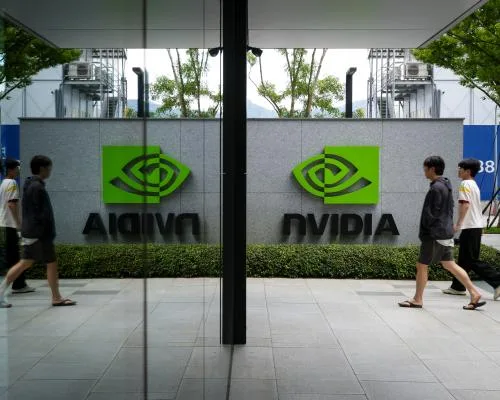
Nvidia's revenue has blown past Wall Street's expectations, with a 92% year-over-year growth. The company's datacenter business saw a record $75.2bn in revenue. This isn't just a win for Nvidia - it's a sign that the AI boom is here to stay.
It's not just about the numbers. Jensen Huang, Nvidia's CEO, says the buildout of AI factories is accelerating at an extraordinary speed. He's talking about the largest infrastructure expansion in human history. Agentic AI has arrived, and it's doing productive work and generating real value.
US tech giants are planning to spend around $750bn on AI infrastructure this year. A significant portion of that will go towards chips for datacenters. Nvidia is well-positioned to cash in on this trend, with its datacenter business seeing a record $75.2bn in revenue. They're likely to benefit from this trend, and their revenue will probably increase as a result.
Huang has also been making the rounds, joining Elon Musk and Donald Trump on a trip to China. He's hoping to expand Nvidia's presence in the country, but it's unclear if Chinese officials will agree to use American technology. The US has allowed Nvidia to export H200 AI chips to China, but sales have been in limbo. They haven't been able to sell as many chips as they'd like, and it's affecting their revenue.
Nvidia's CFO, Colette Kress, says the company isn't currently expecting datacenter compute revenue from China. But Huang is optimistic, saying that the market will open up over time. He believes they'll be able to sell more chips in China, and it'll increase their revenue. The company is also looking to expand its footprint in southeast Asia, with a new research hub in Singapore. They're investing in this region, and it's likely to pay off in the long run.
The world is rebuilding computing for agentic AI and robotic physical AI. Nvidia sits at the centre of these transitions, says Huang. They're playing a key role in this transition, and it's likely to benefit their business.
The company's new AI system, the Vera Rubin platform, is expected to roll out in the second half of 2026. Huang claims it will be a 'generational leap' that will kick off the greatest infrastructure buildout in history. But he also warns that the company will be supply-constrained throughout the life of Vera Rubin. They won't be able to produce as many chips as they'd like, and it'll affect their sales.
So what does this mean for Nvidia's competitors? Companies like Amazon and Google are also producing chips, but Nvidia is still the market leader. They're ahead of the competition, and they're likely to stay that way. The company's ability to keep pace with the AI boom will be key to its success. They can't afford to fall behind, or they'll lose their market share.
Nvidia's revenue was $81.62bn for the first quarter of 2026. Their datacenter business revenue was $75.2bn, a 92% year-over-year growth. US tech giants are planning to spend $750bn on AI infrastructure this year. Nvidia's market cap is $5.4tn. These numbers are impressive, and they show that Nvidia is doing well.
Nvidia's success is a sign that the AI boom is here to stay. It's not just about the tech giants - it's about the impact on the economy and society as a whole. As the world rebuilds computing for agentic AI, Nvidia is at the centre of the transition. They're playing a key role, and it's likely to benefit their business.
The company's ability to innovate and keep pace with the AI boom will be key to its success. They need to stay ahead of the competition, and they need to keep innovating. With its new AI system and research hub in Singapore, Nvidia is well-positioned to lead the charge. They're investing in the future, and it's likely to pay off.
As the AI boom accelerates, we can expect to see more investment in AI infrastructure. Companies like Nvidia will lead the charge, and we can expect to see some exciting developments in the coming years. Nvidia is enjoying its moment in the sun, with a record $75.2bn in datacenter revenue and a market cap of $5.4tn. They're doing well, and they're likely to continue to do well in the future.