

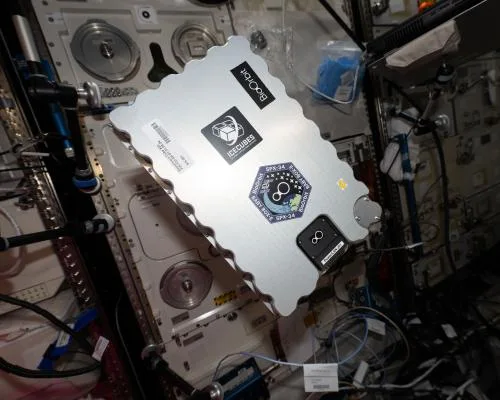
The UK startup BioOrbit has sent a hi-tech box to the International Space Station to grow ultra-pure protein crystals for cancer drugs. This box, called Box-E, is the size of a microwave and was launched on a SpaceX flight from Kennedy Space Center in Florida on May 15.
It will stay in orbit for about six weeks, where the microgravity will enable pharmaceutical compounds to crystallise into pure, highly stable structures. These structures can be turned into cancer medications that patients can keep in a fridge and inject themselves at home or at work.
Dr Katie King, co-founder and chief executive of BioOrbit, says the orbital tests are a big step change towards large-scale production of protein crystals in space. King, who completed her PhD in nanomedicine at Cambridge University and did an internship at Nasa, explains that gravity doesn't help crystallisation - it actually hinders the process.
Gravity negatively impacts crystallisation, especially for protein drugs and antibody drugs, because they're very large and very flexible molecules. By going to space, you see a much better crystallisation process than what you can achieve on Earth. For cancer treatments, a big dose is needed, and the liquid can become too thick to use in an injection pen.
“Box-E is the first step moving towards mass manufacture in a way that will transform cancer treatment, reduce hospital visits and support patients in receiving therapies at home,” says King.
King is the daughter of the TV presenter and maths whiz Carol Vorderman. Despite the huge expense of sending the drugs into space, King argues that the switch to self-injection at home could end up saving the NHS and other health systems millions, potentially billions of pounds. She doesn't think the cost is a major issue - it's the benefits that matter.
BioOrbit is aiming to process thousands of litres of fluid per box every year, and it's confident it could produce enough for a blockbuster drug with a handful of boxes in constant use. Last month, BioOrbit raised £9.8m from investors, led by the UK venture capital group LocalGlobe and Paris-based VC firm Breega, to take its technology into orbit and build the hardware to mass produce crystals.
The company won a £250,000 contract from the UK’s Space Agency in March to manufacture drugs in microgravity. This week, Elon Musk’s SpaceX set out its stock market flotation prospectus, which mentions in-space manufacturing of pharmaceuticals and other materials as a key revenue stream, and estimates a $22.7tn market in enterprise applications.
BioOrbit wants to be part of that market. However, King says it won't be easy - it will take at least five years until the new cancer drug formulations hit the market, as they need to be tested in clinical trials and get approved by health regulators. The Californian startup Varda Space Industries has also flown small capsules into space to process pharmaceuticals, and it's working with the US biotech United Therapeutics Corporation to develop improved treatments for rare lung disease.
About 70% of the world’s biggest-selling drugs are administered intravenously at hospitals or doctor’s offices. To make its cancer drugs, BioOrbit will partner up with pharmaceutical companies, and it's already had interest from several multinational groups, including in the UK and the US.
Key Facts
- BioOrbit’s Box-E unit is the size of a microwave
- It will stay in orbit for about six weeks
- The unit can process thousands of litres of fluid per box every year
- BioOrbit raised £9.8m from investors last month
- The company won a £250,000 contract from the UK’s Space Agency in March
- It will take at least five years until the new cancer drug formulations hit the market
The use of space to produce pharmaceuticals is a growing trend, with several companies exploring the potential of microgravity to create new and improved treatments. As the technology advances, we can expect to see more companies like BioOrbit pushing the boundaries of what's possible in space.
The market for in-space manufacturing of pharmaceuticals is likely to grow, and it's likely that we'll see more partnerships between companies like BioOrbit and pharmaceutical giants. This could lead to a new era in cancer treatment, where patients have access to self-injected treatments at home, rather than having to undergo lengthy and costly hospital visits.
For now, the focus is on the orbital tests, and seeing whether the technology can deliver on its promise. If it does, it could be a game-changer for cancer patients around the world - it could save lives and improve the quality of life for many people. The potential benefits are huge, and it's worth watching the progress of BioOrbit and other companies in this field.