

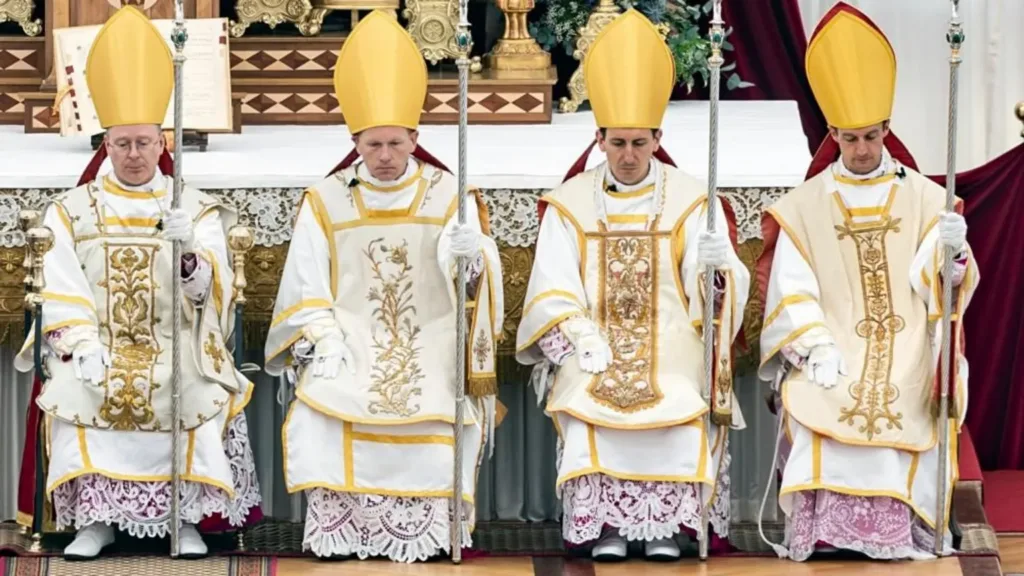
The controversial ordination of four new Catholic bishops in Switzerland has drawn a stern warning from Pope Leo XIV, who fears it could tear the church apart. The bishops, two from France and one each from Switzerland and the United States, were ordained in a ceremony in the village of Écône, despite a last-minute appeal by the Pope.
The Society of Saint Pius X, to which the bishops belong, is known for its traditionalist views, rejecting many of the reforms introduced by the Vatican in the 1960s and 1970s. This includes the use of vernacular languages in Mass, rather than just Latin. Davide Pagliarani, the Superior General of SSPX, denied trying to sustain a rift with the Vatican, saying they love the Pope as the vicar of Christ, but refused to be part of what they see as a corrupted church.
The ordination was attended by thousands of people, who were offered novelty gift packs of Swiss wine costing $92 (£80) each. The ceremony, which was live-streamed on YouTube in seven languages, was seen as a major challenge to Pope Leo's authority. Pope Leo made a last-minute appeal to SSPX leaders not to proceed with the ordination, describing it as a 'schismatic act' that could 'tear the seamless garment of Christ'.
The Society of Saint Pius X has consistently defied the Vatican over the years, and its views have been seen as a threat to the unity of the Catholic Church. While it has an estimated 600,000 followers worldwide, the Catholic Church has over 1.4 billion members. The SSPX has funds to support its activities, and has been known to live-stream its events online.
The ordination of the four new bishops is likely to have implications for the Catholic Church, which has been trying to heal the rift with traditionalist groups like the SSPX. The Pope has made it clear that he views the new bishops as illegitimate, and their ordination as a clear attack on the Catholic Church. But he may not want to do anything further to make his feared schism any worse.
The Society of Saint Pius X was founded by Marcel Lefebvre, a French archbishop who was excommunicated by the Vatican in 1988. He died in 1991, but his followers have continued to push for a more traditional form of Catholicism. Lefebvre's views were seen as a threat to the Vatican's reforms, which were aimed at making the Church more accessible and egalitarian.
The SSPX has been involved in several controversies over the years, including its opposition to the Vatican's decision to establish ties with other religions, and its recognition of the right to religious freedom.
The ordination of the four new bishops is likely to be a major challenge for Pope Leo, who is relatively new in post. While the Society of Saint Pius X is small compared to the Catholic Church, it has a significant following and has been able to defy the Vatican's authority in the past.
The full implications of the ordination are still unclear, but it is likely to have significant consequences for the Catholic Church and its relationship with traditionalist groups like the SSPX.
Pope Leo has said that he will take action to resolve the situation, but has not specified what this will entail.
The Catholic Church has a long history of dealing with challenges from within, and has a strong tradition of resolving disputes through dialogue and compromise. However, the situation with the SSPX is seen as particularly complex and sensitive.
The Vatican has a long history of trying to heal the rift with traditionalist groups like the SSPX, but it has not always been successful. In 2009, Pope Benedict XVI repealed the excommunication of four bishops, but this move was widely seen as a failure to fully address the issues with the SSPX.
In the years that have followed, the SSPX has continued to defy the Vatican, and has gained a significant following. The ordination of the four new bishops is likely to be seen as a major challenge to Pope Leo's authority, and may have significant implications for the Catholic Church and its relationship with traditionalist groups like the SSPX.