

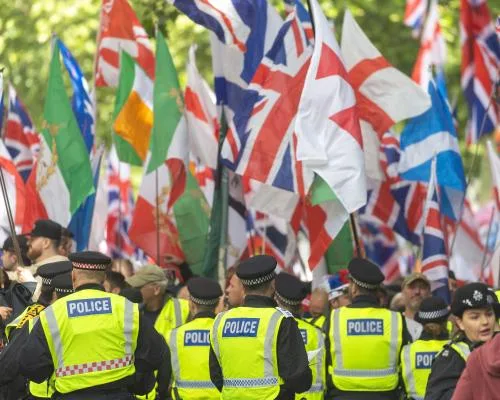
The city of London is bracing for a potentially volatile day as tens of thousands of people are expected to descend on the city for two major demonstrations. The Metropolitan police have deployed 4,000 officers to maintain order and prevent clashes between the far-right Unite the Kingdom (UTK) rally and the pro-Palestine Nakba Day march. They're taking this measure to ensure public safety.
The police are also using armoured vehicles, horses, dogs, drones, and helicopters to patrol the area. This equipment won't be used lightly, as the police want to be prepared for any situation. The UTK rally, organised by Stephen Yaxley-Lennon, also known as Tommy Robinson, is expected to draw around 50,000 people. The pro-Palestine march, on the other hand, is expected to attract between 15,000 and 40,000 people.
The potential for violence and extremism is what's really causing concern. Sir Mark Rowley, the commissioner of the Metropolitan police, has warned that both protests will be policed on the same basis, with similar conditions and timings. He's made it clear that the police will make arrests if they see anti-Muslim and antisemitic hate crimes. They won't tolerate this kind of behaviour.
'Our duty is clear: to protect communities, to uphold free speech and to police lawful protest without fear or favour,' said Rowley. He's committed to ensuring the protests remain peaceful.
However, John Rees, one of the organisers of the pro-Palestinian march, has accused Rowley of being 'reckless' with free speech. Rees told BBC Radio 4's Today programme that it's 'amazing' that a police officer could arrest someone for saying something during a speech. He didn't think this was fair. He also accused the police of allowing Tommy Robinson to 'take over' the area around Whitehall. This move has raised concerns among some groups.
The Metropolitan police have introduced strict conditions on the timings and routes of both demonstrations. The UTK rally will begin in Kingsway and move along the Strand before ending in Parliament Square. The pro-Palestine march will start in Exhibition Road in Kensington and finish in Pall Mall. These routes have been carefully planned to minimize the risk of clashes.
The police are also using live recognition cameras for the first time at a demonstration. They're using this technology to identify potential troublemakers. Organisers will be held personally responsible for the behaviour of the speakers they invite. This means they'll have to ensure their speakers don't incite violence or hatred. Deputy assistant commissioner James Harman said the operation could cost the force £4.5m.
It has the potential to be one of the busiest days for policing in London in recent years.
This situation isn't just about the policing operation - it's also about the climate of hostility around Palestinian identity and activism in the UK. Many Palestinians feel unable to speak openly about Israel's war on Gaza. They're afraid to wear Palestinian symbols at work or display Arabic jewellery and keffiyehs in public. Sara Husseini, the director of the British Palestinian Committee, said this fear is palpable. It's affecting many people's daily lives.
It's not just the Palestinian community that's affected - the rise of the far right is also a major concern. Prime Minister Keir Starmer has described Tommy Robinson and others organising the UTK rally as 'individuals with long records of violence and extremism'. He's warned that their goal is to 'inflame and divide' and that they're seeking the support of far-right agitators around the world. This kind of rhetoric is worrisome.
The police have also banned several individuals from attending the rally, including a Polish far-right MEP and a Canadian supporter of Tommy Robinson. The new guidance issued to prosecutors urges them to consider whether protest placards, banners, and chants viewed on social media may amount to offences of stirring up hatred. They're taking a close look at these materials.
As the city prepares for a potentially volatile day, the police are taking no chances. They've deployed 4,000 officers and are using advanced technology to maintain order and prevent clashes between the two groups. They're determined to keep the peace. The city is on high alert, and the police are ready to respond to any situation.
Despite the police's best efforts, there's still a sense of unease in the air. The rise of the far right and the climate of hostility around Palestinian identity and activism are just two of the many issues that need to be addressed. The city is navigating a complex and sensitive situation. It's going to be a long and challenging day.
Key Facts
- 4,000 officers have been deployed to maintain order
- Armoured vehicles, horses, dogs, drones, and helicopters will be used
- The UTK rally is expected to draw 50,000 people
- The pro-Palestine march is expected to attract 15,000-40,000 people
- The police will make arrests if they see anti-Muslim and antisemitic hate crimes
- Live recognition cameras will be used for the first time at a demonstration
- Organisers will be held personally responsible for the behaviour of the speakers they invite
The situation in London is a stark reminder of the challenges that cities face in maintaining order and preventing extremism. The police and the government must work together to address the root causes of these issues and prevent them from escalating further. They can't afford to ignore these problems. The city's safety depends on it.