

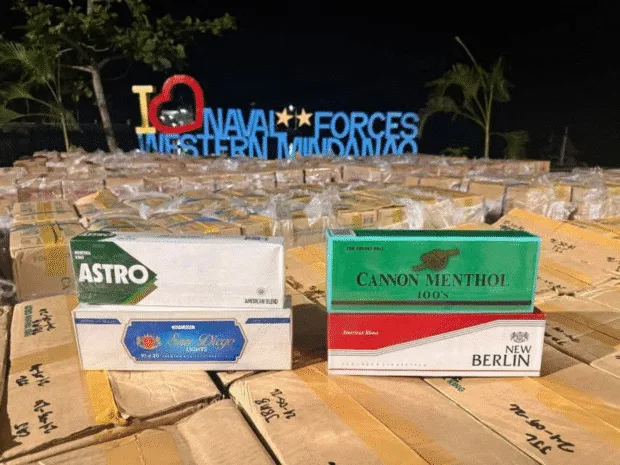
The sea off Tongquil Island and Sibago Island is usually quiet, but lately, it’s become a hotspot for high-stakes cat-and-mouse games between government forces and smugglers. Over the last 48 hours, the Philippine Navy’s Western Mindanao Naval Command (WMNC) alongside the Naval Task Force 61 made their move. They didn't just catch a few small-time peddlers; they intercepted massive shipments of untaxed foreign cigarettes worth a staggering P113 million.
It started on May 23 when the Navy spotted two suspicious vessels, FB Sea Dragon and MPB Sea Horse, lurking near Tongquil Island in Sulu. When the troops boarded, they discovered 282 master cases of cigarettes that clearly didn’t belong on those boats. With a market value of P42.7 million, this wasn't just a simple mix-up with paperwork. The haul suggests a well-oiled operation designed to bypass local duties that should be flowing into the national treasury.
The sailors weren’t done yet. Barely 24 hours later, the action shifted toward Basilan. Near Sibago Island, in the municipality of Hadji Mohammad Ajul, they cornered the M/B Lappas. This vessel was even more loaded, carrying 473 master cases of the same contraband. By the time they tallied everything up from both operations, the total value hit P113 million. That is a lot of money to be floating around on local waters without a single receipt in sight.
"The intensified maritime patrols are part of our commitment to secure our borders from illegal trade that undermines our local economy," said a spokesperson for the naval forces during the initial briefing in Pagadian City.
Smuggling is a constant headache for the Bureau of Customs and the Coast Guard. Tobacco products are often targeted because they’re light, easy to stack, and command a high price in local markets. When these cigarettes slip through, they undercut legitimate businesses that follow the law. Small retailers who stock legal brands often struggle to compete when cheaper, untaxed alternatives flood the streets of cities like Zamboanga or Isabela.
When a Navy patrol identifies a target like the FB Sea Dragon, they don't just ram the boat. The process involves a tactical approach to verify the vessel's registration and cargo manifest. If the crew can't produce proper documentation from the Bureau of Customs, the entire shipment is tagged as smuggled goods. The vessels are then towed to a secure port facility while the cargo is inventoried under the supervision of local officials.
Once the evidence is processed, the cigarettes are typically earmarked for destruction. This prevents the items from leaking back into the supply chain. The seized boats themselves are also subject to forfeiture proceedings. If the owners can’t prove they were operating legitimately, they face a long road of legal battles and the loss of their vessels. It's a costly business model for the syndicates involved, though they often view these losses as just another operational risk.
For residents in the Basilan and Sulu regions, these interceptions have a tangible impact on local commerce. These waters are vital for local trade and artisanal fishing. When smuggling routes become too active, the security presence naturally increases. This leads to more checkpoints and restricted movement for locals. The Navy is currently maintaining a consistent maritime presence to disrupt these illicit supply chains.