

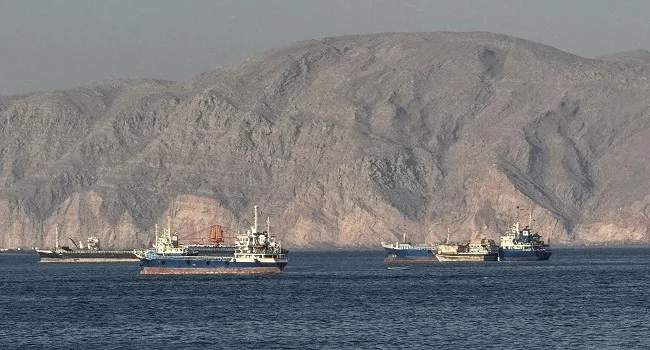
The single sharpest fact in one or two punchy sentences: The US has launched a third night of strikes on Iran, targeting coastal Bushehr and Bandar Abbas to 'degrade Iran's ability to attack commercial shipping'. President Donald Trump plans to reimpose a blockade on Iranian ports and float a 20% fee on cargo in the vital Strait of Hormuz.
The US military said its five-hour mission hit targets across Iran, including coastal Bushehr and Bandar Abbas. Iran's Revolutionary Guards announced they had fired missiles and drones on Bahrain, targeting a residential building for US forces and other facilities. This escalation comes after Iran started blocking the Strait of Hormuz after US-Israel attacks in February, which prompted Washington's blockade on Tehran's ports.
Iran's ports on the waterway will be blockaded from 2000 GMT on Tuesday, according to US Central Command (CENTCOM). Oil prices shot up more than nine percent on Monday over fears of renewed conflict and rose again on Tuesday, piling on more than one percent.
The US president said a deal with the Islamic republic was still possible, despite the escalating attacks. However, Iran's Foreign Ministry spokesman Esmaeil Baqaei said the June memorandum of understanding that formed the basis for the negotiations and lifted the US blockade was 'in crisis'. Baqaei added that Iran would ignore its obligations under the deal if the Washington did the same, but Tehran was continuing talks with mediators from Qatar, Pakistan, and Oman to prevent further escalation.
Bader Al-Saif, an associate fellow at Chatham House, said the escalating attacks would merely delay a permanent agreement. 'Both sides want to end the impasse on their own terms, and they are increasingly finding it difficult to do so,' he said. 'Hence the return to and increase in the scale of attacks.'
The US has formally notified Congress that the US has resumed military conflict against Iran, giving the Pentagon an additional 60 days to operate in the region without congressional approval. Trump threatened to destroy Pickaxe Mountain, a deeply buried nuclear site near Natanz where Western intelligence suspects Iran is building an undeclared enrichment facility.
Iran's foreign minister, Abbas Araghchi, responded mockingly on X that Trump was 'absolutely right' that whoever guarantees safe passage should be compensated – but that Tehran would charge less. '20% is of course too much,' he said.
Washington has vehemently opposed Tehran's desire to charge tolls in the Strait of Hormuz, which international law generally forbids. Trump declared on Truth Social that the United States would be 'known as 'THE GUARDIAN OF THE HORMUZ STRAIT'' and levy a 20% fee on all cargo shipped through the waterway. 'All other countries will have fair and open use of the strait', he said.
Iran's Revolutionary Guards said their strikes targeted US forces at an air base and urged Jordanians to issue a 'serious demand for the removal of the occupying American bases from the region'.
The escalating conflict raises concerns about the safety of commercial shipping in the region. The US has a significant stake in the stability of the Middle East, given its strategic location and economic interests. The conflict also has implications for global energy supplies, as the Strait of Hormuz is a critical chokepoint for oil shipments.
Oil prices shot up more than nine percent on Monday over fears of renewed conflict and rose again on Tuesday, piling on more than one percent. The increase in oil prices may have far-reaching consequences for the global economy, particularly for countries that rely heavily on oil imports.
The US has a complex relationship with Iran, dating back to the 1979 Islamic Revolution. The two countries have been embroiled in conflict over issues such as nuclear proliferation, terrorism, and regional influence.
The conflict in the Middle East has significant implications for the global balance of power. The US and its allies have a strong interest in maintaining stability in the region, particularly given the presence of strategic oil reserves.
Tension continues to escalate in the Middle East as diplomatic efforts to resolve the conflict remain stalled. The international community is closely following the situation and urging calm.
The region has witnessed a number of attacks in recent days, with Iran launching strikes on US allies in the region, including Jordan. The US has responded with airstrikes on Iranian targets, causing widespread damage and loss of life.
Iran has accused the US of 'piracy' and violating international law by imposing a blockade on its ports. The US has maintained that its actions are necessary to maintain regional stability and protect its interests.
The conflict has also had a significant impact on global markets, with oil prices surging in response to the escalation. The increase in oil prices may have far-reaching consequences for the global economy, particularly for countries that rely heavily on oil imports.
Tehran has urged its citizens to prepare for a long and difficult process, as the conflict is expected to drag on for months.
'We're going to hit them very hard tonight, and we're going to hit them hard tomorrow,' Trump said at the White House on Monday.
>